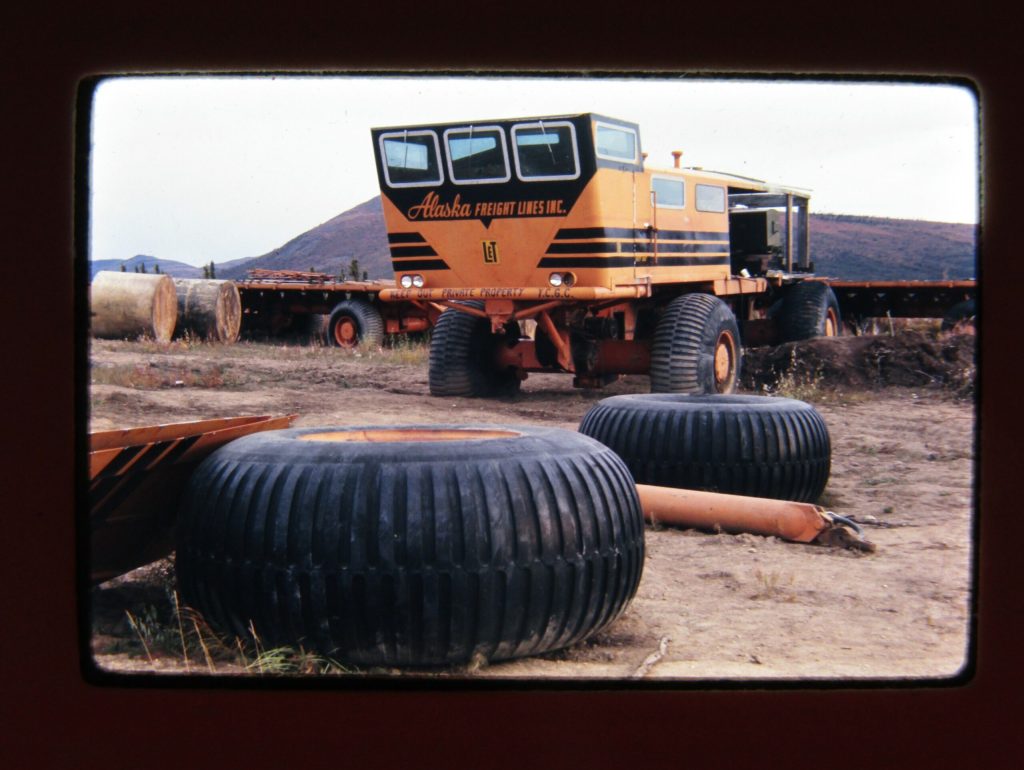
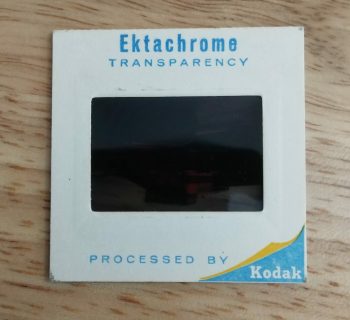
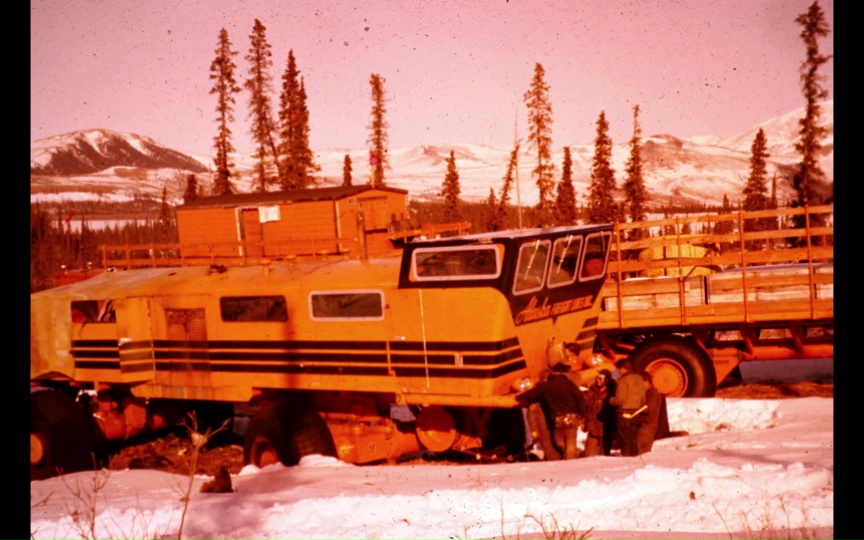
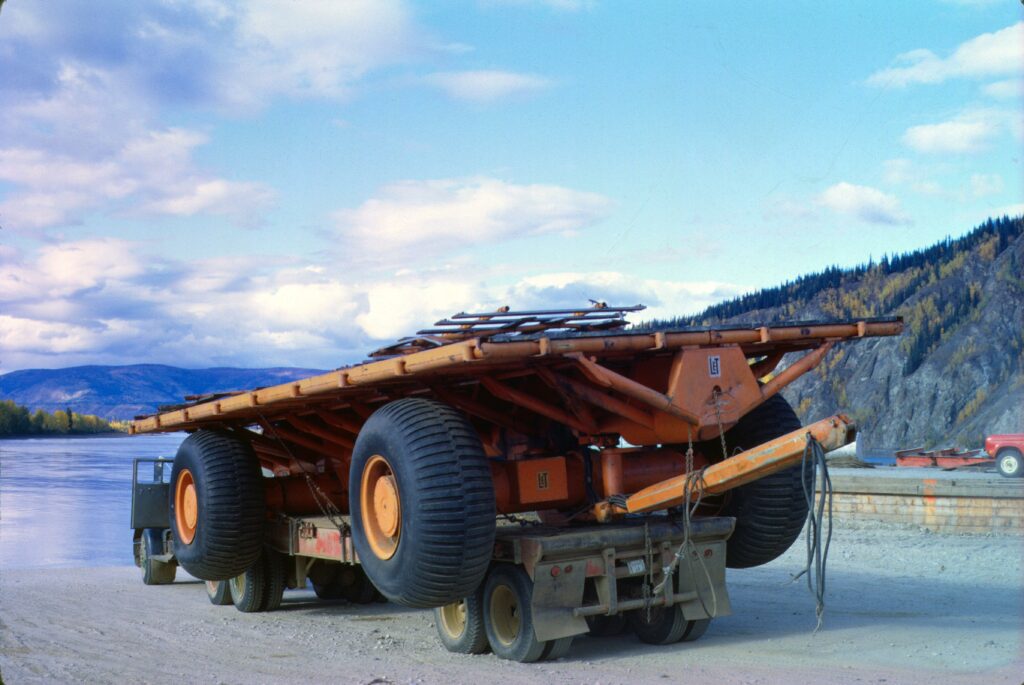
I recently acquired a new Sno-Freighter image slide. The slide is dated September 1969, which places it in Alaska, just after it left Bear Creek, YT.
Slide negative dated September 1969
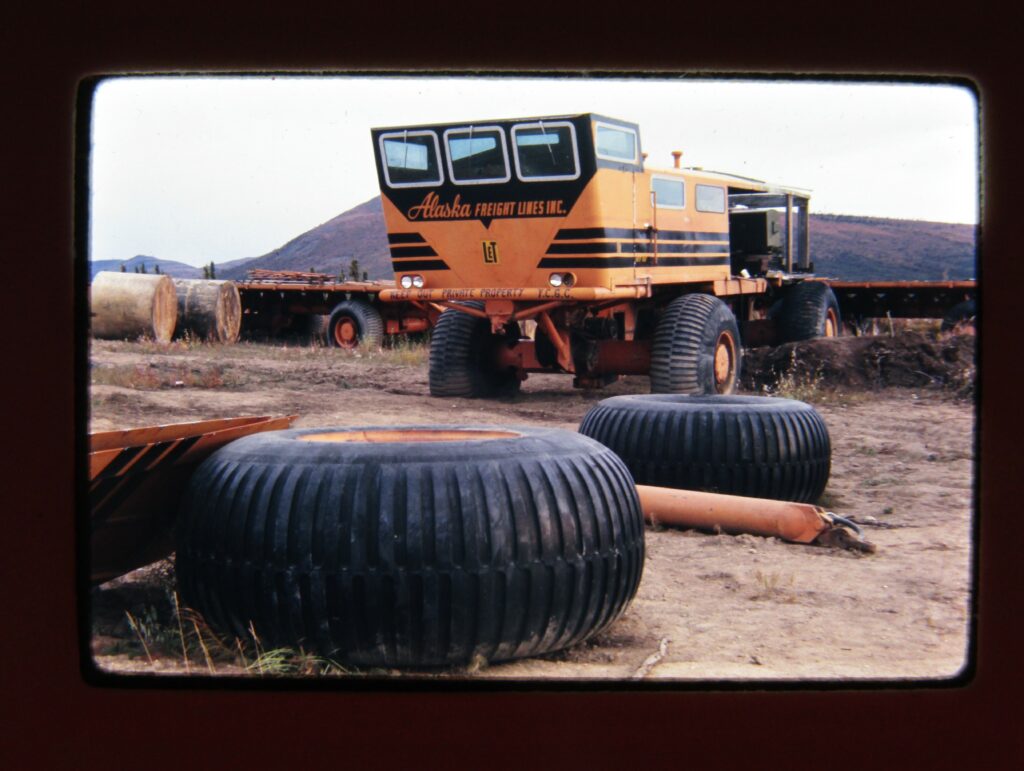
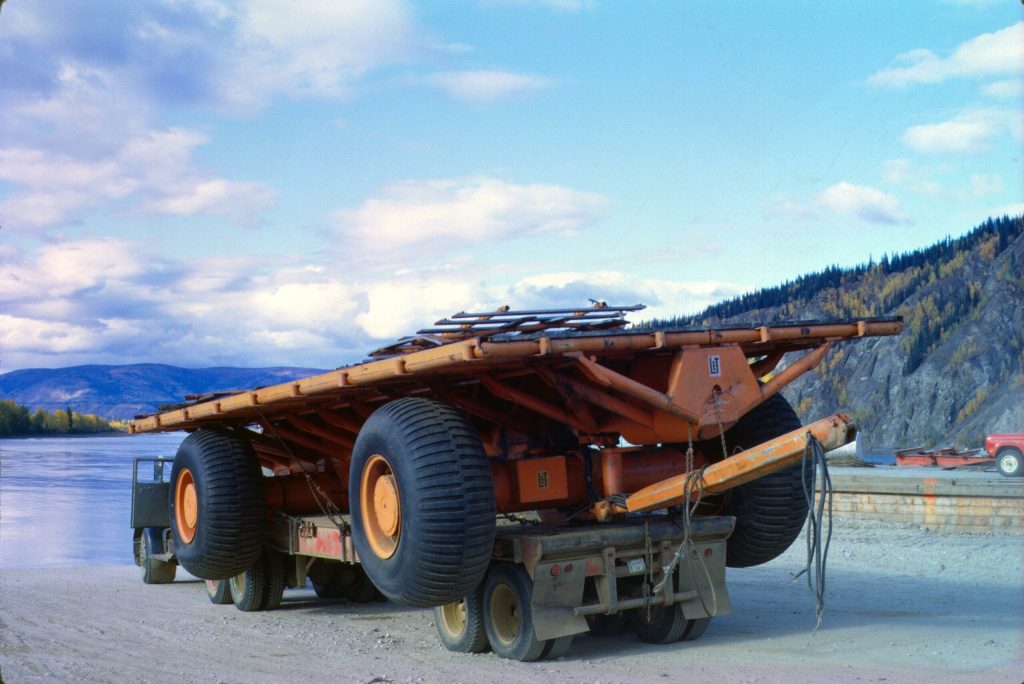
After I digitized the photo, it came out like this.
Sno-Freighter slide dated September 1969
As you can see in the photo, two tires in the foreground appear to be from the trailers. The orange bar between the tires is how the trailers connect to each other. The side paneling in laying on the side of one of those tires. There are two cylinders on let-hand side of the photo. To the rear of the Sno-Freighter sticking out on the right-hand side, you see a metal cage of sorts. It houses a military green generator that was used during the Sno-Freighter’s recovery in 1961-1962.
In 1968, the Sno-Freighter was towed from Bear Creek, Yukon Territories to the Alaska, United States. The trucking company that was contracted to haul the Sno-Freighter placed the the trailers on flatbeds. The control car was fitted with a 5th wheel attachment and towed from the rear. If you were following the Sno-Freighter as it was being towed, it would have looked like it was traveling the wrong direction.
Sno-Freighter with 5th wheel attachment, M. Martinez.
In May 1961, the Sno-Freighter was being prepared for its final rescue. It had been sitting for nearly five years in a valley without the ability to move. It’s engine’s were inoperable and the wiring in the control car were destroyed after it jackknifed and caught fire during a DEW Line resupply mission. However, the crew assigned to bring it back to civilization successfully negotiated its freedom. The Sno-Freighter was unable to recover from the fire that night. But, there is more than one Monster in the Yukon.
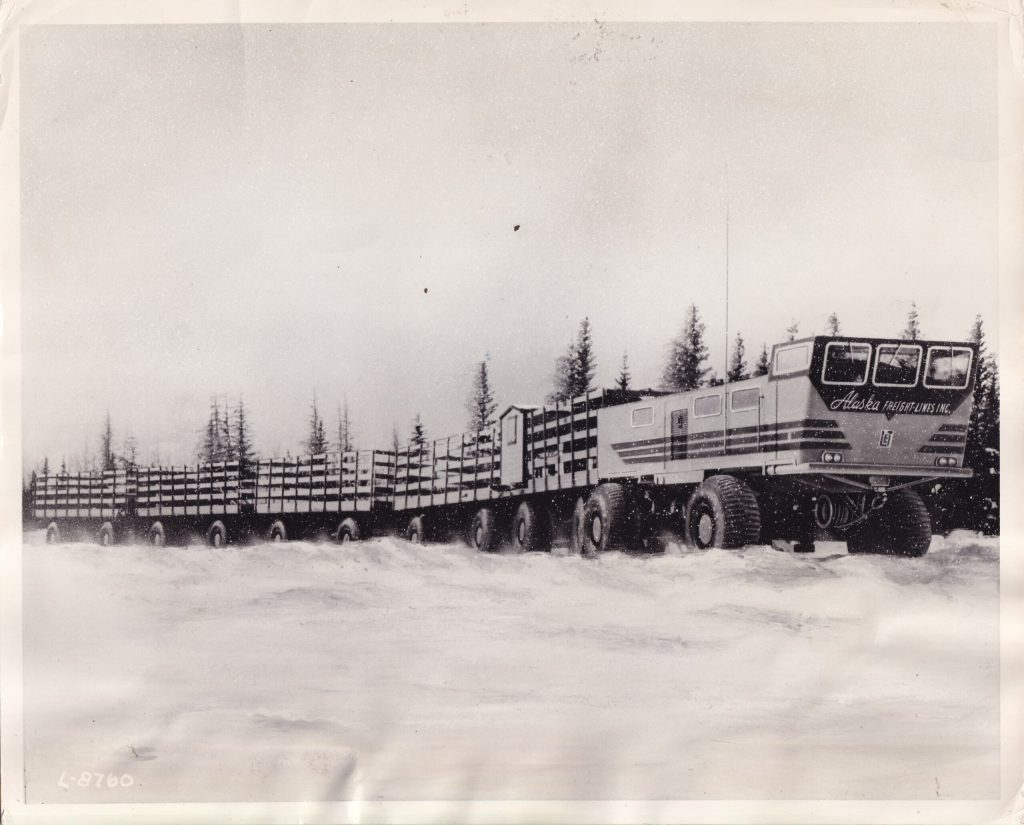
I am a bit of a sucker whenever a LeTourneau image is for sale online. I opened my front door and found the USPS had delivered my latest image. When I started writing this book nearly two years ago, I erased all of my assumptions and previous data I thought that I knew about the Overland Trains. All of the content that I have written on the Overland Trains so far has been supported by factual data and interviews with folks that were directly in contact with the machines, and backed up by the original or scanned original documents, not conjecture. When I find an image like the one seen below, I make sure to ignore the data on the back of the photos – they are usually wrong – and work off of what I can see and what I know for certain about the timeframes associated with the Sno-Freighter.
Alaska Freight Lines Sno-Freighter.
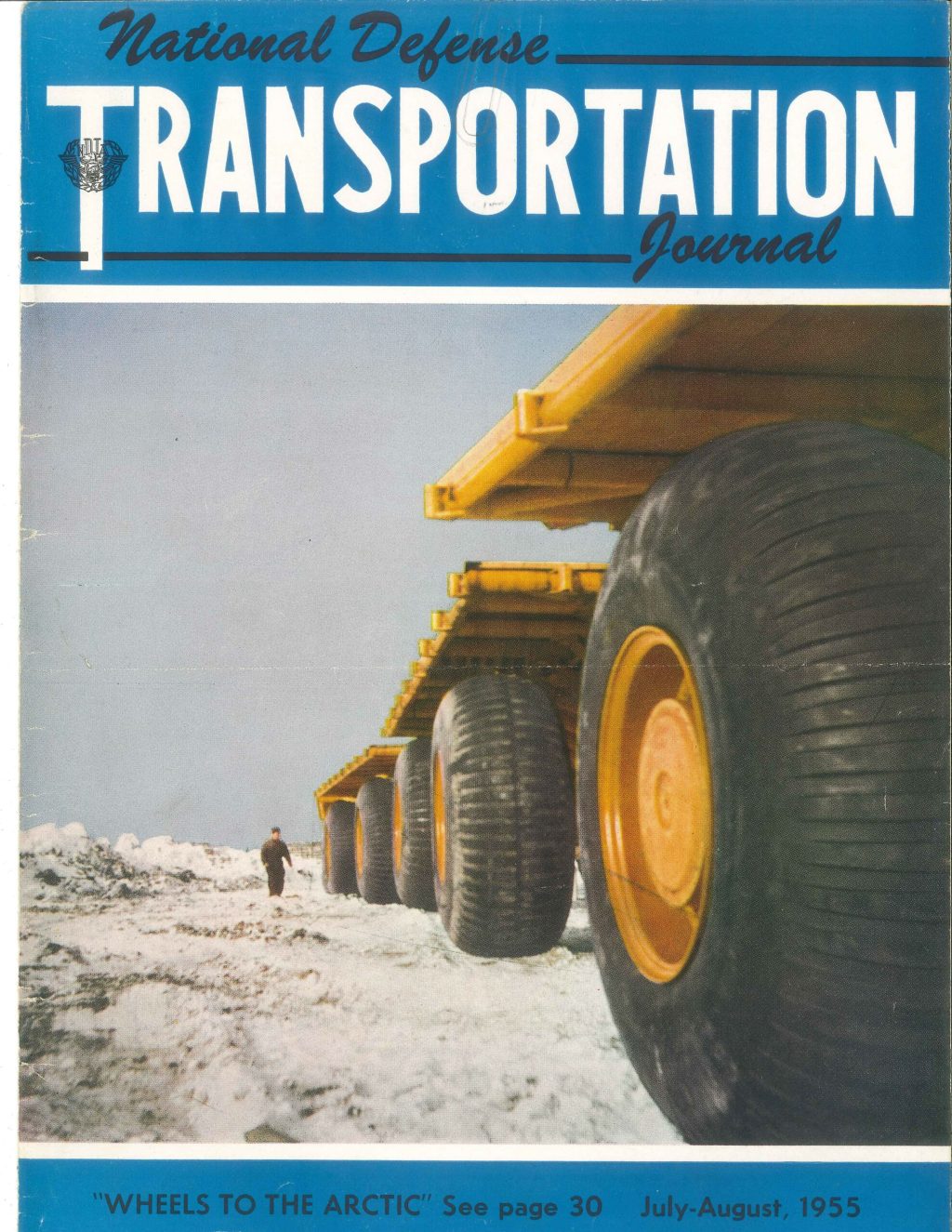
Some of these photographs show an “L” number that helps to date the photograph. In this instance, the L-8760 number shown on the bottom left corner of the image refers to a date of 09-26-55. The back of the image shows a date of March 12, 1962. In this case, both of the dates are incorrect. The Sno-Freighter was sitting at the mouth of the blow river until November of 1955. A similar photo dated July 1955 (below) is a more reasonable date for this image (above)
When I watch or read about Overland Trains, authors typically forget, or don’t know, that there are 6 of them. The Overland Trains were built from 1952-1961.
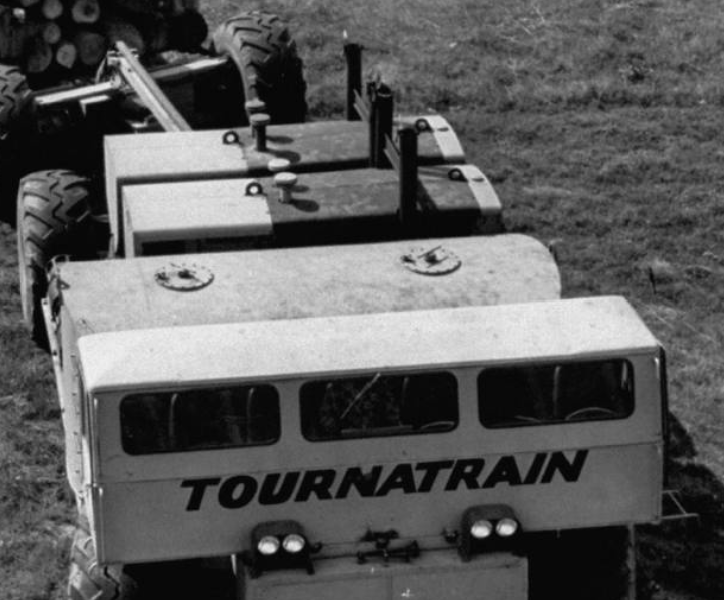
The first built train was the Tournatrain. R. G. had many concepts prior to building the first train.
Next, was the VC-12 Tournatrain. This was an entirely different machine than the first train. It had two engines versus one in the original.
Alaska Freight Lines was the recipient of the 3rd Overland Train, the Sno-Freighter. This was the only train that was purchased by a private party. This train made several trips to the Distant Early Warning (DEW) Line stations
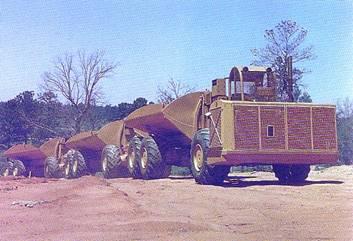
The Side Dump Train had a few concepts before coming up with the built machine we know of. It also had a royal visitor!
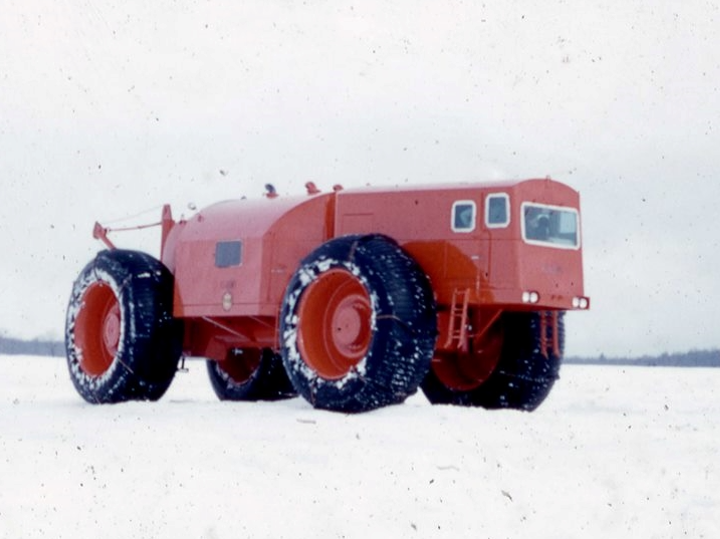
The Sno-Train has the most complex and active history out of all the trains. Expect some mind blowing stories and facts when the book comes out. This was the first Overland Train to use the Firestone 120x48x68 tires.
Lastly, the Overland Train Mark 2. It was the most engineered and well thought out train of them all. it never entered active service and went from Longview, TX to Yuma, AZ. While it is said that none of the train made it out of the scrapper besides the control car, that is not accurate.
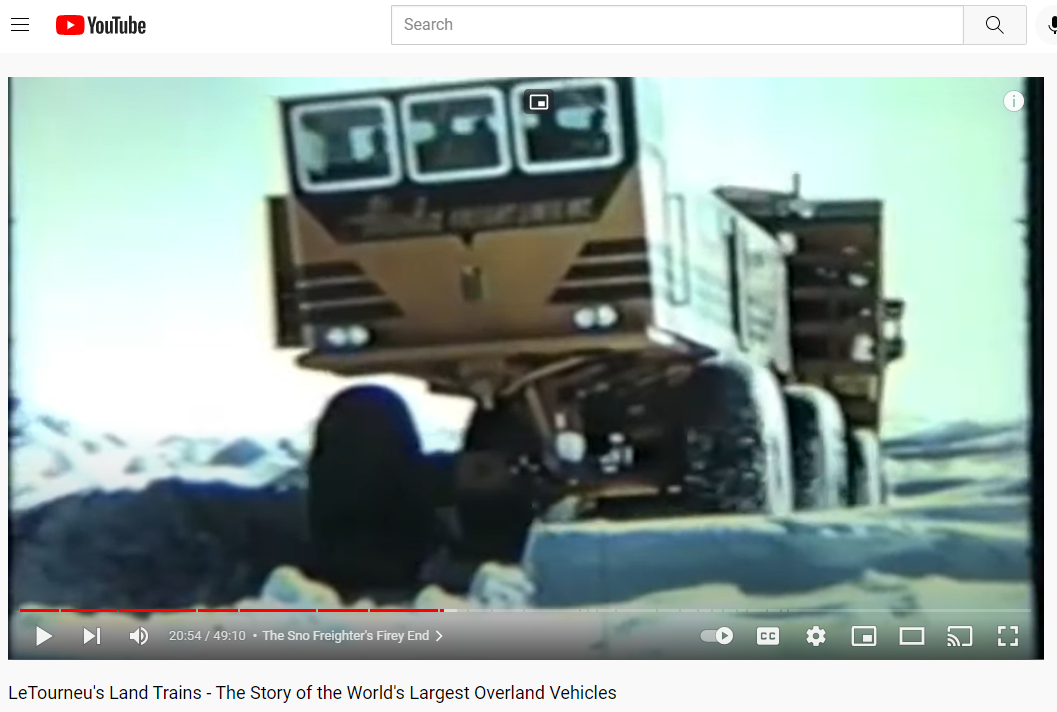
An acquaintance of mine posted a video on the Overland Trains today. It has been a labour of love for him over the past 2 years. His research and narration are top class. I can’t recommend watching his video enough.
I have been working on the finishing the Sno-Train chapter for the last two weeks. This machine has the most complex history out of all of the 6 Overland Trains. In one of the more detailed sections of my book, I am writing about a vehicle recovery journey where the Sno-Train was used as the primary vehicle. This journey took months of travel time, ingenuity, and drive to complete the mission.
During the months long recovery mission, men were exposed to continuous Arctic cold, rain, mucky conditions, and then more cold. They did not have running water or YouTube videos to help them figure out how-to. They had the knowledge, skills, and ability to fail fast and often, then keep on going to accomplish the mission.
My day job has nothing to do with writing or history. When I find my self in a conversation about history at work, it tends to spark my interest a little more. I was talking to a guy on video chat yesterday about publishing options and why I chose Amazon. He was explaining that Amazon would not publish his friend’s book because it was too gory and too long of a book. The book was titled simply and was about the lifecycle of a pig – it was something like “Pig to Table.” The book describes and shows how to go from a living animal to a meal on your plate in graphic detail. How many people living know the right way to raise, kill, butcher, and prepare a pig full cycle? I don’t. The book successfully raised money on Kickstarter and was published.
The conversation with this man led to his own interests in iron works and our inability to figure things out. How many people know how, or have the ability work with iron? How many of us could can effectively farm to feed ourselves or our family? I have interviewed over a dozen people for my book, with the majority between the ages of 75-98. Their stories demonstrate extreme adaptation abilities, humility, and character. How many of us would be willing to get paid Army wages to go out into the mud for months on end without our home comforts, finish the job, and not complain a single day?
We have forgotten how to endure. We have forgotten how to adapt creatively in less than ideal physical conditions. More importantly, we have forgotten how to be good humans. As David Goggins would say, “Go out and do something that sucks everyday.” Let’s see what happens.
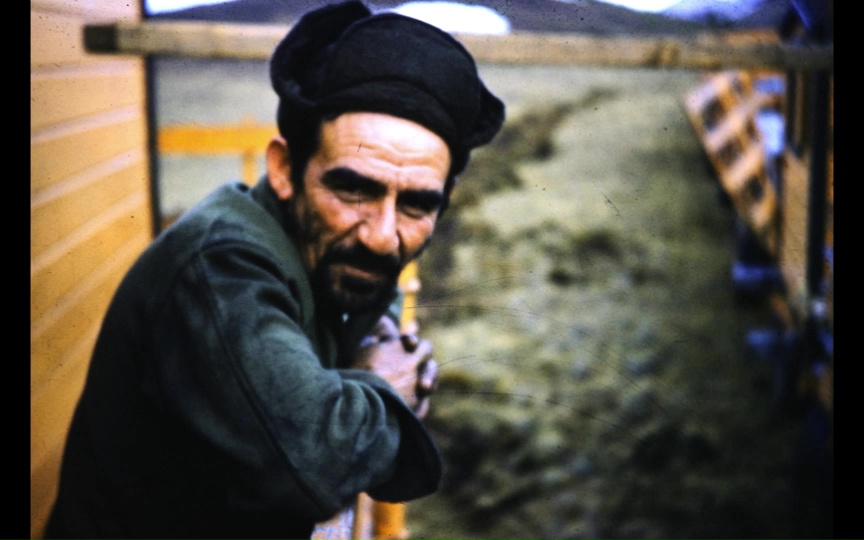
SP5 Alfonso Colon-Rivera 1961. Image: Marty Martinez.
In October 1968, the Sno-Freighter and its trailers were being shipped out of the Yukon. The 5 trailers and Control, or Power Car were transported across the International line to Alaska by a local contractor. The equipment sat at Boundary for several years until it made its way to Miller Salvage in Fairbanks, Alaska. The Sno-Freighter and its trailers would reside in Miller Salvage until purchased by two Fairbanks locals.
One of the Alaska Freight Lines trailers preparing to cross the river. Image: Millen Collection
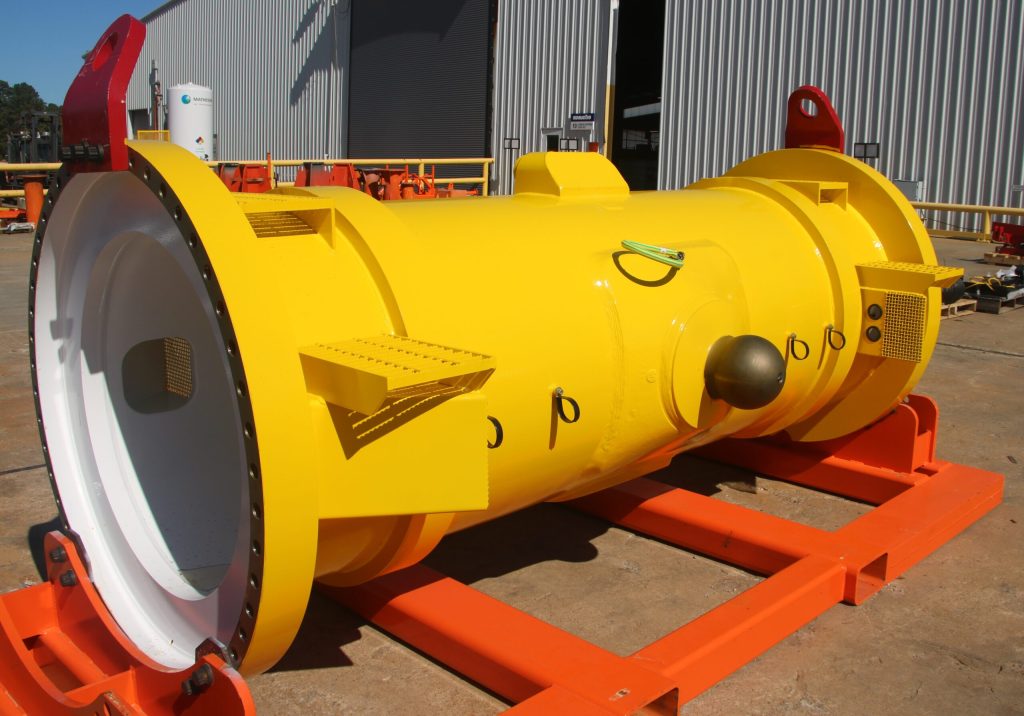
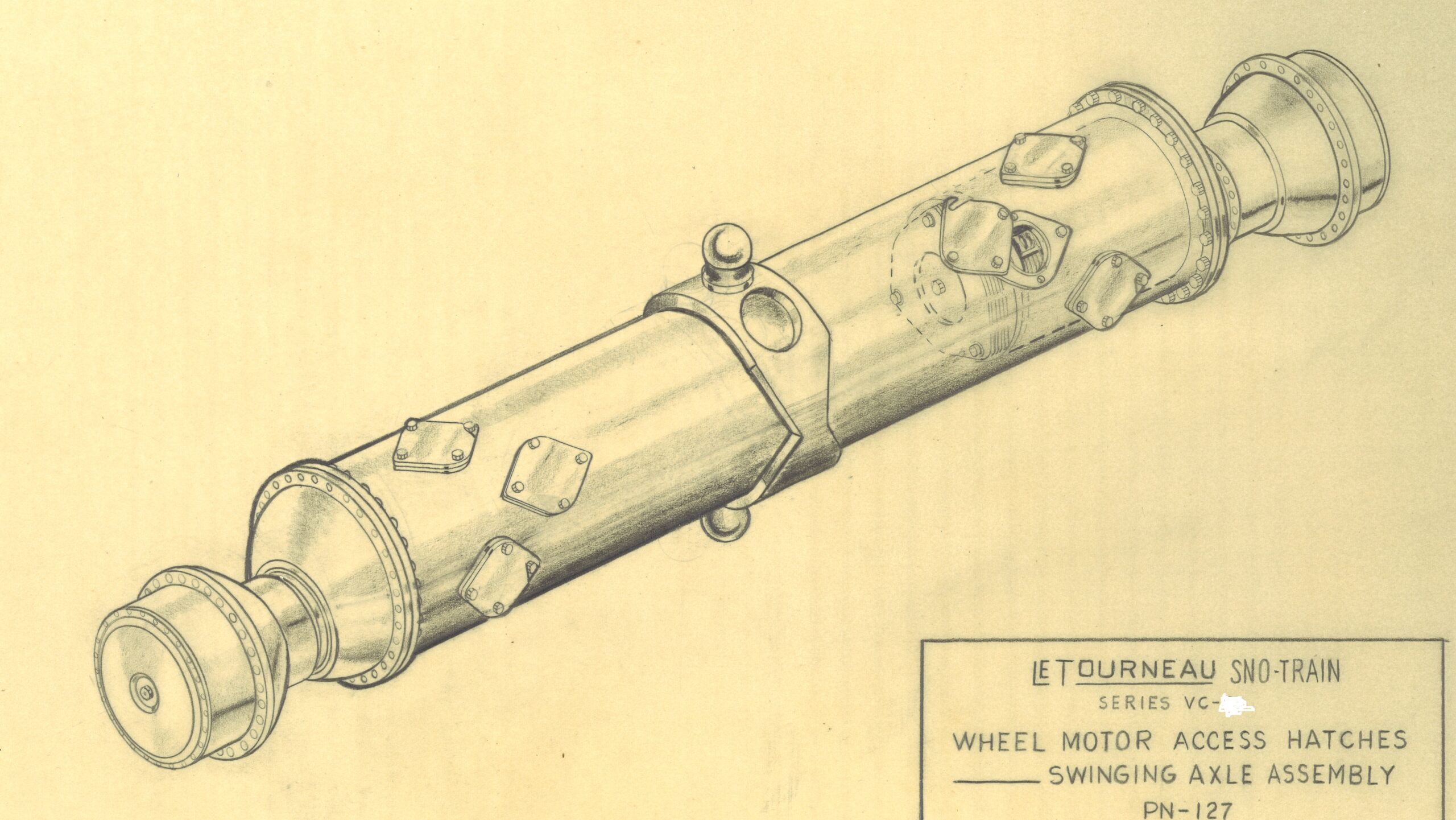
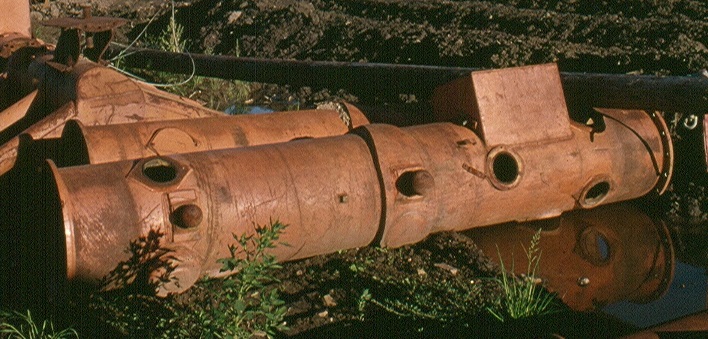
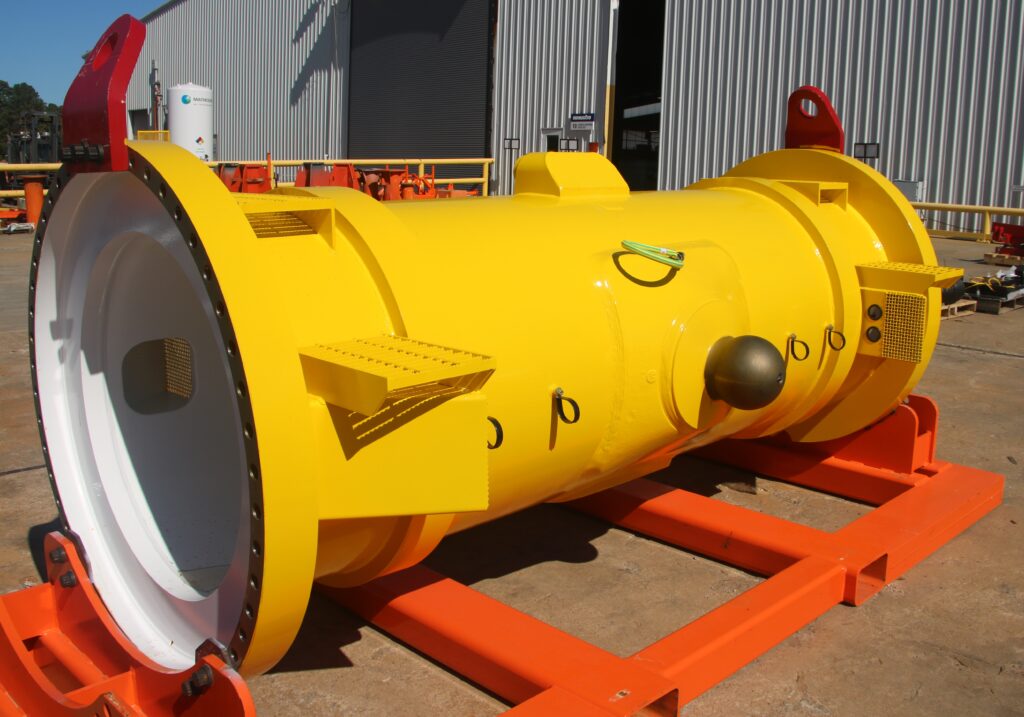
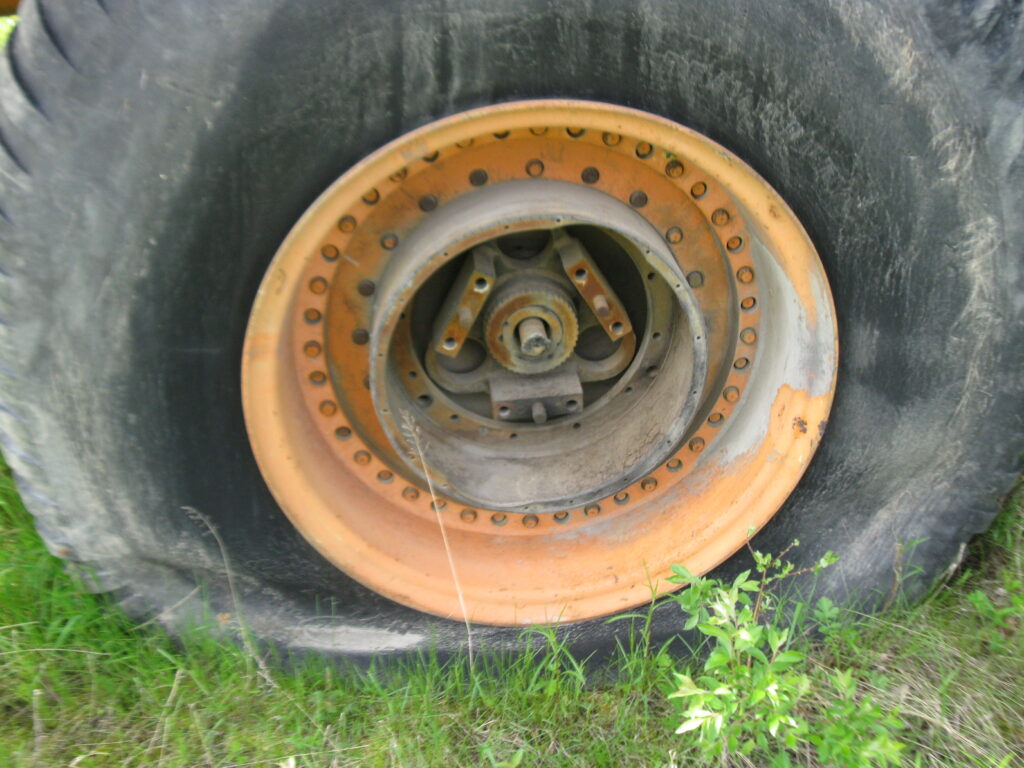
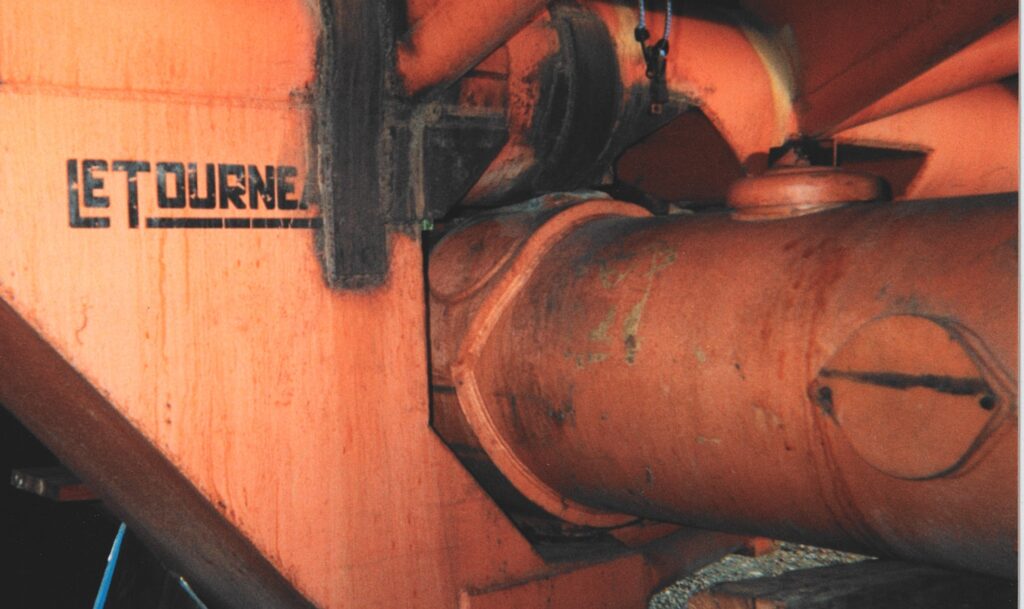
When Alfred Ghezzi purchased the Sno-Freighter for supply runs to the Distant Early Warning Line, he never realized that it would make just three working trips before coming inoperable. Over the last couple of months, I have been contacted by two individuals about suspension and steering mechanisms. I thought that I would go ahead and pre-emptively post these images of the Sno-Freighter swinging axle assembly and explain LeTourneau’s Electric Drive assembly. A LeTourneau built electric motor is bolted to the mechanical gear reduction called a Driver. The entire assembly is inserted into the swinging axle assembly. The axle assembly also had wheel motor access hatches. You can see in the assembly drawing below where the electric motor would be accessible by removing the small hatch cover.
Swinging axle assembly and electric drive drawing. While the drawing shows it is for the Sno-Train, the drawing listed here was for a VC-XX model not produced
VC-22 axle assembly. Image: Mike Haskins
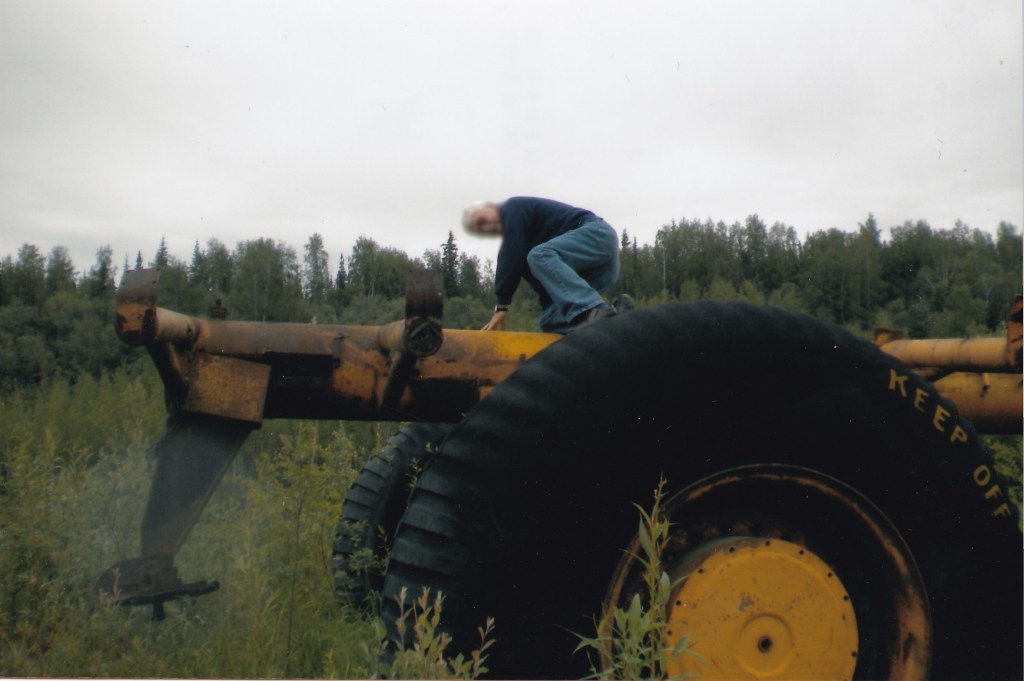
The modern day swinging axle assembly with pivot balls. Image Dale HardySno-Freighter exposed Driver housing. Image Jeffrey Smoker.The pivot balls are on the top and bottom, hidden from sight. Image source unknown – for education purposes.


 Overland Trains