Category: research

  • Mobile Micro Reactors Resurrected from the Army’s Nuclear Power Program

    Mobile Micro Reactors Resurrected from the Army’s Nuclear Power Program

    In 1960, the Army’s Nuclear Power Program had completed several nuclear reactors for research and testing purposes. Their micro-reactor (MCR (MM-1)) expected outputs were 500-800kW (MCR) and 2,000-3,000kW (MM-1). The MM-1 was targeted for use on a large logistical train and designed to help offset Petroleum, Oil, and Lubricants (POL) logistics needs in active war-time environments. During the 1960-1970 Army estimates, a theater of military operations would require fuel equivalent to 3.4 gallons/man/day to 7.5 gallons/man/day.
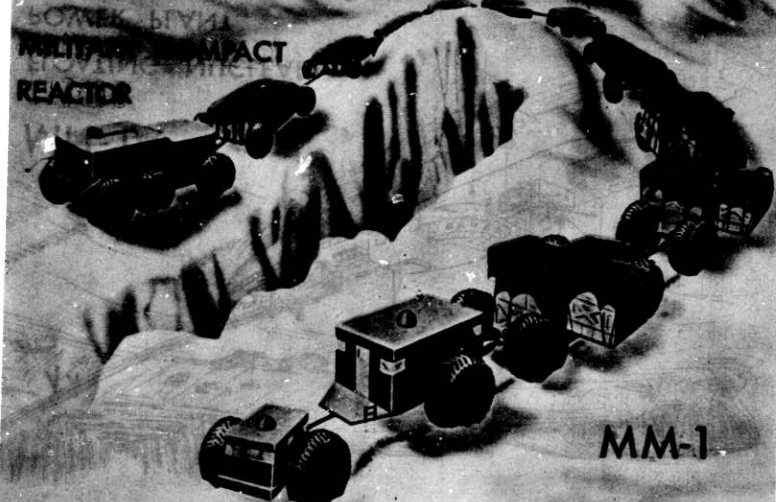
    The Army’s Nuclear Power Program had conceptualized the MM-1 reactor being placed in a logistical cargo carrier. Image from U.S. Army Engineer School, Mobile Nuclear Power Program Plants 1960-1970.

    The MM-1 concept never came to reality, as the radiation shielding needed to protect men and equipment was too heavy. In 2016, the Defense Science Board (DSB) identified energy use as a major requirement for military operations. We have know this since before the Army Nuclear Power Program in the 1960’s. I am not sure why this point needed to be justified again.

    Renewable power sources simply can not keep up with the military demands, which catalyzed the military to restart their efforts at a meltdown-proof (see TRISO fuel), miniature nuclear reactor concepts as Project Pele. As of March 22, 2021, to companies, BWXT Advanced Technologies and X-energy were given the go-ahead for their final mobile micro-reactor designs.

    Similar to the 1960’s designs, these modern day micro-reactors are targeted at electrical output between 1mW to 5mW (1,000-5,000kW). I doubt we will see another logistical cargo train concept anytime soon. If you want to read more about Project Pele and micro-reactors, here are a few good places to start.
    https://www.cto.mil/pele_eis/

    https://www.mobilemicroreactoreis.com

    https://www.defense.gov/Newsroom/Releases/Release/Article/2545869/strategic-capabilities-office-selects-two-mobile-microreactor-concepts-to-proce/

    https://www.ans.org/news/article-3260/draft-eis-released-for-project-pele-mobile-microreactor-demo-at-inl/

  • Book Writing Update September 19, 2021

    Book Writing Update September 19, 2021

    The first 6 book chapters are being reviewed and edited! I received the first copy edit on Chapter 1 last night. I have three “Monster” chapters in the book, the Sno-Freighter, Sno-Train, and the Overland Mark II. The good news is that the remaining chapter drafts are complete, aside from the aforementioned three.

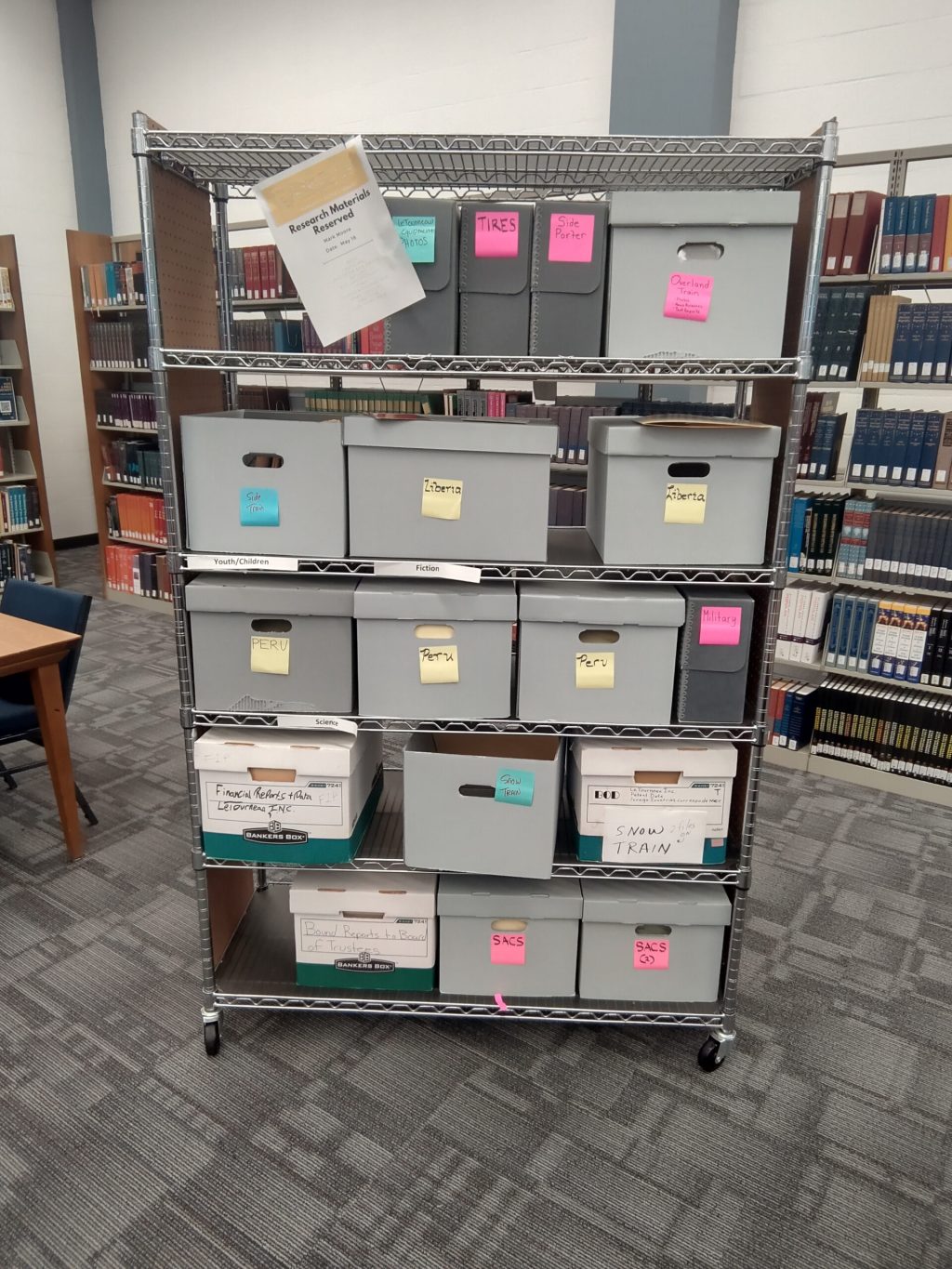
    When I went to Texas for research last month, I had boxes and boxes of old documentation to review. The image below is just a small percentage of data that were reviewed. Part of the problem with all of these fantastic data sources was filtering. Sometimes, there were an excessive amount of documentation on a particular topic; I had to mentally step back and filter what was important to telling the story.

    Some of the historical records researched for this book

    As I started writing this book, I wanted to throw out any of the data derived from stories. I started from scratch, presenting information only from physical documentation or from those present during the event. Aside from the mass amount of information in this book, it is based on data that I can back up by documentation and first hand accounts.

  • Overland Trains Facebook Page Reaches 1,000 Followers

    Overland Trains Facebook Page Reaches 1,000 Followers

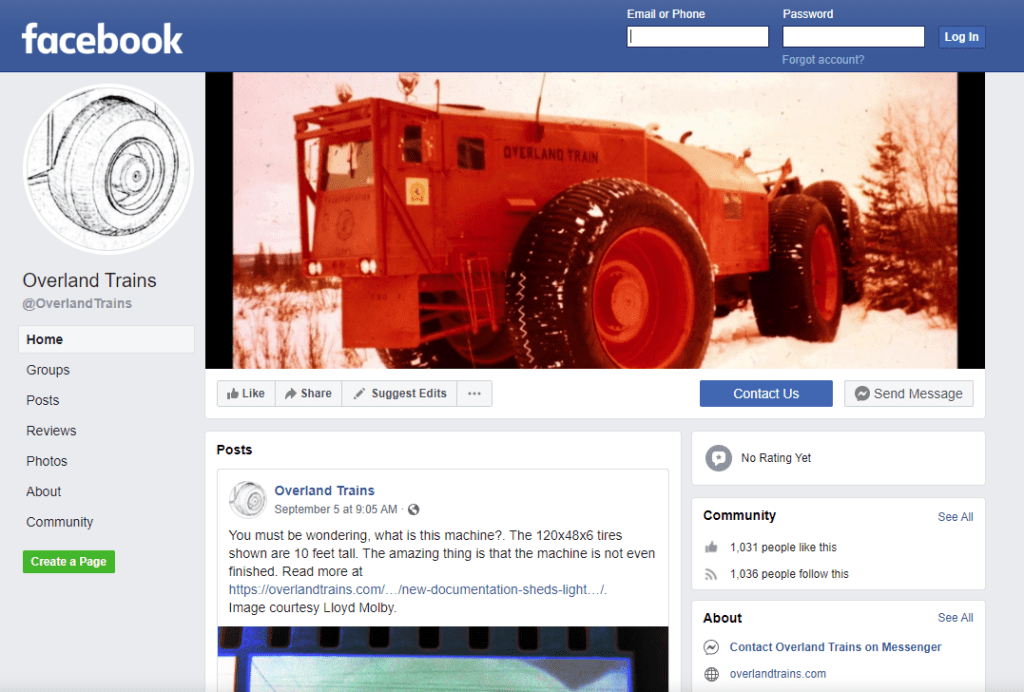
    Our Facebook Overland Trains page reached 1,000 followers yesterday! The first 7 chapters of the Overland Trains book are being edited, while I continue to work on the larger 3 chapters, the Sno-Freighter, Sno-Train, and Overland Mark II. Thank you for joining our Facebook Page – https://www.facebook.com/OverlandTrains.

  • New Documentation Sheds Light on the Overland MarkII Surplus Parts

    New Documentation Sheds Light on the Overland MarkII Surplus Parts

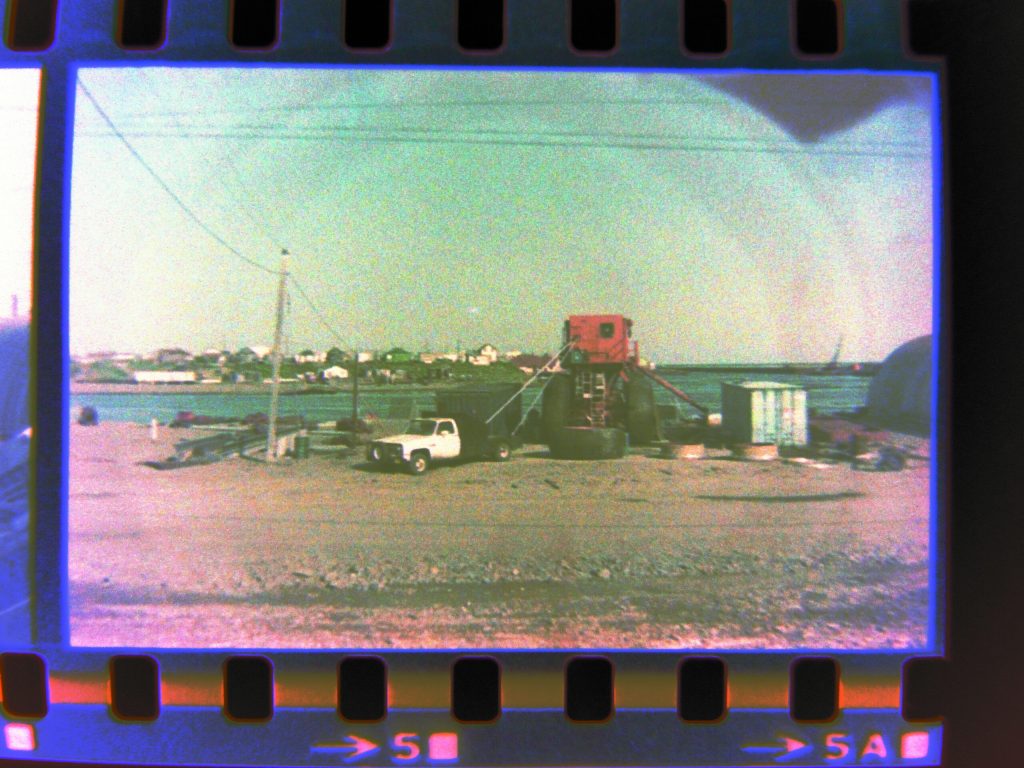
    As part of researching “The Overland Trains Project,” I have been able to take use some of my technical background to good use. These slides show one of the Overland Trains trailers. On Thursday, I received an envelope of old film negatives. These needed to be digitized and analyzed for content. How in the heck do I do that?

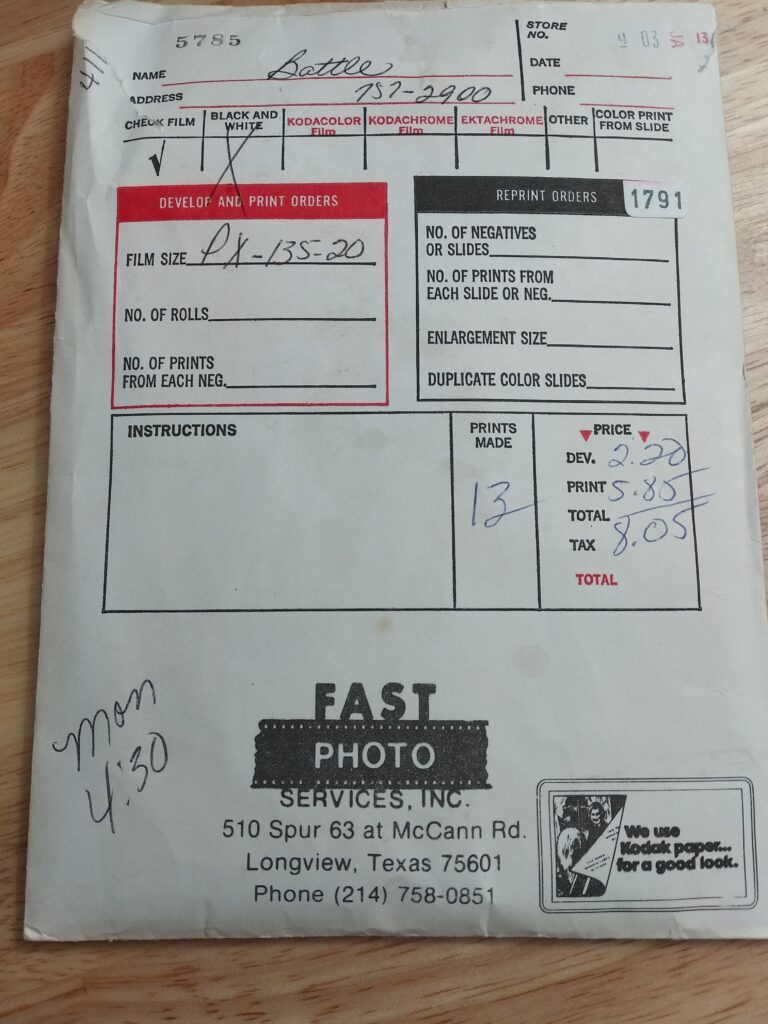
    Film negatives pouch

    When I was a kid, I used to buy 35mm film, take random pictures, and take them to PayLess for developing. I would get back pictures and these negatives. I did not realized until now, how important these negatives are as a part of history.

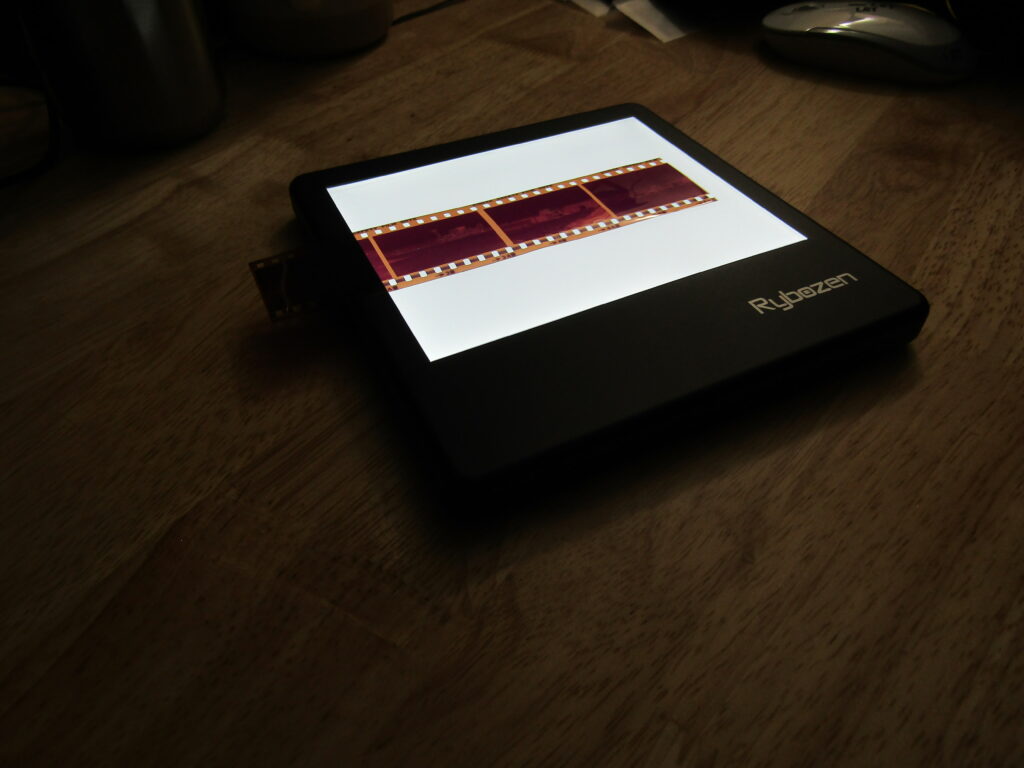
    I called up a couple of pharmacy stores that had photo print capabilities. Anytime a customer wants negatives digitized, they are sent to Fuji, with a turnaround time of 2-4 weeks. Realistically, this would end up being 6-8 weeks. I searched Neeva and found out that digitizing negatives is quite simple. In short, use a high quality, uniform light source, take a completely still digital camera image, then edit the colors in a photo editor.

    Rybozen 5″x4″ light table

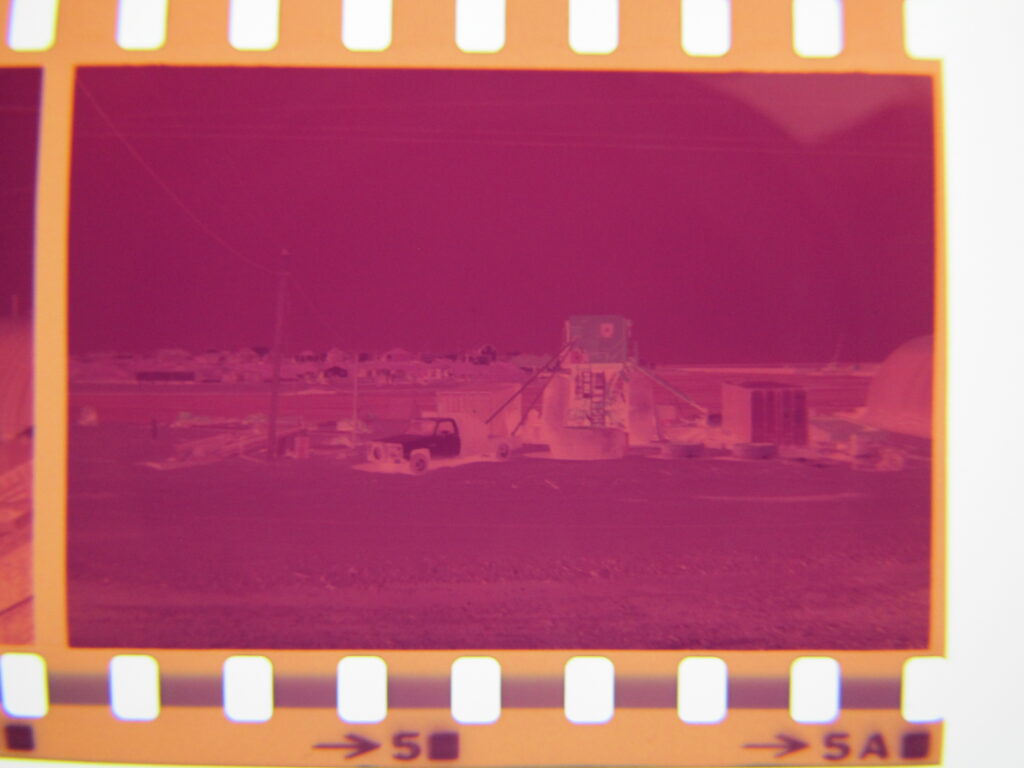
    I used a high quality digital camera to capture an image of the negative. The raw image looks like this.

    Raw negative image under a light table

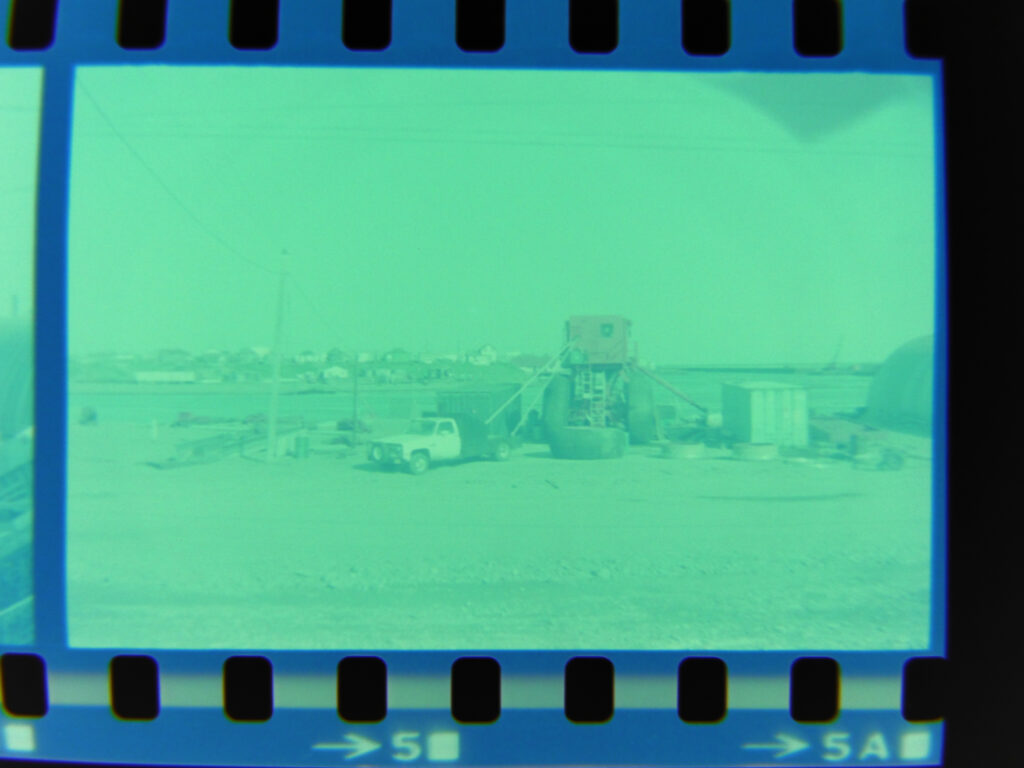
    Next, I used Gimp photo editor to Invert the colors, which makes the image have a blue hue.

    Negative image after Invert colors was applied.

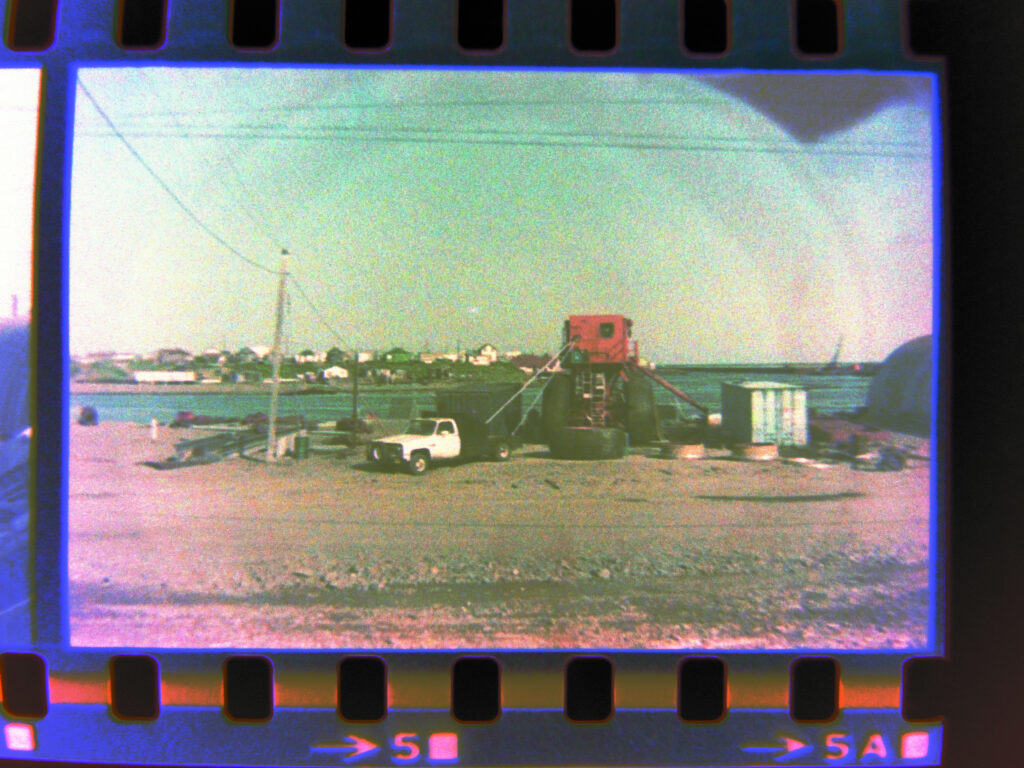
    Lastly, Auto Equalize the image, and you are left with a digitized negative to image.

    Final processed image from film negatives

    Once the image is processed, crop and apply additional filters to meet your needs.

    By now, you must be wondering what is the machine in this image. One of the more recognizable feature is the Firestone 120x48x68 tires. The tires above are 10 feet tall, with the machine standing well above the tire height. The amazing thing is that the machine is not even finished. Additional slides in this series show closeups of the rims and trailer. The trailer platform for this machine is from the Overland Mark II from Yuma Proving Ground, AZ. There is an additional top deck that is placed on top – not shown. I will discuss this machine, provide additional images, and talk about the story of this machine in my book.

    The photo negative above was captured by Lloyd Molby. Thanks to a few amazing people, we are able to learn and relive Lloyd’s experiences. This is just the surface.

  • The United States Air Force Modern Day Project Iceworm

    The United States Air Force Modern Day Project Iceworm

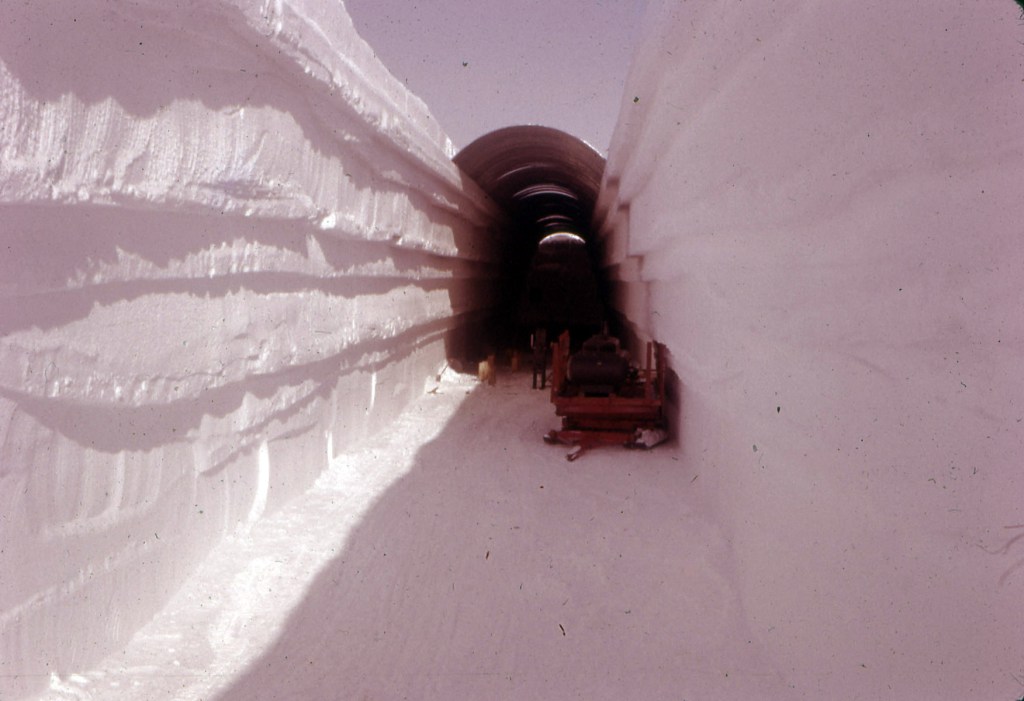
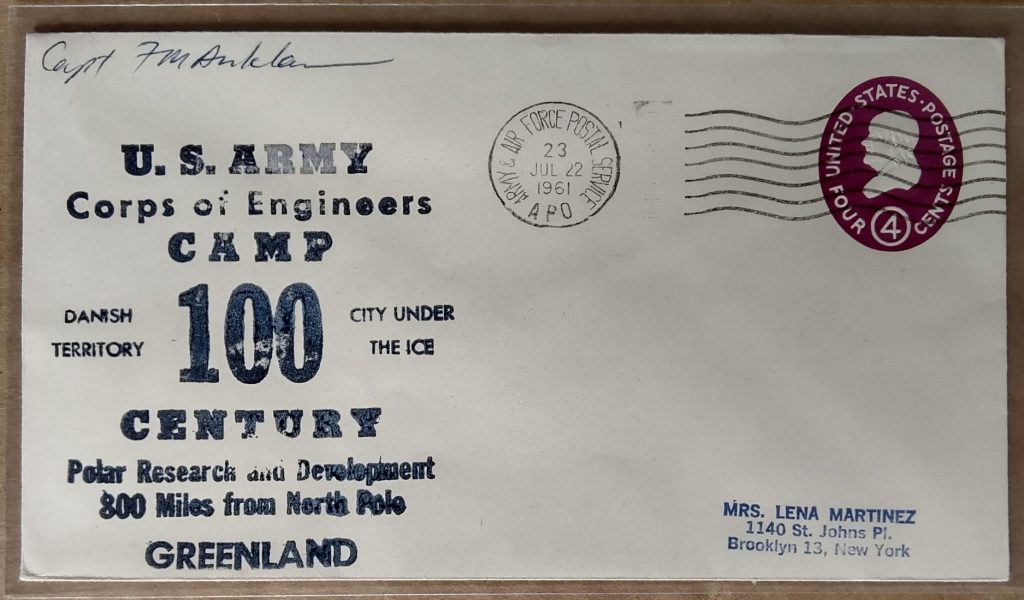
    In the late 1950s, the United States Army (USAR) started carving ice tunnels in the Greenland ice shelf. The tunnels formed Camp Century, secretly known as Project Iceworm. Publicly, Camp Century was a research and development station. Ice cores sampled during this time are the foundation for scientists climate change assertion. The first functional nuclear power station, as part of the Army’s Nuclear Power Program, went CRITICAL in Camp Century – the reactor was called PM-2A and built by ALCO. Project Iceworm’s mission was to determine the feasibility for the Greenland ice shelf to support nuclear missile launches.

    Letter stamped with Camp Century processed through Army and Air Force Postal Service dated 22July61.

    A couple of decades after Camp Century was abandoned, a 1962 memo was found, detailing Project Iceworm’s proposal. The USAR really wanted to determine the feasibility for the Greenland ice shelf to support 600 nuclear missiles, targeted at the Soviet Union. The missiles would be moved around, under the ice sheet, by rail. The warheads would be safely concealed under 28 feet of ice, with a surface area equal to the state of Alabama.

    photo: A. Haynes

    In 2013, the United States Air Force Nuclear Weapons Center was planning to award several study contracts, worth up to $3 million each. The goal of the study contract was to figure out how to extend the operational life of the Minuteman III missiles.

    There were two possible outcomes that the Air Force was looking to pursue, (1) maintain the current Minuteman III missiles until around 2030 or, (2) replace the current setup with a new ICBM that would be hidden within a trackless, underground subway system. The cost of developing a complex underground system would be a considerable, with figures between $52 billion to $210 billion.

    You can read the 2013 United States Air Force Counterproliferation Research & Education article at https://media.defense.gov/2019/Jul/24/2002161886/-1/-1/0/CPC%20OUTREACH%201049.PDF. I did not want to post the article here because of possible copyright issues.

  • Firestone 120x48x68 Tires

    Firestone 120x48x68 Tires

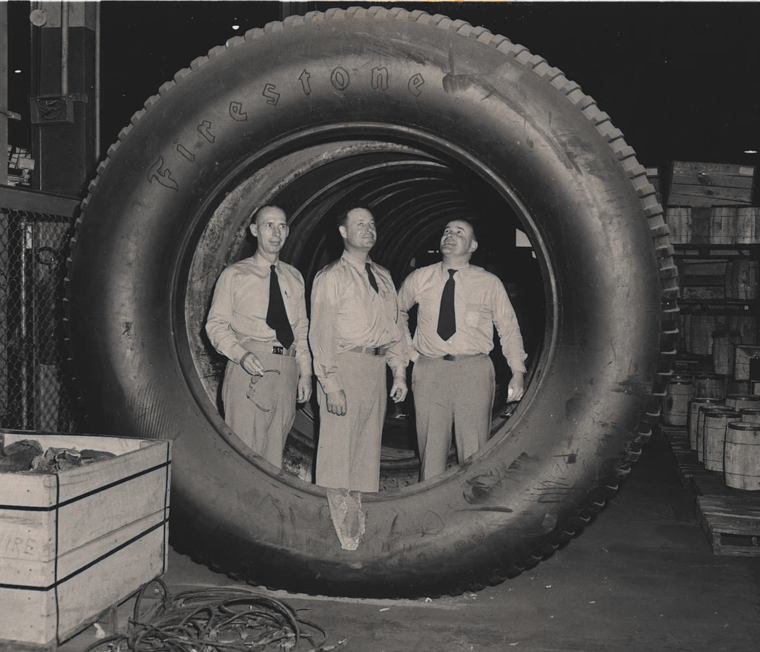
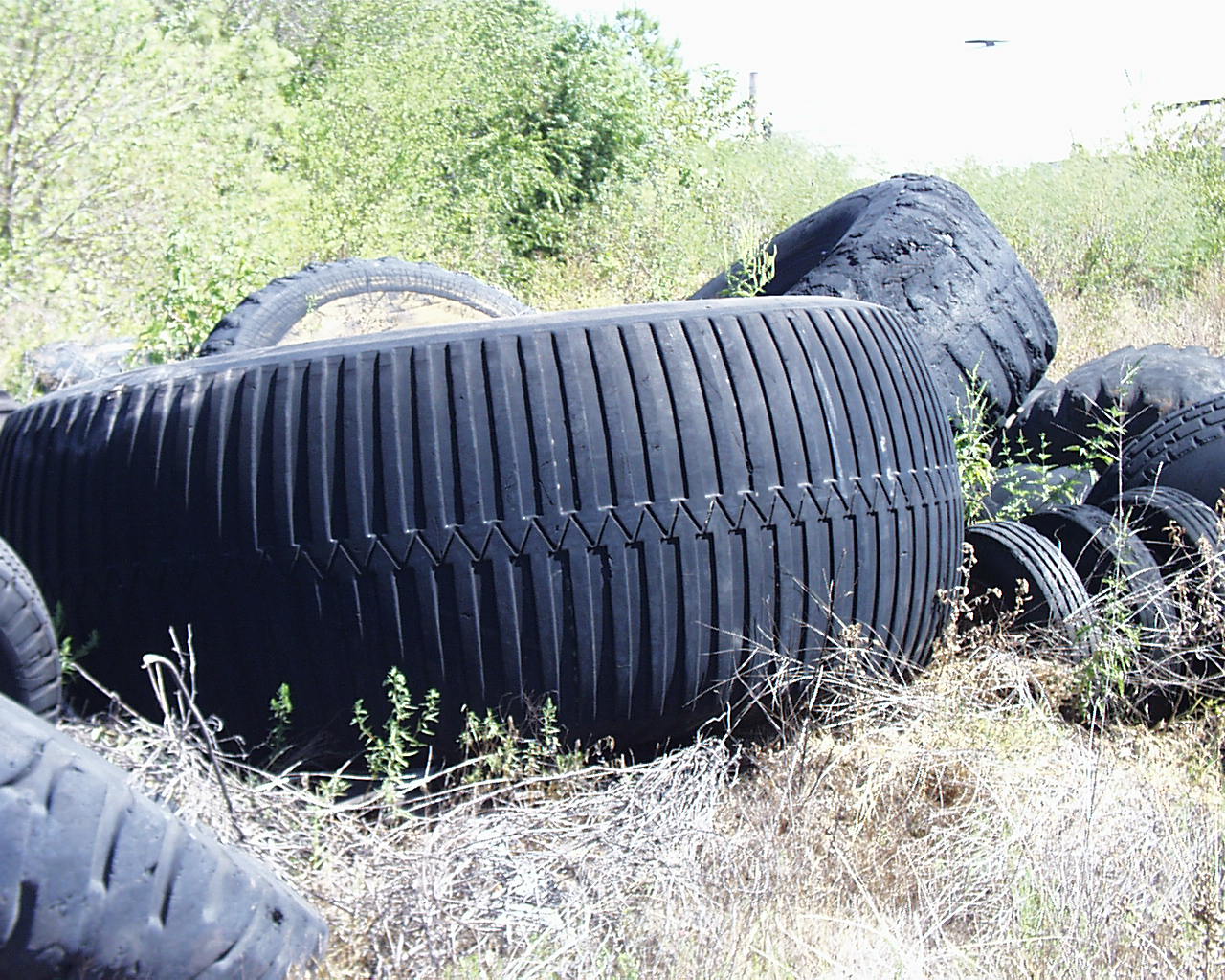
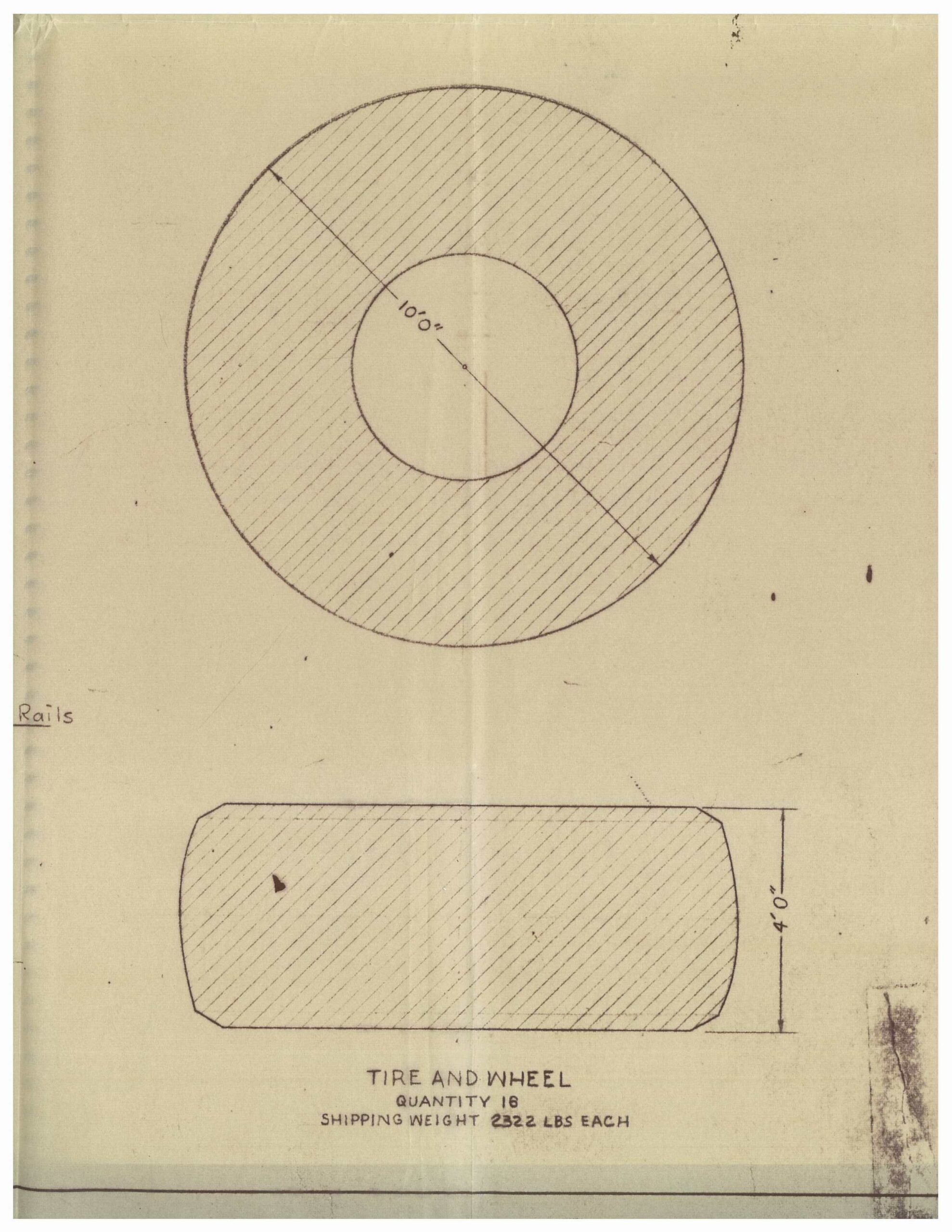
    The Firestone 120x48x68 tires are arguably, one of the most recognizable features on the last 3 LeTourneau Overland Trains. These tires were first produced in 1952. The numbers describe the tire dimensions as 120 inches tall – diameter (10 feet), 48 inches wide (4 feet), and 68 inches inner diameter. The were manufactured in thicknesses of 10-ply to 36-ply based on the machine it was used. If you wanted to buy a tire and rim combination during the 1960s, you would expect to shell out around $3,500 per tire and $1,600 per rim.

    Tire and rim combination weights will vary by rim model, rim metal composition, and tire plies. These tires were also used on the Crash Pusher, Water Wagon, Marsh Buggy, Sno/Swamp-Buggy, and possibly a few others that I have not seen.

    April 15, 1954 – Ft. Eustis, VA. Three visitors marvel at the new Firestone tires.
  • LeTourneau Train Concept for the Iraqi Government

    LeTourneau Train Concept for the Iraqi Government

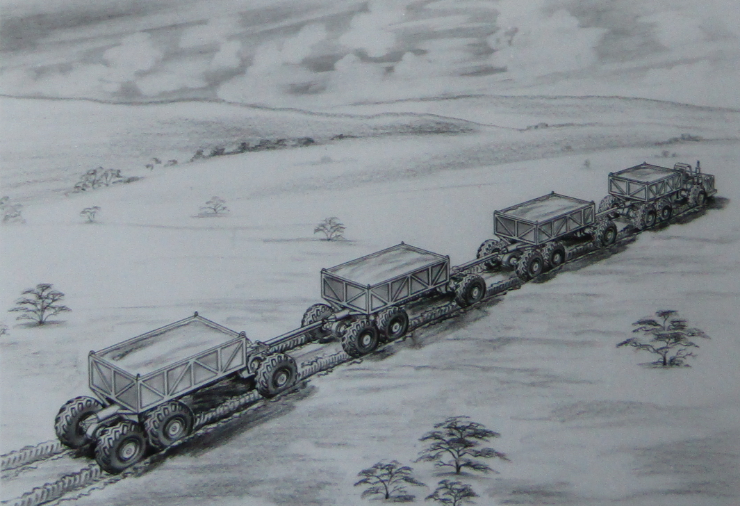
    R.G. LeTourneau, Inc. drew a number of trailer concepts and trains before the 6 Overland Trains we know of today. His newly developed electric drive wheel seemed to spur his Train concepts. R.G. developed nearly a dozen train ideas during the early to late 1950s. The train concept below is a 6×6, powered electric drive developed for the Iraqi government. The lead car, or control car looks to use a Side Dump Train style front. The 4 containers on this train were designed to be removed and left at a work site, only to be picked up later. This train was never built.

    undated train concept for the Iraqi government

    The train above was not the first to be targeted for use in a desert environment. The Sno-Freighter was also marketed for use in the Sahara! Read through the Sno-Freighter brochure below.

    https://advnscuba2.wordpress.com/updates/vc-22-sno-freighter-brochure/ VC-22 Sno-Freighter thumbnail

  • Writing Continues, Plus Interviews!

    Writing Continues, Plus Interviews!

    These last couple of weeks have been full of interviews, both in-person, email, phone conversations, and one video chat. The interview usually starts off with me asking when they served in Greenland, Alaska, or in other parts of the world. Once you start jogging the memories of these fantastic people, the information flows well. I do not understand how many of these service men still remember the details of their Temporary Duty deployments over 60 years later. As I rethink that last statement, the raw, mostly untouched Greenland of the mid to late 1950’s and early 1960’s was a sight to see. They were figuring out how to make the equipment work in Arctic extremes.

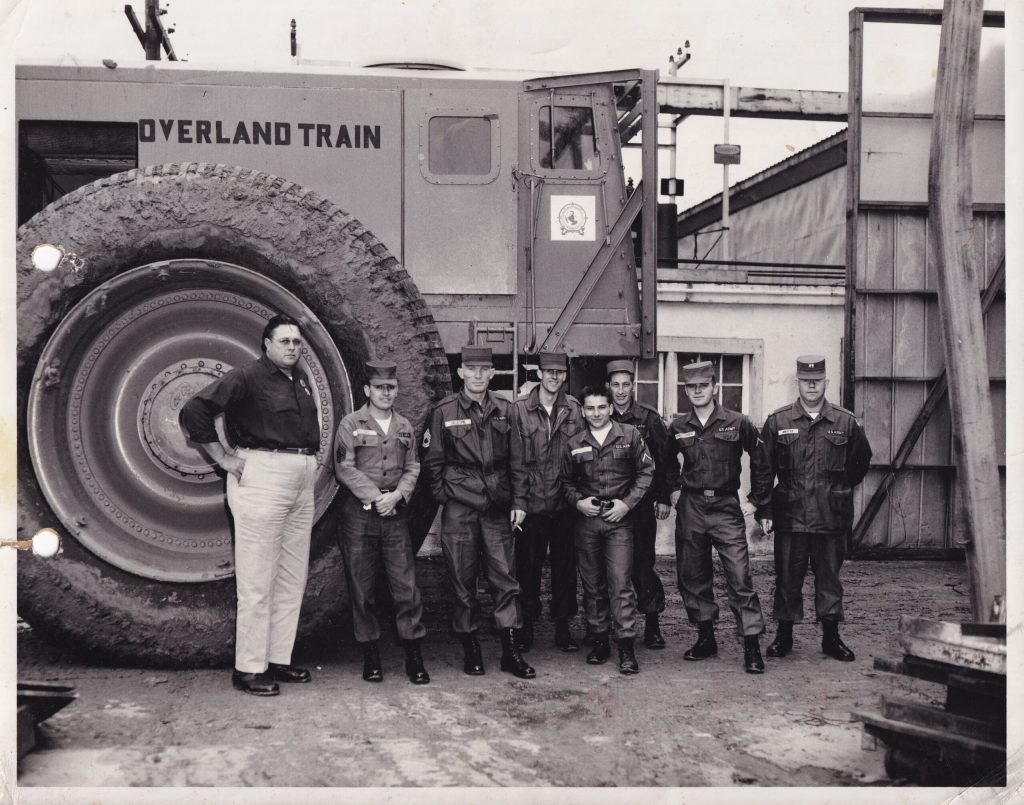
    Around a month ago, I had a person reach out to me because they found this website. This contact has led to a wealth of new information and the opportunity for me and my wife to meet some truly great people. I met them both for lunch around 20 minutes from my house. Later next week, my wife and I went over to their house, around 30 minutes away, and spent three hours talking over pizza and beer. He was a Korean and Vietnam Vet, and had extensive time spent with the Sno-Train and Sno-Freighter – you just don’t hear of these individuals any more. He provided the image below from his time in Fort Eustis, VA.

    Image courtesy M. Martinez (2nd from the left). Fort Eustis, VA

    I am still processing the data from my trip to Texas. Rest assured, the pages are flowing!

  • Sno-Train during Environmental Operation Willow Freeze

    Sno-Train during Environmental Operation Willow Freeze

    Willow Freeze was a 5 phase maneuver during the winter of 1960-1961. It involved elements from the United States Army Transportation Corps, United States Army Transportation Board Task Detachment Logistical Support, and others. The goal of Willow Freeze was to figure out logistical operations in Arctic terrain. The Sno-Train was one of many different types of logistics machinery. I will cover Willow Freeze and subsequent recovery operations in great detail within my book.

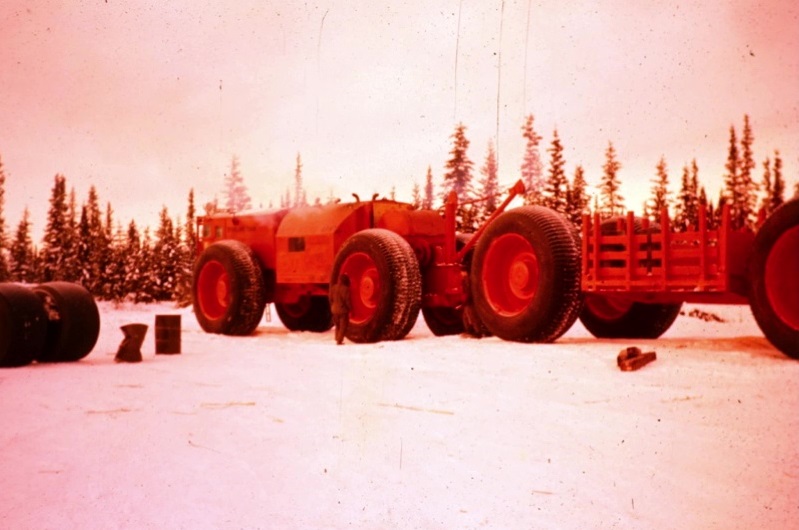
    Sno-Train during Willow Freeze – image courtesy Marty Martinez

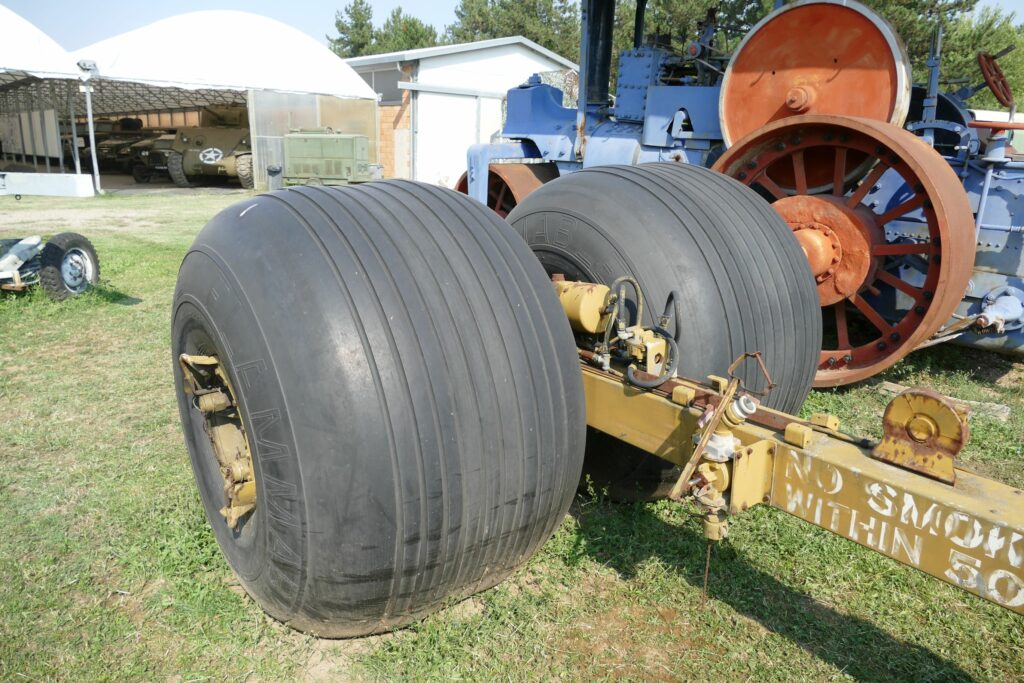
    The image above shows the Sno-Train and two large wheels to the left-hand side. These wheels were the 1,000 gallon Rolling Liquid Transporters (RLT). The RLT were designed to transport fuel within the wheels. They performed well over the terrain. The Army’s only concern was that fuel could only be dispensed out of one RLT at a time.

    Rolling Liquid Transporter – image: maquetland.com
  • Sharing Overland Trains Links using Neeva Spaces

    Sharing Overland Trains Links using Neeva Spaces

    Neeva provides ad-free, private search results. They are in a private Beta with around 5,000 users, with plans to go public using a paid subscription model – priced somewhere around $5 a month. Because Neeva is supported by your subscription fee, they are accountable to their users, not advertisers. Read the Neeva Bill of Rights at https://neeva.com/digital-bill-of-rights.

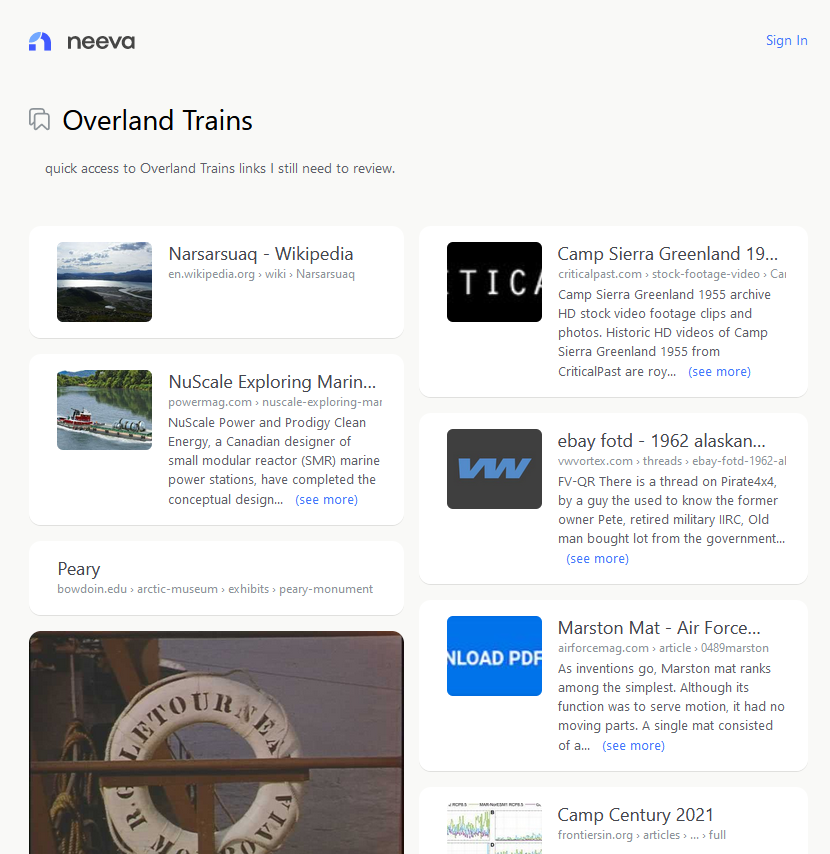
    Neeva Spaces is a new way to organize bookmarks. You can add links through the Neeva Search page, manually, or through the Neeva browser extension. You can take a look at the Overland Trains Neeva Spaces at https://neeva.com/spaces/nBACORibPbXU4a0Pje25-cXpT5XP9JObytsry0n_.

    The Overland Trains Neeva Spaces