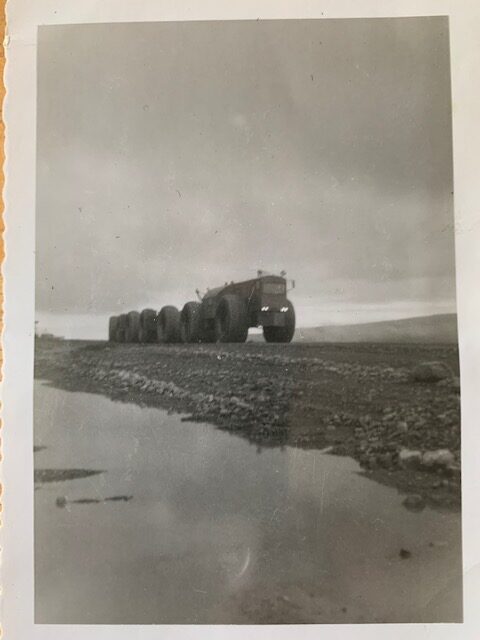
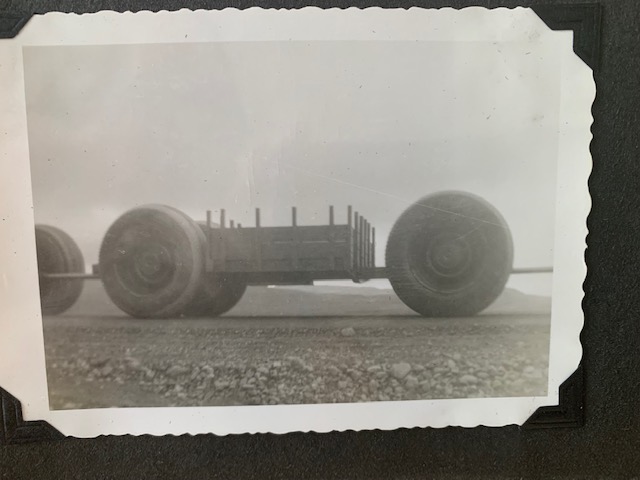
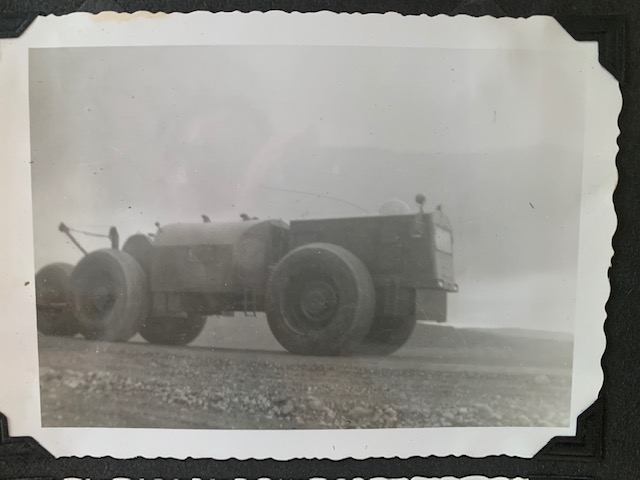
The Sno-Train arrived in Greenland in June 1956. It was being tested in extreme conditions. The Army Transportation Corps was looking at how the Sno-Train performed in the cold Arctic terrain. The Army was also testing how the huge Firestone 120x48x68 tires performed. During the Sno-Train’s time in Greenland, it was also tested with a variety of other trailers and load configurations. The image below were captured between June and December 1956. One year earlier, R. G. LeTourneau visited Greenland to see firsthand how the Sno-Buggy was performing with its dual stacked Firestone tires.
Category: LCC-1-Sno-Train
-
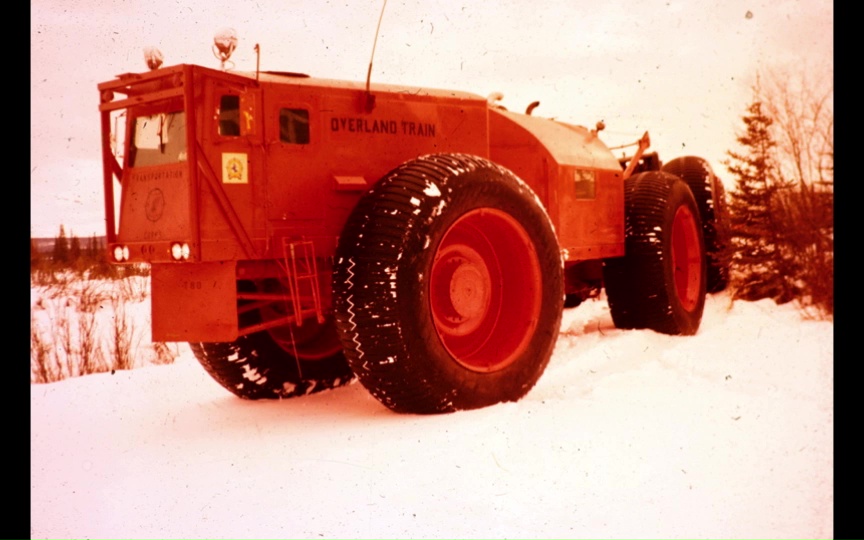
How did the Sno-Train Steer?
The Sno-Train’s power car and 3 cargo cars have square axles in front. These square axles were responsible for steering the Sno-Train and the cargo cars behind it. However, only the control car had an active role in steering. The Sno-Train used a 120 volt, 3 phase Alternating Current (A/C) electric motor, which connects to a large steering gear, turning the axle. As the control car turned, the cargo cars would follow, or track, right behind it with amazing accuracy.
The rear axles on the control car do not have the ability to steer. However, they can move up and down to ease the cabin and cargo movements over uneven terrain.
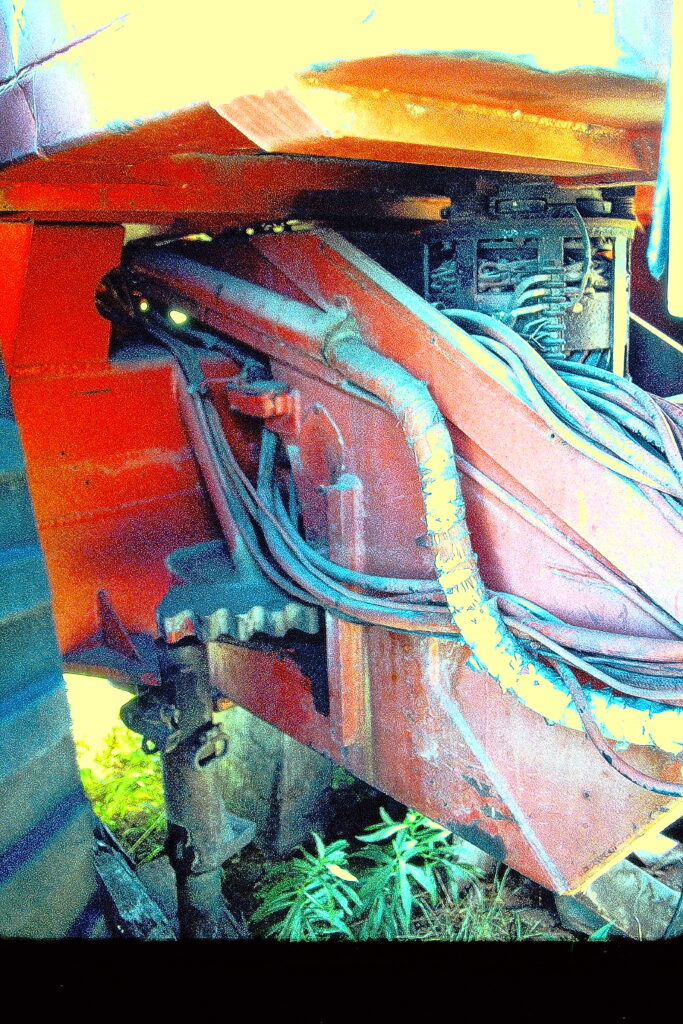
Steering gear shown middle. A/C steering motor shown top right. Image: Mike Haskins. 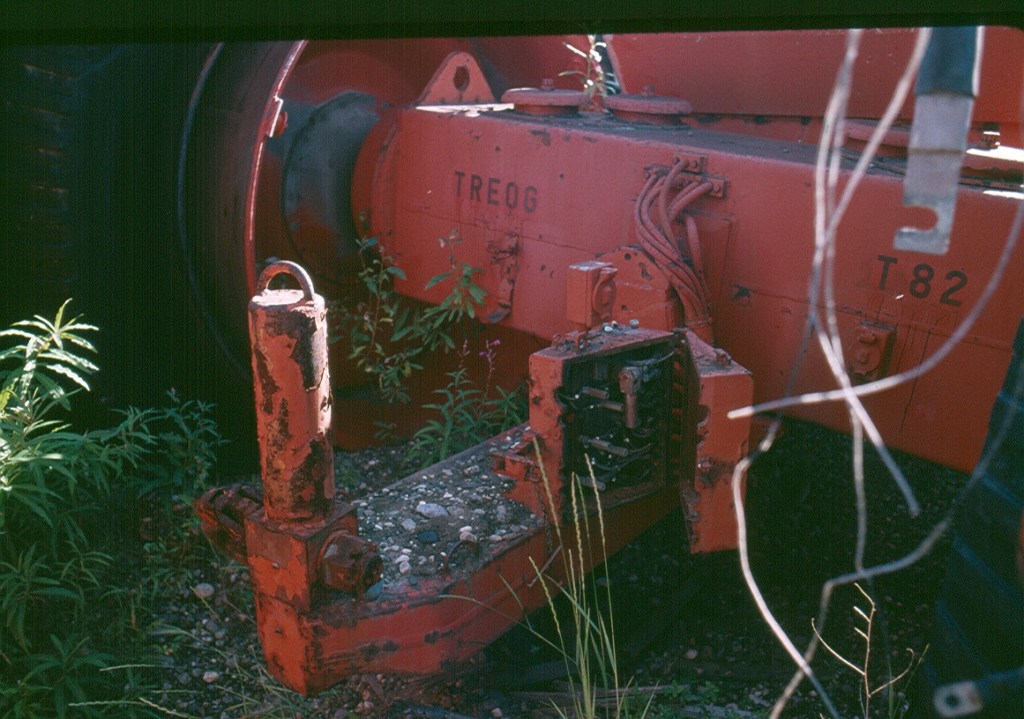
Cargo car square axle. Image: Mike Haskins. 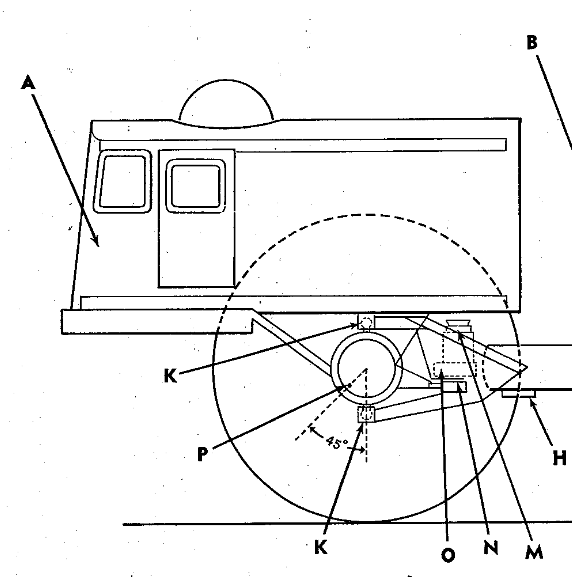
Sno-Train control car schematic. Image: O&M Manual 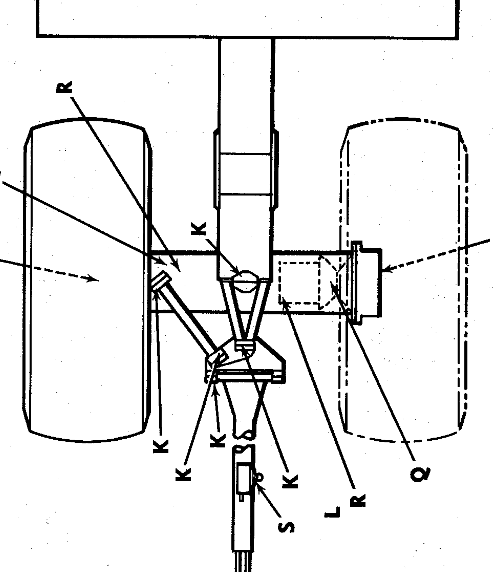
Sno-Train cargo car steering pivot denoted by a “K.” Image: O&M Manual
-
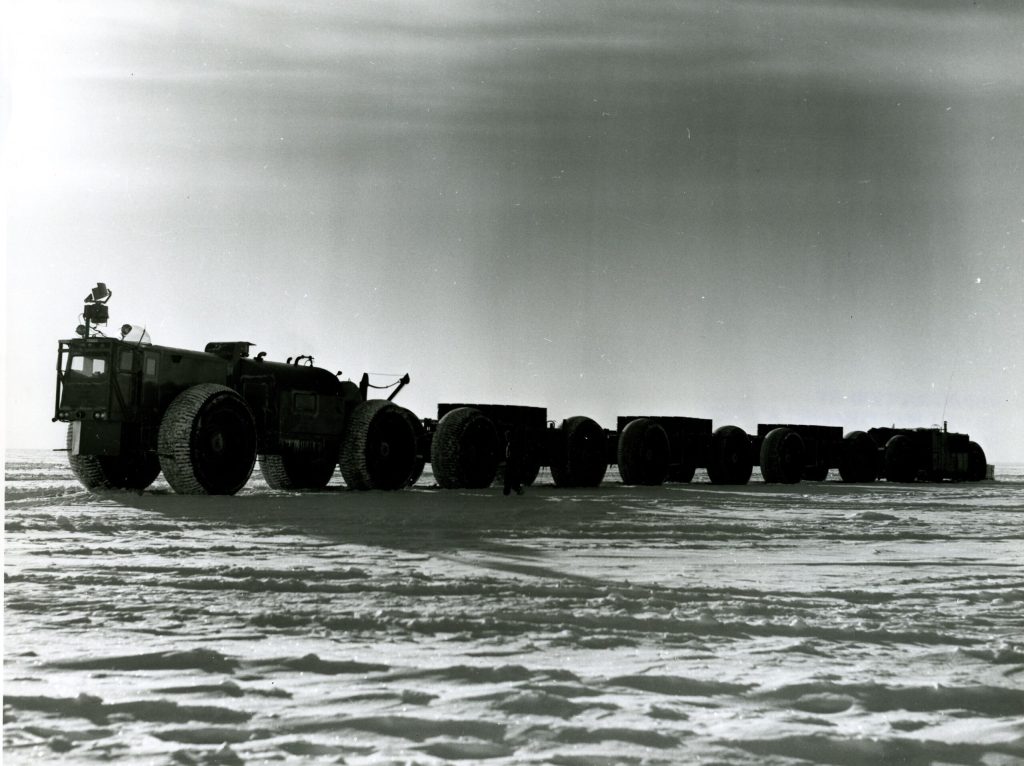
Sno-Train Sold as Surplus
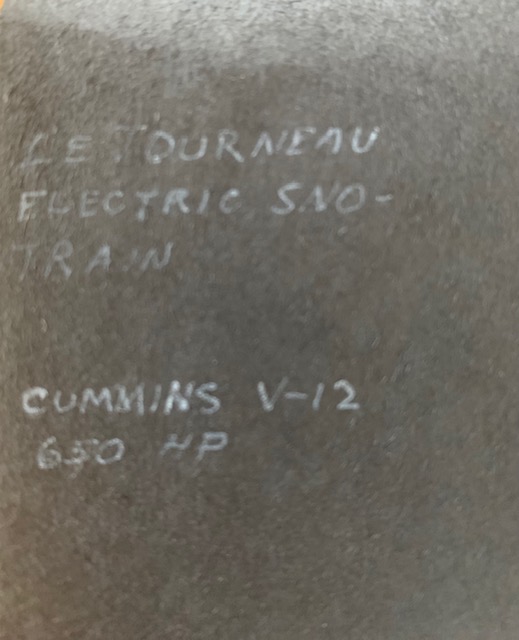
When the United States Army decided to sell the Sno-Train as surplus, it came with a parts inventory valued at $20,000, description, technical capabilities, and images. All of this were listed on the Army form “Sale of Government Property: Item Bid Page.” One of the images that came with the Sno-Train was of the Cummins VT-12 diesel engine, seen below. The Cummins produced 600 horsepower. The engine was coupled with an A/C and D/C generator to power The Electric Drive (wheel motors and drivers (mechanical gears)), interior cab lights, exterior lighting, winch, and job crane. The Sno-Train was sold as surplus from the Fort Wainwright Property Disposal Office. At the time of its sale, it was in working condition.
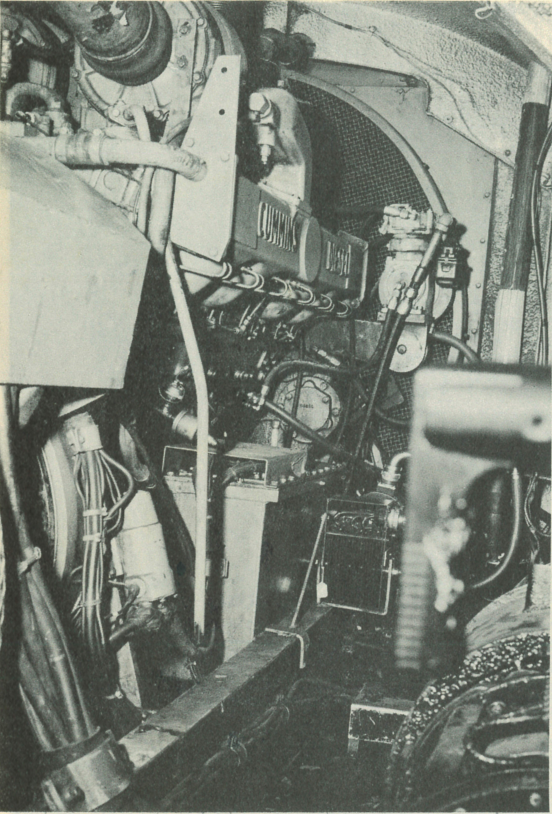
The Sno-Train engine room Image: Greater St. Louis Air & Space Museum 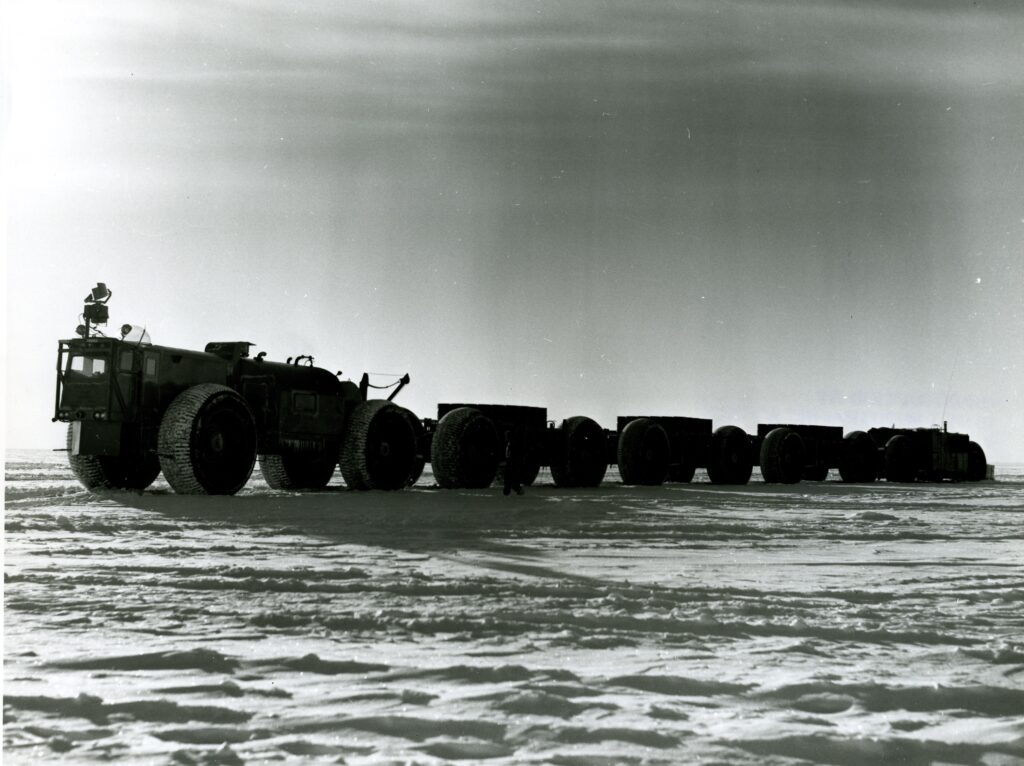
Sno-Train. Image: U.S. Army, Fair Use. -
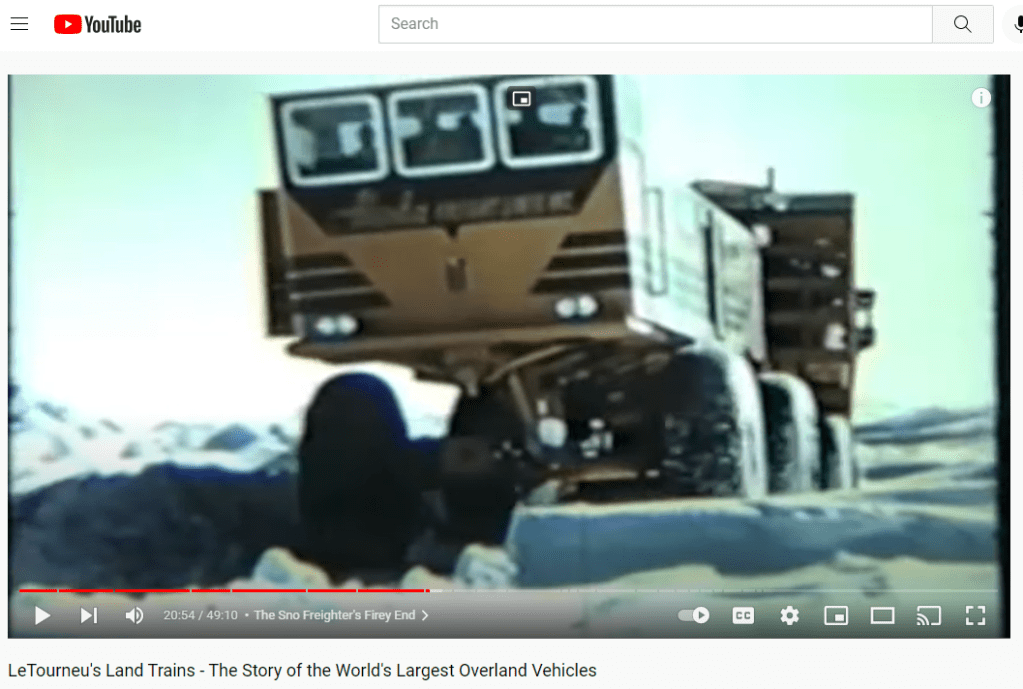
Overland Trains Video by Calum
An acquaintance of mine posted a video on the Overland Trains today. It has been a labour of love for him over the past 2 years. His research and narration are top class. I can’t recommend watching his video enough.
https://www.youtube.com/watch?v=abGyX2uwXsw -
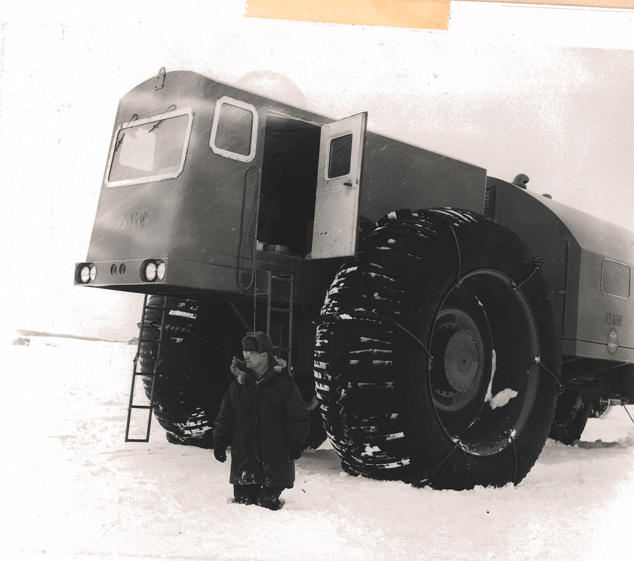
Did the Sno-Train Have Tire Chains for the Ice?
Well, kind of. The Sno-Train’s wheels came equipped with what LeTourneau called traction lugs. Breaking it down a little more simply, the traction lugs were long rubber pieces or cables that were on the tread bearing part of the tire. The rubber or cable was attached to the wheel, or rim, by other chain and cables. The connection points and traction lugs varied in design over the years. The drawing below shows traction lugs for the last Overland Train called the Overland Mark 2. The traction lugs on the later Mark 2 train had pointy, claw-like attachments for the lugs. While, the traction lugs attachments for the Sno-Train rims used circular, washer-like attachments for the traction lugs.
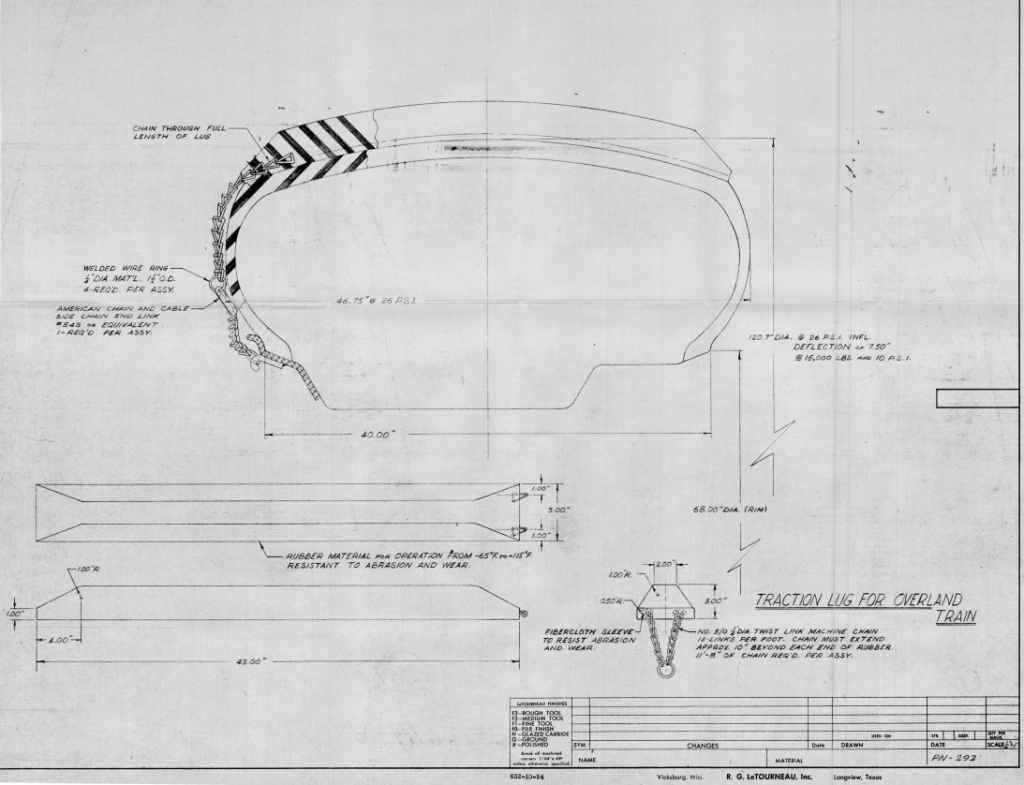
Traction lug diagram for the Overland Mark II The Sno-Train also used a more cable-like lug to wrap around the massive Firestone 120x48x68 tires. The traction lugs were not used all that often during real world missions. The Sno-Train tracked extremely well in snow and ice. Which, is not to say that it did not have its fair share of jackknifes. More on that in my book.
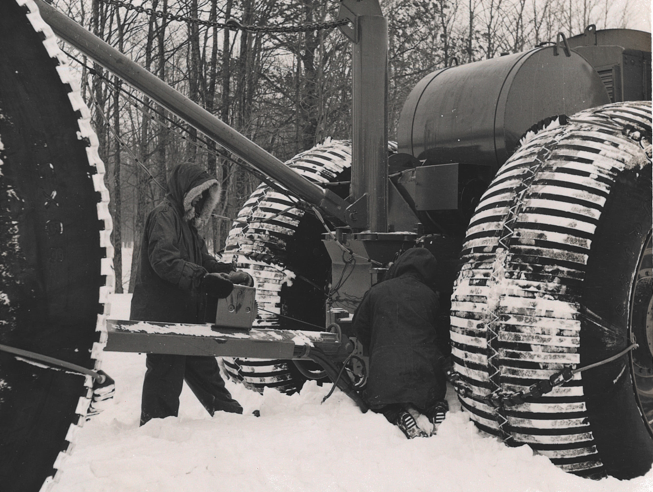
The Sno-Train’s mechanical and electrical connections are being inspected in Houghton, Michigan – dated 3-10-56 -
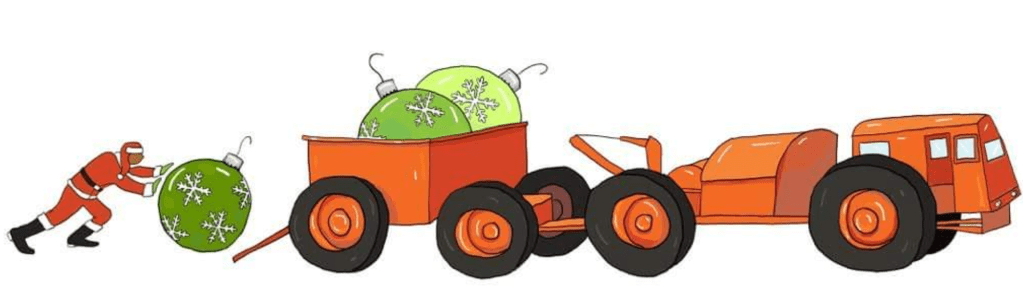
Christmas Sno-Train
Christmas Sno-Train. Image: Monika Melnychuk/i2iart.com While the Sno-Train never transported Christmas ornaments, it did move tons of cargo for supplying Distant Early Warning (DEW) Line sites in the Arctic. The Sno-Train had the most diverse and longest operational career out of all 6 trains. It was tested in Longview, TX and Michigan. After testing state side, it was sent to Greenland where it was operationally tested in the cold Arctic environment and driven over 2,000 miles.
The Sno-Train participated in numerous Army logistics exercises and engaged in a massive vehicle equipment recovery operation, where personnel and equipment were pushed to their limits. It even performed a rescue operation for an Eskimo child.
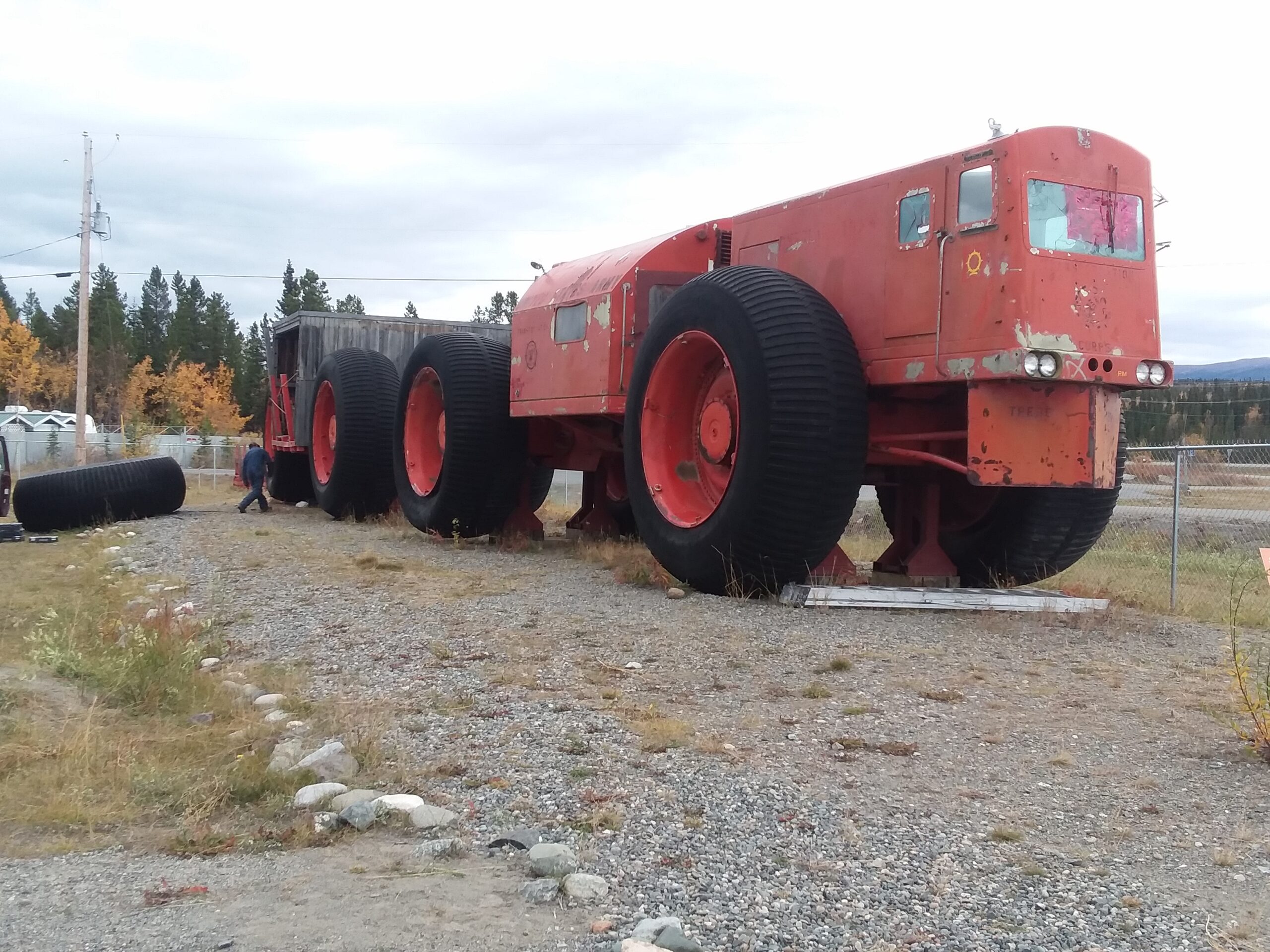
You can see the Sno-Train at the Yukon Transportation Museum in Whitehorse, YT. If you are averse to the cold, Google Maps shows it here -> https://g.page/goYTMgo?share.
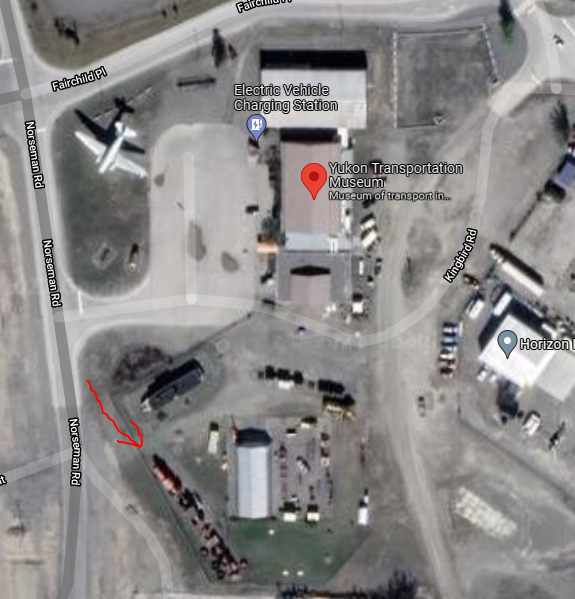
Sno-Train seen in Google Maps on the lower-left corner denoted by a red arrow. About the Artist: Monika Melnychuk is a transient illustrator who has worked out of Los Angeles, Toronto and Whitehorse. She’s currently in a committed long-term relationship with her Macintosh laptop, which has resulted in several wine labels for west coast wineries including the award winning Blasted Church series. Her work has also appeared in many other publications such as UTNE Reader, The Wall Street Journal and Key Porter Books. When not illustrating Monika enjoys running, biking, sketching in coffee shops and hanging out with her dog Boogaloo.
-
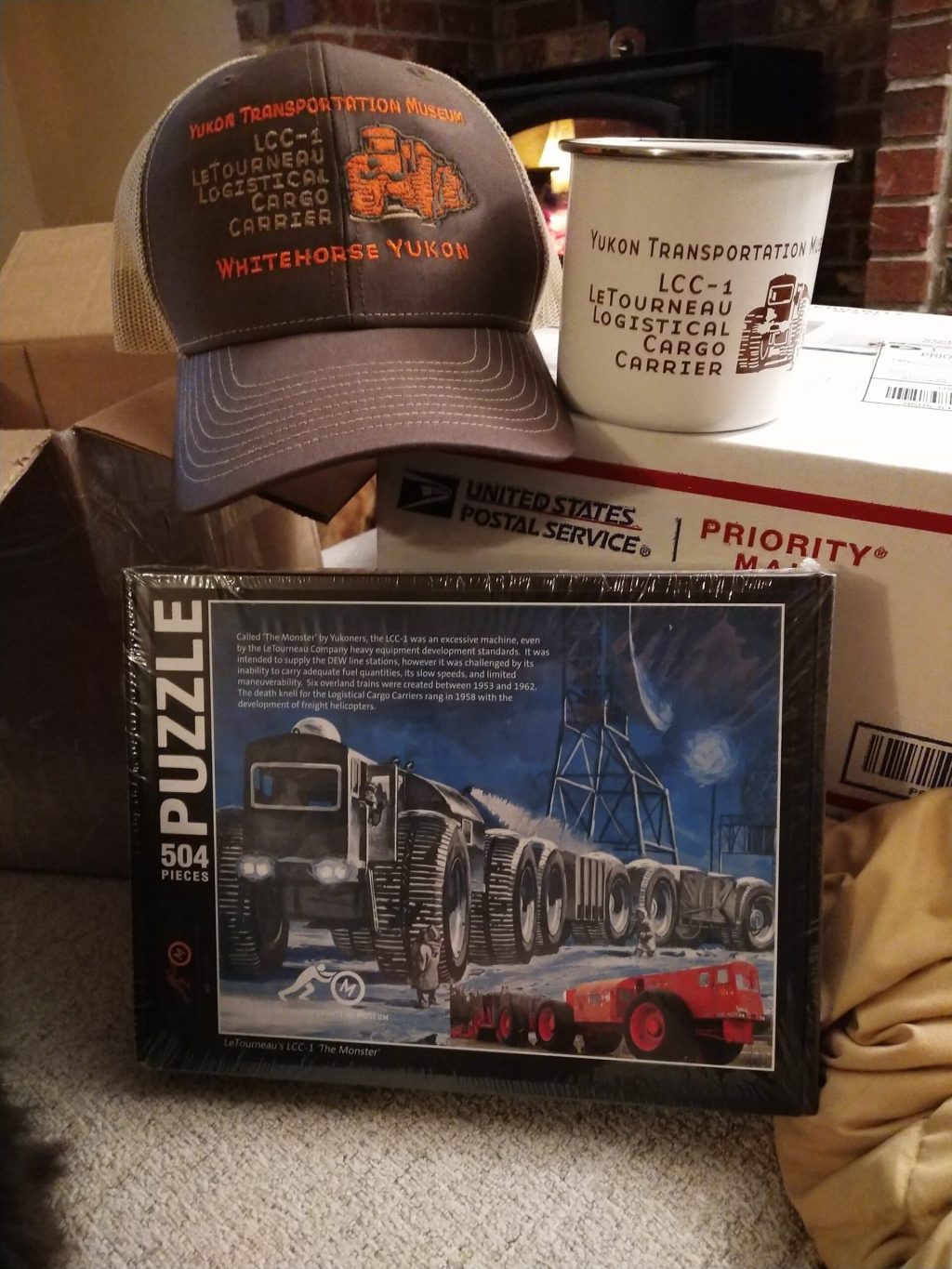
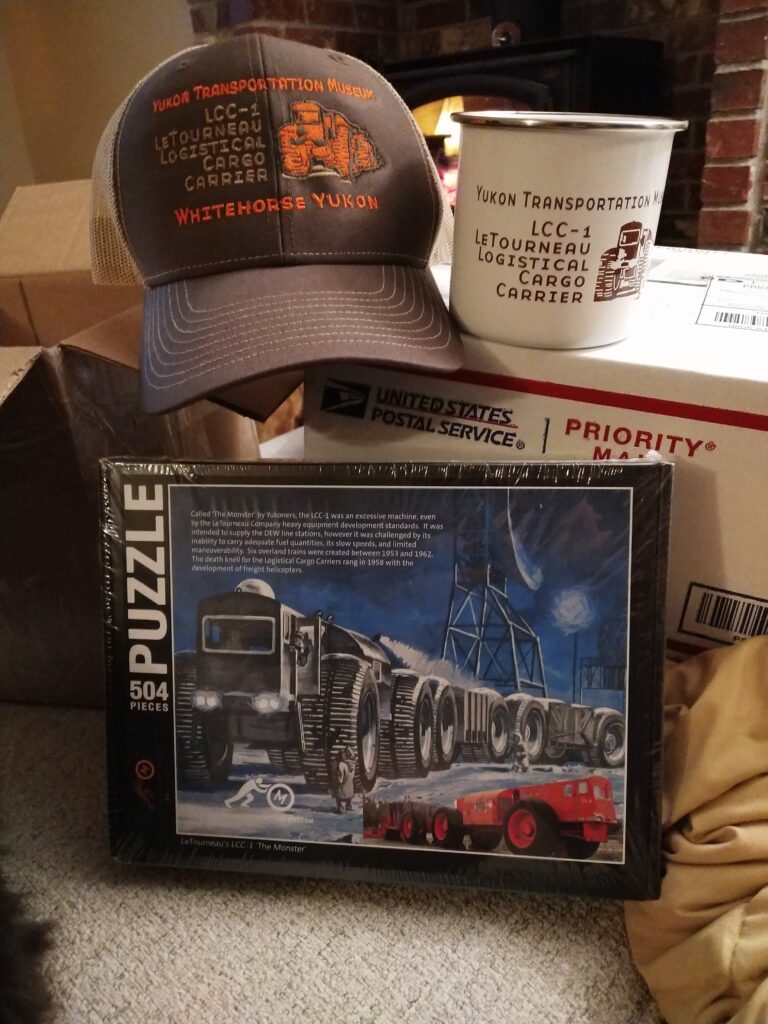
Yukon Transportation Museum Swag
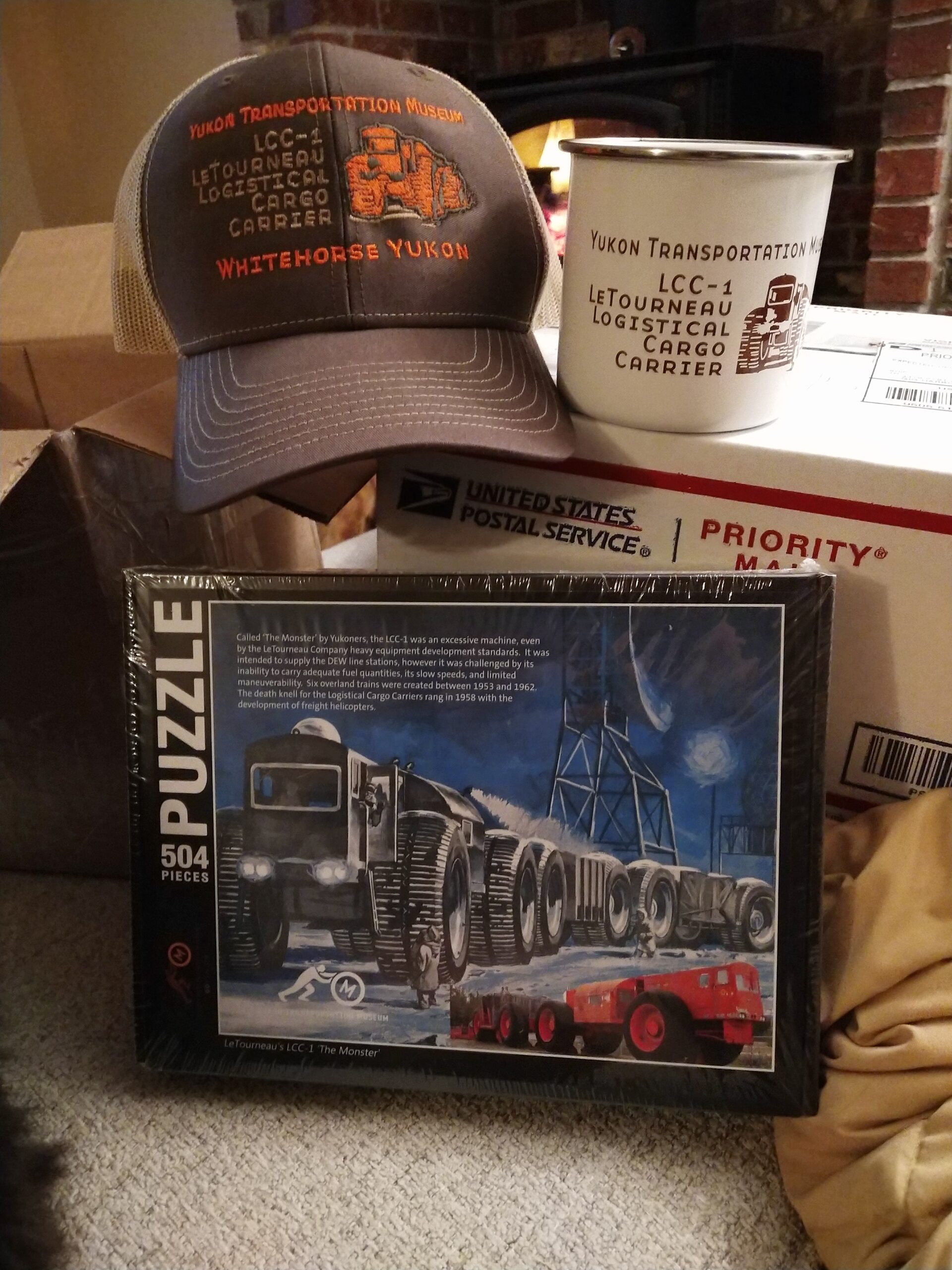
The Sno-Train has been on display at the Yukon Transportation Museum (https://goytm.ca) for over 10 years. They have a wide array of museum and Sno-Train swag for you to choose from. You can order your own Sno-Train LCC-1 swag from their online store at https://yukon-transportation-museum.shoplightspeed.com.
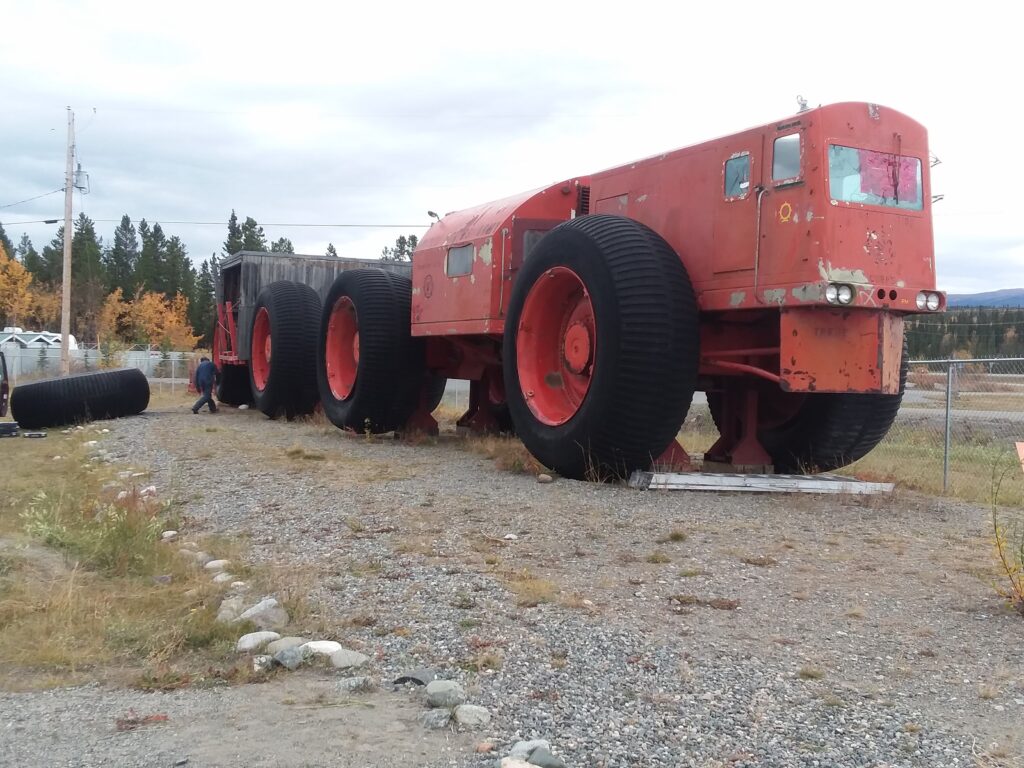
Sno-Train at the Yukon Transportation Museum. Image: Arnold Haynes.
-
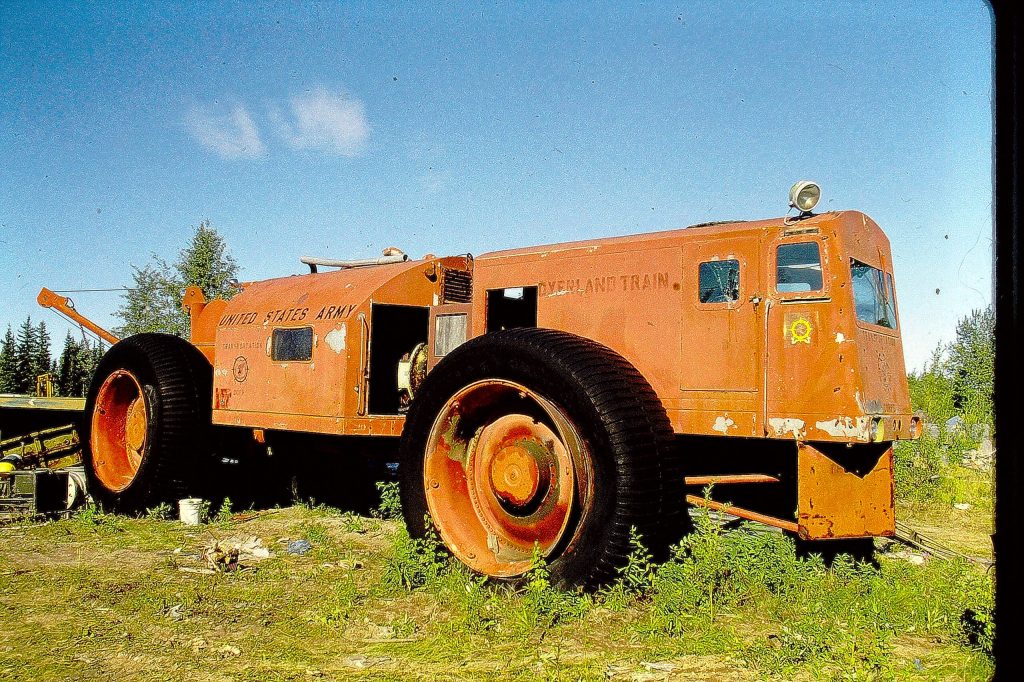
The Origin of the Sno-Train’s Snow Plow
When the Sno-Train was originally designed in 1955 and accepted by the Army in 1956, it did not have a snow-plow, the v-shaped steel component directly under the front window. Shortly after the Sno-Train was in Greenland, the Army decided that it needed a device to keep the snow from building up around the components underneath.
Sno-Train without snow plow in Houghton, Michigan. Image: R.L. Book The resulting modification was a v-shaped steel plow to push the snow buildup away from the machine. In late 1960, the snow plow was scrapped and rebuilt. The differences in construction between the original and rebuilt snow plow help historians date photographs and further enhance the timeline for the Sno-Train. Most of the ungroomed terrain the Sno-Train traveled was snow or muskeg. In 1960, the Army realized that the snow-plow caused problems in heavy brush areas. During an Army operation in 1960, the snow plow would break trees off at the 3 foot and lower height, causing excessive tire popping hazards. As you could imagine, changing a 2,322 pound tire and rim is not the easiest of operations.
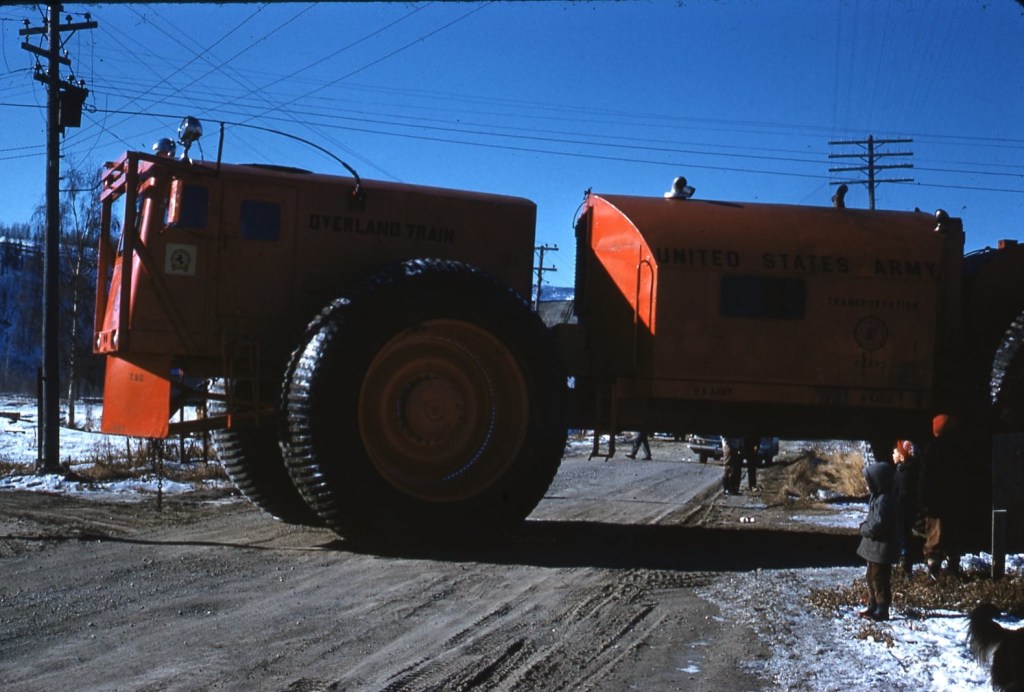
from the Roy McPhail fonds, Dawson City Museum 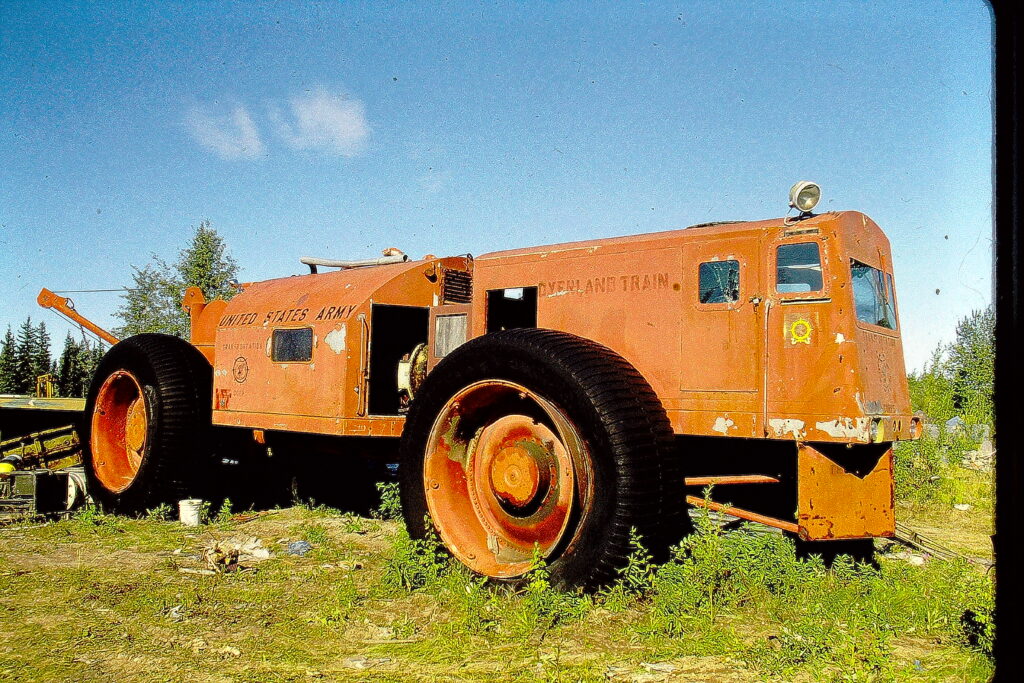
Sno-Train at Carl “Pete” Pederson’s salvage yard. Image: Mike Haskins 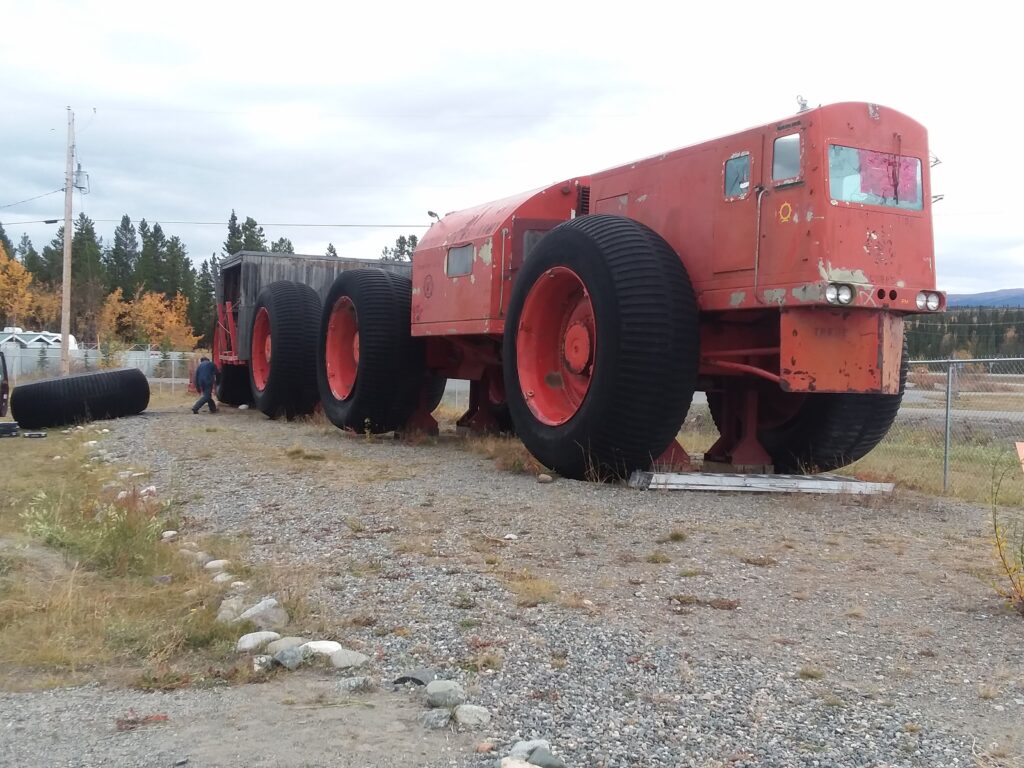
Sno-Train at the Yukon Transportation Museum. Image: Arnold Haynes. -
Are we Forgetting How to… Everything?
I have been working on the finishing the Sno-Train chapter for the last two weeks. This machine has the most complex history out of all of the 6 Overland Trains. In one of the more detailed sections of my book, I am writing about a vehicle recovery journey where the Sno-Train was used as the primary vehicle. This journey took months of travel time, ingenuity, and drive to complete the mission.
During the months long recovery mission, men were exposed to continuous Arctic cold, rain, mucky conditions, and then more cold. They did not have running water or YouTube videos to help them figure out how-to. They had the knowledge, skills, and ability to fail fast and often, then keep on going to accomplish the mission.
My day job has nothing to do with writing or history. When I find my self in a conversation about history at work, it tends to spark my interest a little more. I was talking to a guy on video chat yesterday about publishing options and why I chose Amazon. He was explaining that Amazon would not publish his friend’s book because it was too gory and too long of a book. The book was titled simply and was about the lifecycle of a pig – it was something like “Pig to Table.” The book describes and shows how to go from a living animal to a meal on your plate in graphic detail. How many people living know the right way to raise, kill, butcher, and prepare a pig full cycle? I don’t. The book successfully raised money on Kickstarter and was published.
The conversation with this man led to his own interests in iron works and our inability to figure things out. How many people know how, or have the ability work with iron? How many of us could can effectively farm to feed ourselves or our family? I have interviewed over a dozen people for my book, with the majority between the ages of 75-98. Their stories demonstrate extreme adaptation abilities, humility, and character. How many of us would be willing to get paid Army wages to go out into the mud for months on end without our home comforts, finish the job, and not complain a single day?
We have forgotten how to endure. We have forgotten how to adapt creatively in less than ideal physical conditions. More importantly, we have forgotten how to be good humans. As David Goggins would say, “Go out and do something that sucks everyday.” Let’s see what happens.
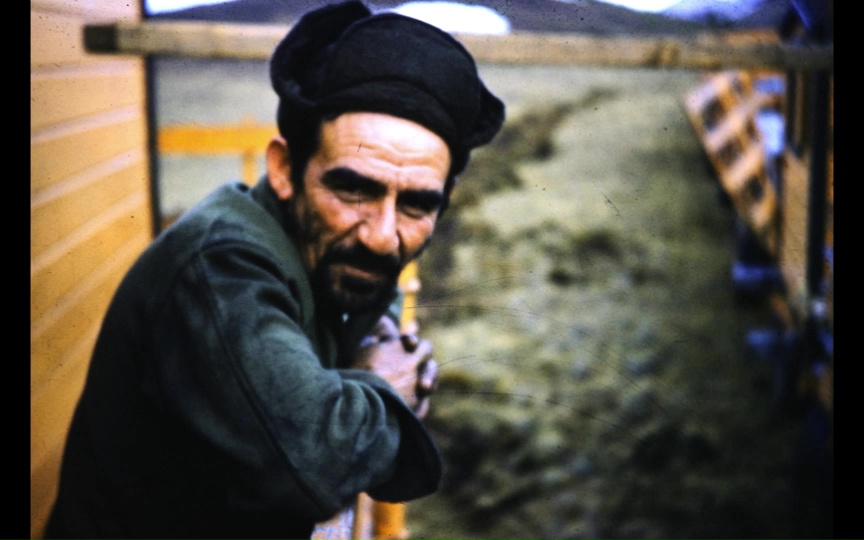
SP5 Alfonso Colon-Rivera 1961. Image: Marty Martinez. -
Sno-Train Passing Over the Gulkana River Bridge
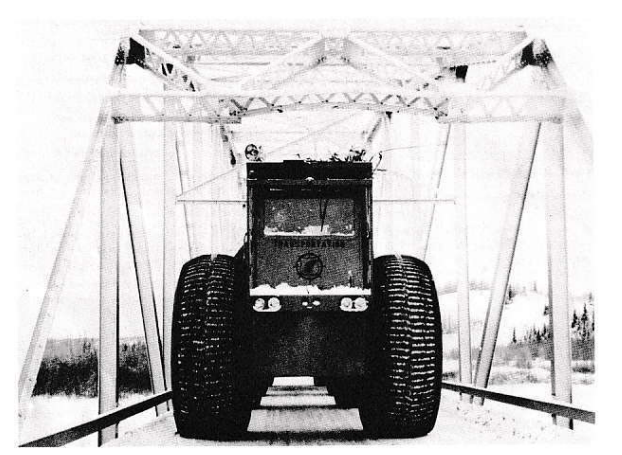
In 1961, the Sno-Train was involved in Environmental Operation Willow Freeze. At the conclusion of the exercise, it departed Gulkana, Alaska for a contract mission east of Dawson. The Sno-Train image below was captured March 31, 1961. The Sno-Train left Galkana at Mile 117 on the Richardson Highway and cross the bridge at Mile 126.5.
Sno-Train crossing the Gulkana River Bridge, Alaska. Image: U.S. Army 1962 Public Domain
 Overland Trains