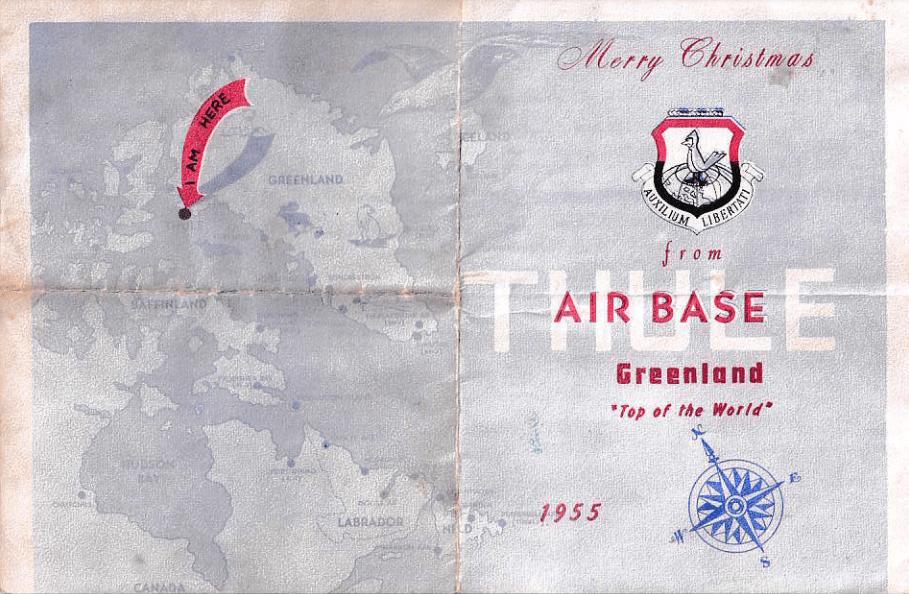
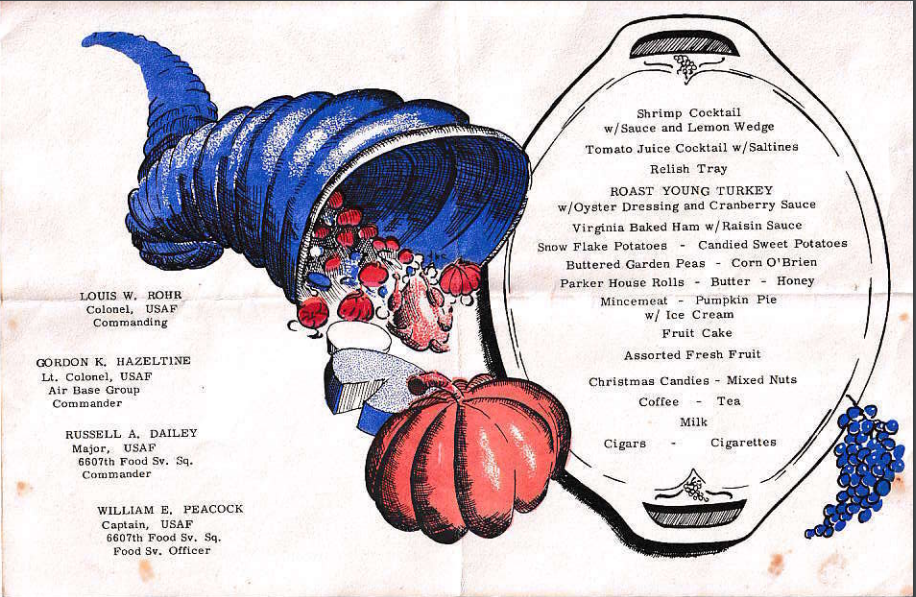
In 1955, Christmas dinner looked and felt a little different for Air Force Service Members at the “Top of the World.” The menu included Shrimp Cocktail, a relish tray, roast young turkey, Virginia baked ham, Christmas candies, coffee, tea, and milk. Something that you won’t typically see on a Christmas menu are cigars and cigarettes. Thank you to Jackie for sharing your father’s small piece of history with me. Jackie’s father spent 27 years in the United States Air Force. He was stationed in Thule Air Base during Christmas, 1955.
Thule Air Base, Greenland Christmas Dinner 1955Thule Air Base, Greenland, Christmas menu
An acquaintance of mine posted a video on the Overland Trains today. It has been a labour of love for him over the past 2 years. His research and narration are top class. I can’t recommend watching his video enough.
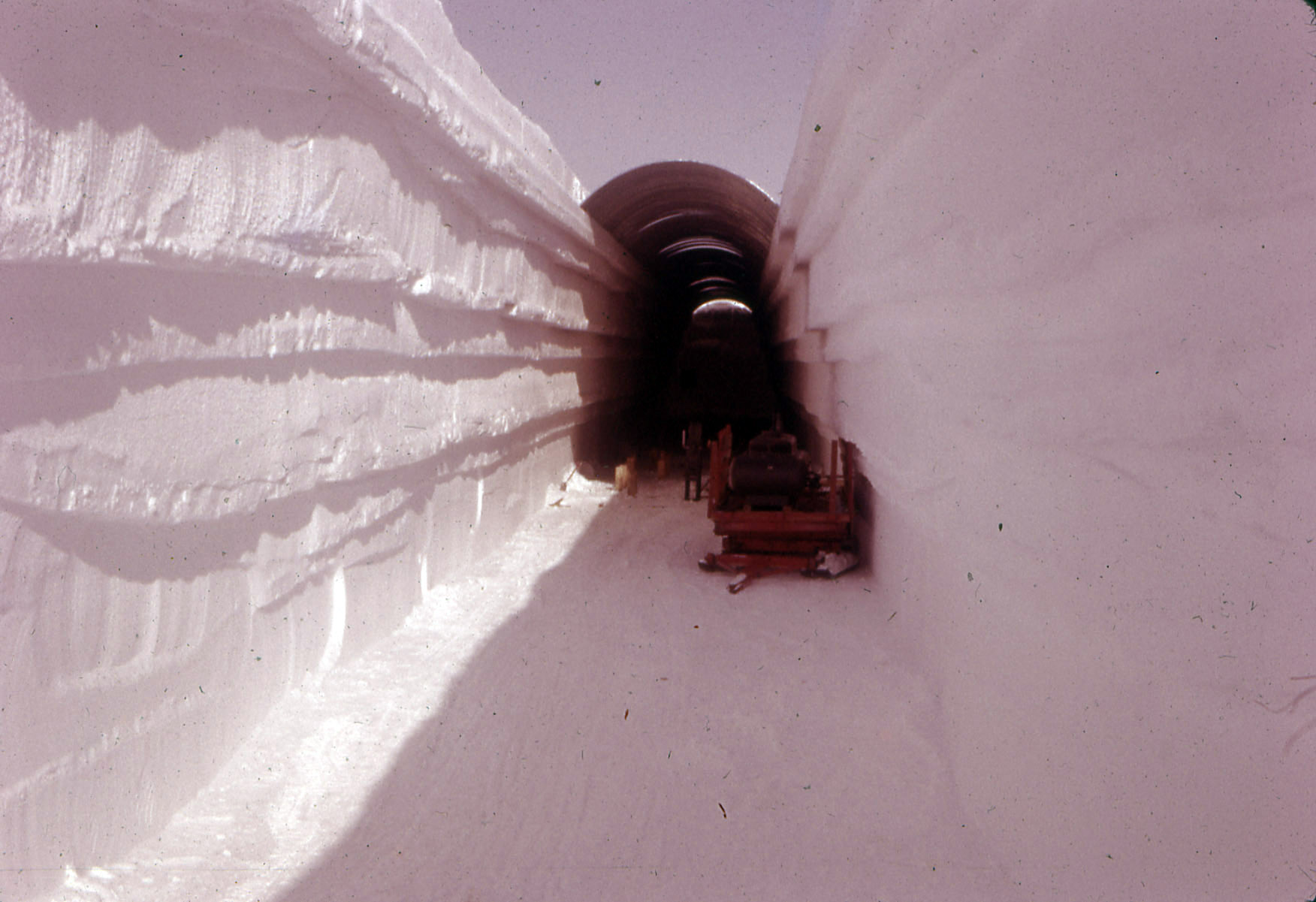
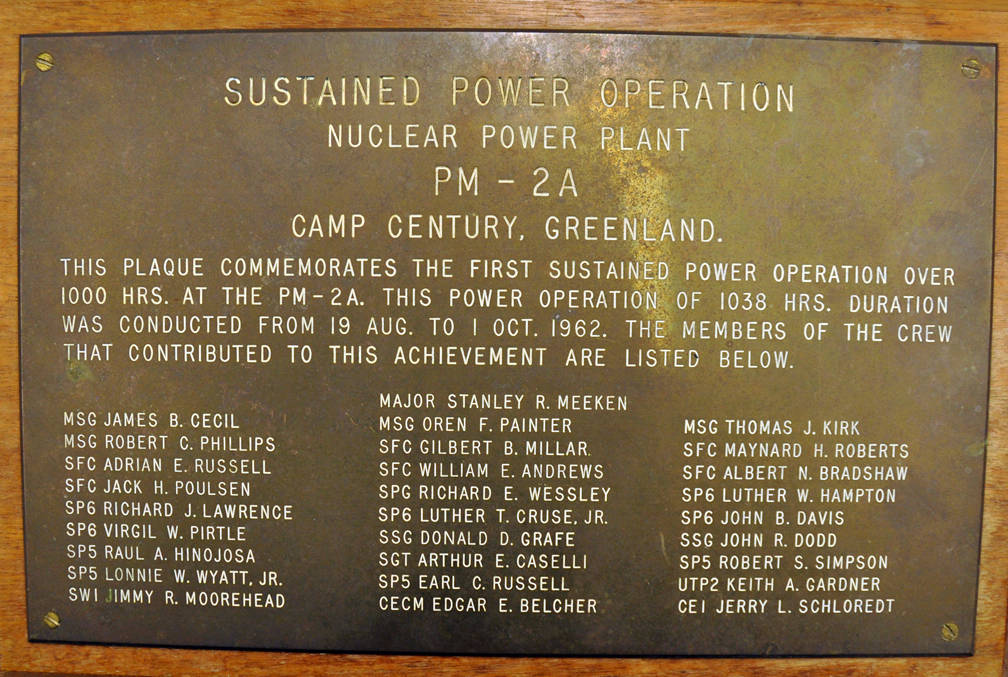
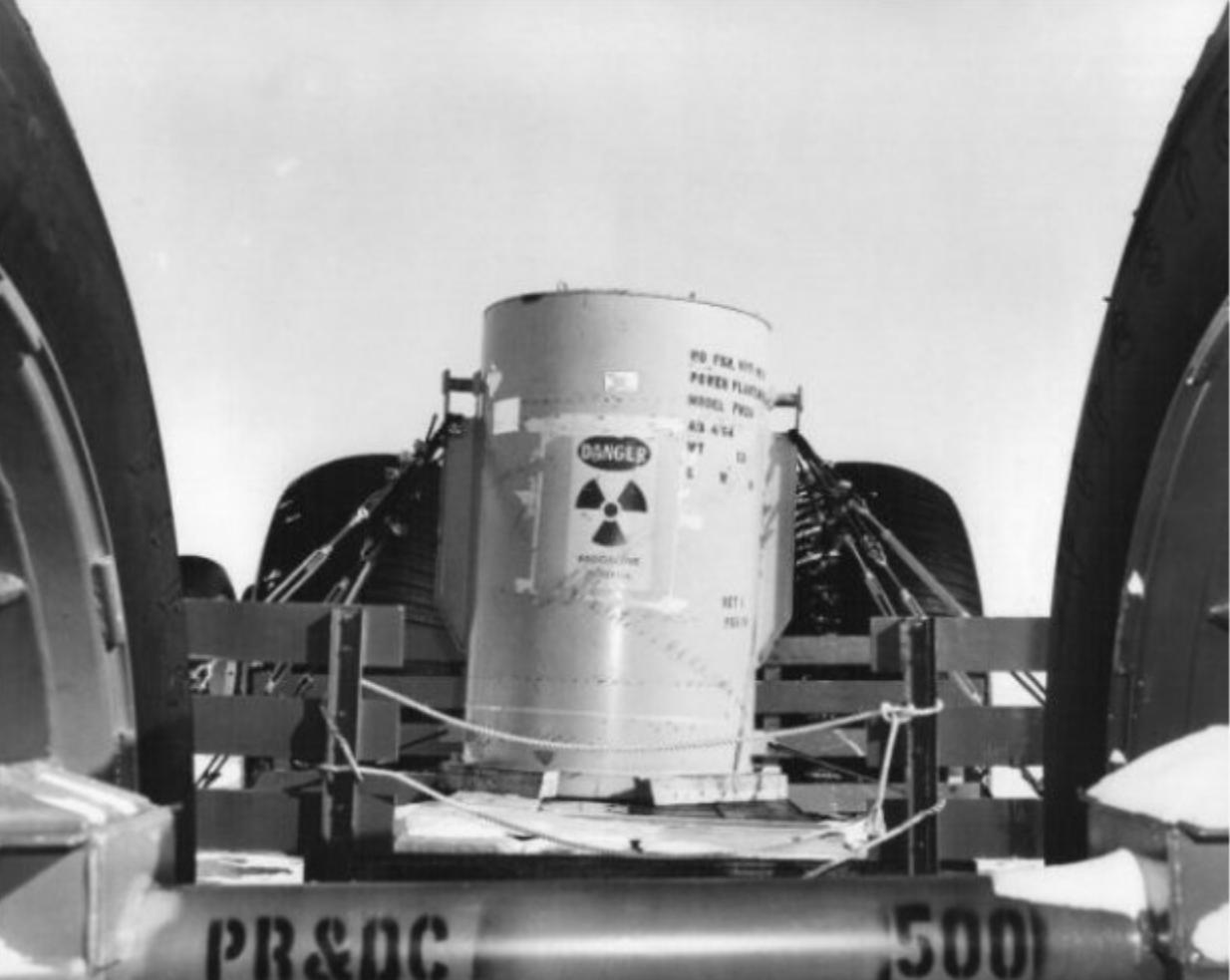
Camp Century was a United States military installation buried under the northwestern tip of the Greenland ice sheet. It was active from 1959 and quickly dismantled in 1967. In 1960, Camp Century received it’s electrical and heat energy from a Portable Medium-sized nuclear reactor, starting operations on October 3, 1960. It ceased operations the next year when Camp Century shifted operations to summer only. Camp Century was used for a wide array of experiments, from using the ice for fuel storage to determining if it was feasible to have a city under the ice. When Camp Century was abandoned, the Army left behind equipment, petroleum, oil and lubricants (POL), and other materials.
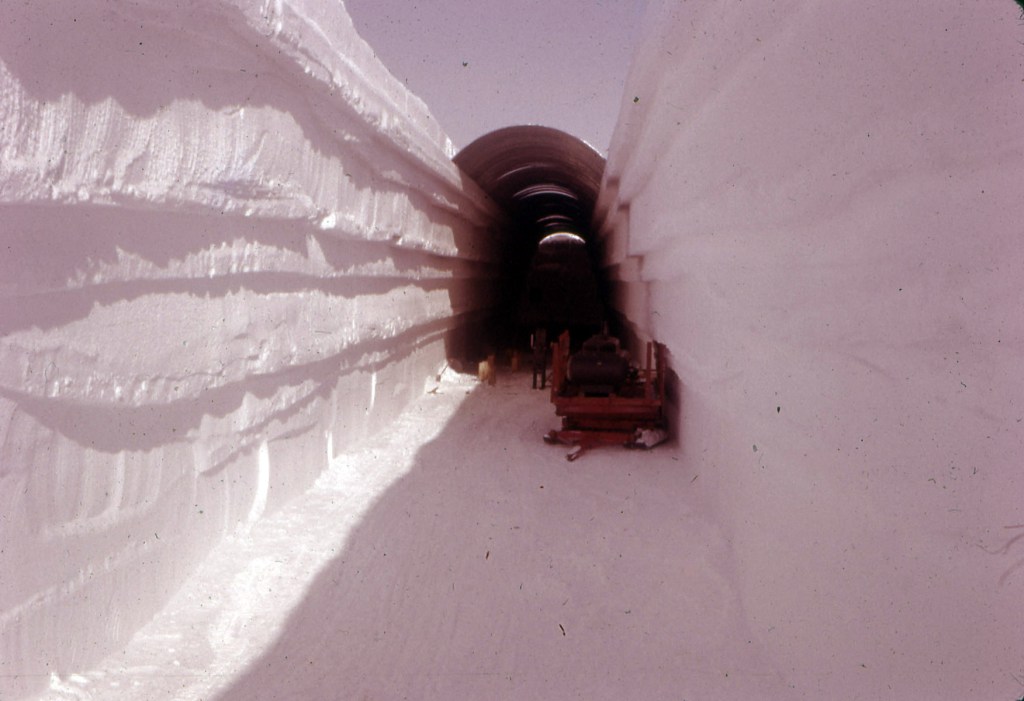
Building a tunnel under the ice at Camp Century. Image: Arnold Haynes.
Camp Century Pm-2A plaque. Image: Office of History, HQ, U.S. Army Corps of Engineers
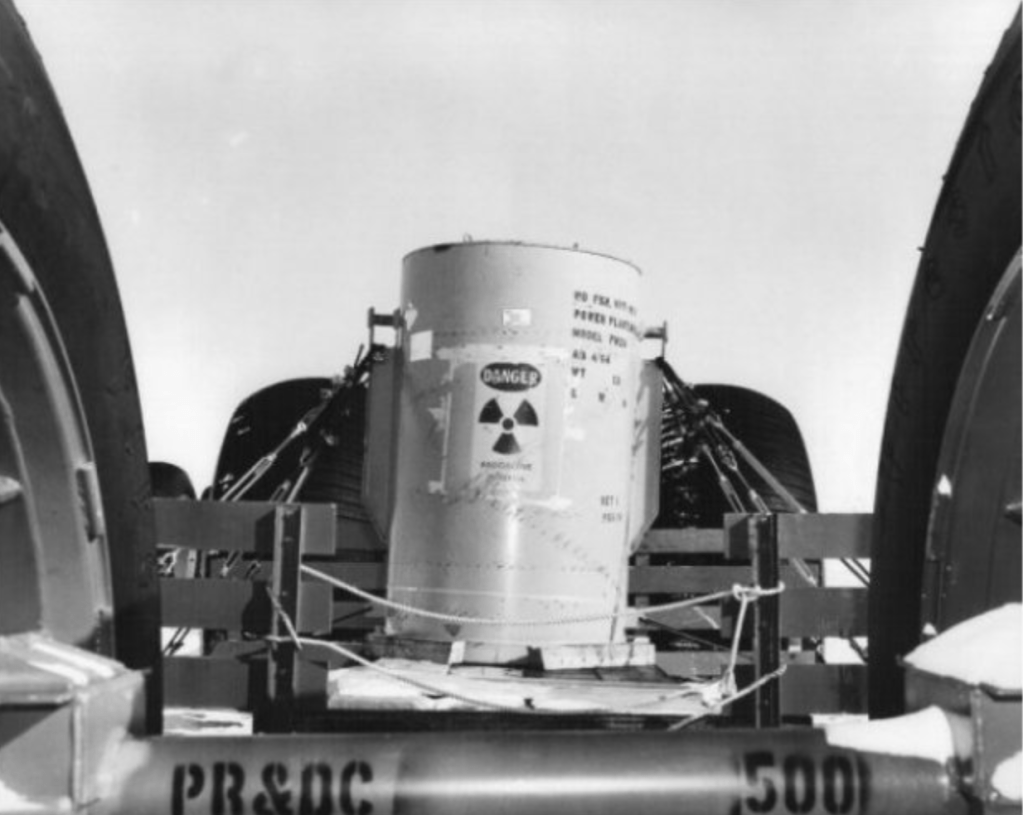
A 14-ton cask of nuclear material from Camp Century, May 1964. Image: Steffan Winther – The ThuleForum
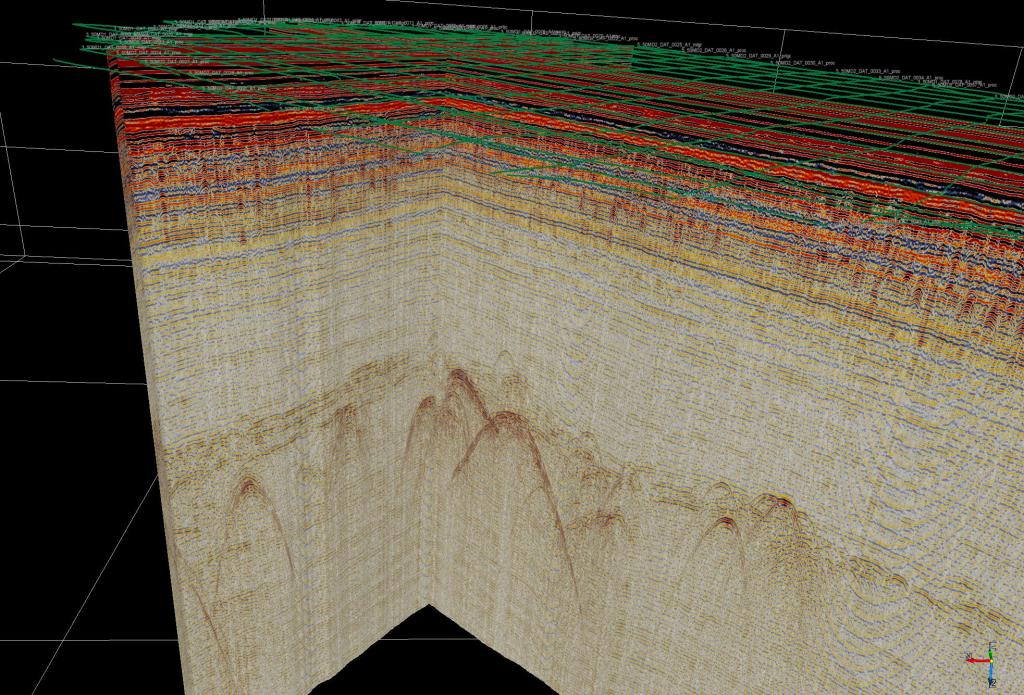
In the summer of 2017, scientists at the Geology Survey of Denmark and Greenland (GEUS), lead by Project Manager William Colgen, headed up a project to understand the climate and snow cover at Camp Century (http://campcenturyclimate.dk/ccc). The nuclear material, POL, and other leftovers from Camp Century has scientists wanting to understand more of how glacial and water flows under the ice might transport these toxic materials. The report conclusion was the snow will continue to accumulate on top of Camp Century and meltwater will not reach the toxic debris field – by the year 2100, it will be buried under 190 feet to 209 feet of ice and snow. Read more about the project and data at http://campcenturyclimate.dk/ccc.
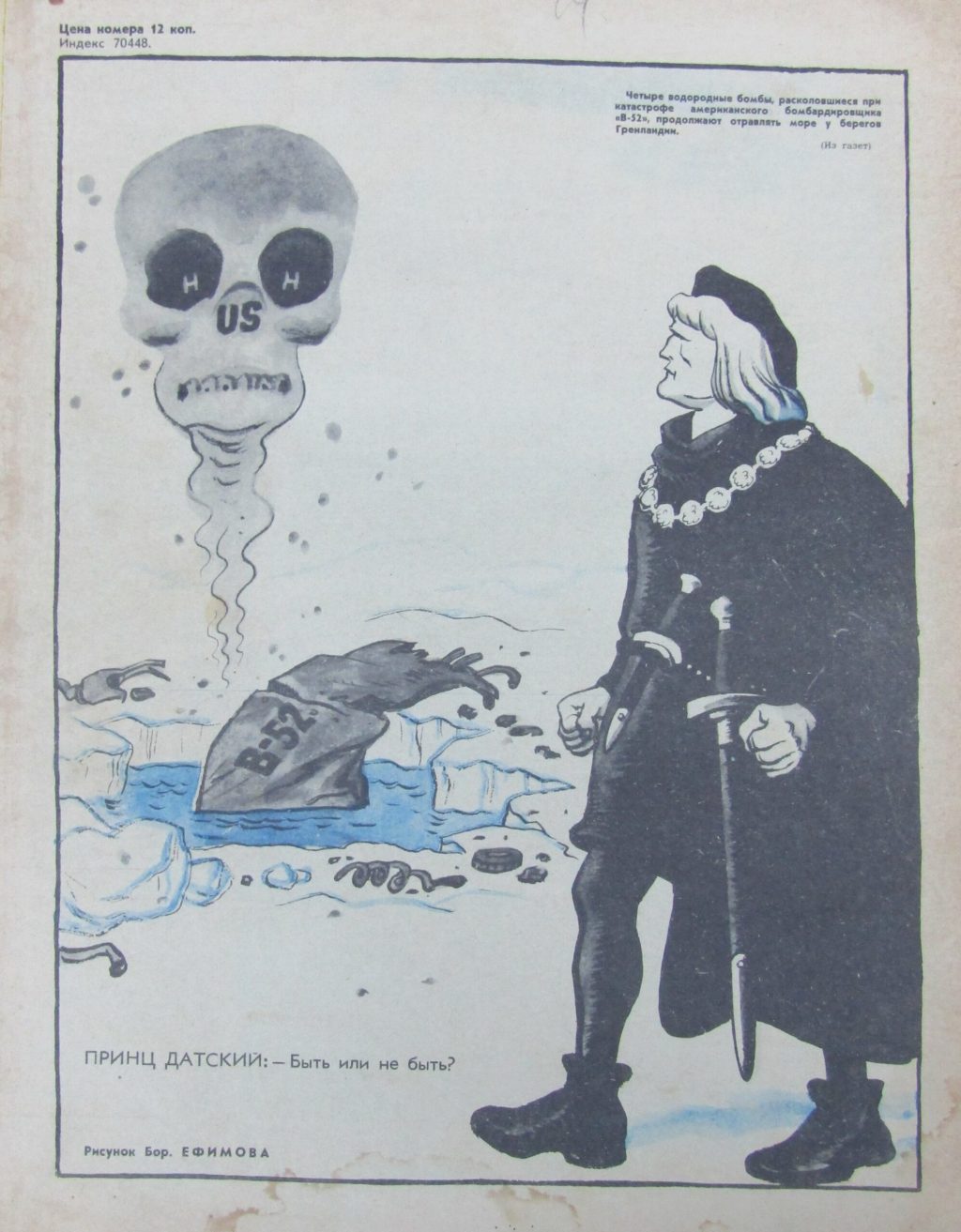
The Russian humor/satirical magazine “Crocodile” began publishing in 1922. During the United States Greenland build-up, the Soviets were watching us closely. Their Moscow Millie radio propaganda broadcasts knew intimate details about the service members that were at the base. For example, the broadcast would call out service members by name and state the hut number where they bunked. Investigators into information leakage at Thule Air Base never revealed their findings. It was assumed that the more than 8,000 individual contractors that helped build the base were leaking information to the Soviets.
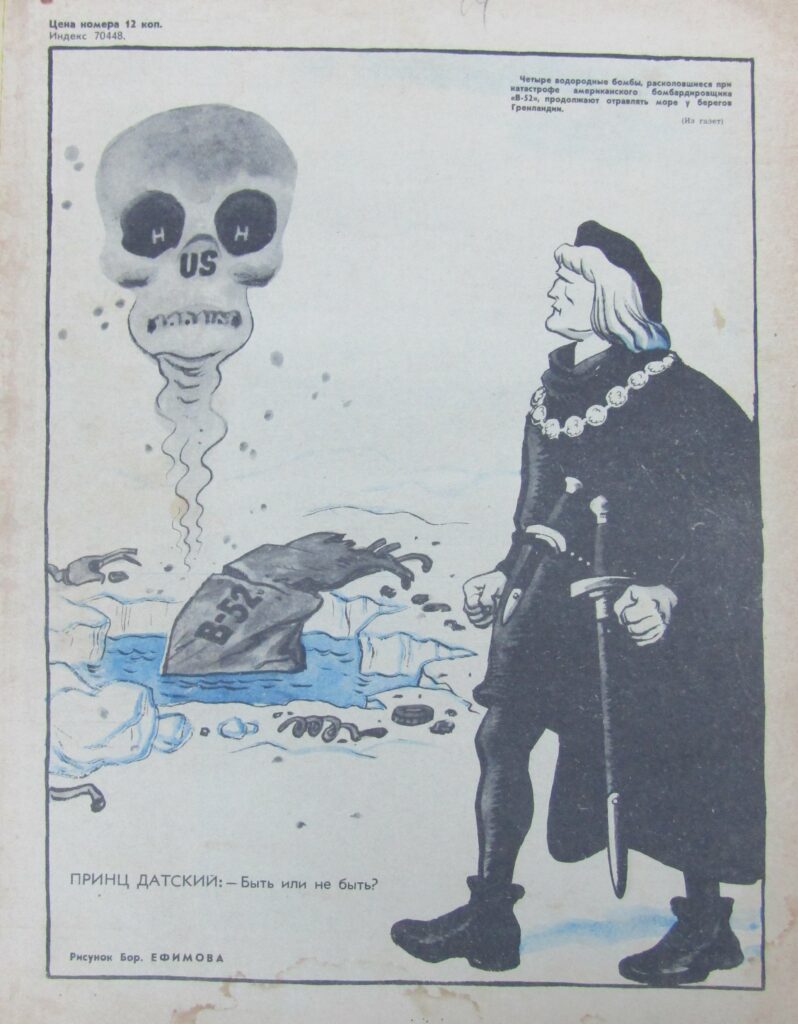
In the magazine below, the Soviet magazine “Crocodile” depicts the January 21, 1968 crash of an American nuclear B-52 bomber. The crash was caused by a a crew member placing seat cushions in a heater vent, which later caused a fire onboard. The smoke became so thick that the pilot lost visibility and it crashed. Unknown to the Dutch, the United States had been conducting flyovers with nuclear bombs. The B-52 bomber crashed on the northwest corner of Greenland – Wolstenholme Fjord. 6 of the 7 crew escaped by parachute before impact and the subsequent fire. The fire broke up the hydrogen bomb’s fissionable nuclear material and leaked radiation into the fjord, contaminating the surrounding waters. Russian translation are in the captions. Thank you for the translation Irina. “Crocodile” ceased publication in 2008.
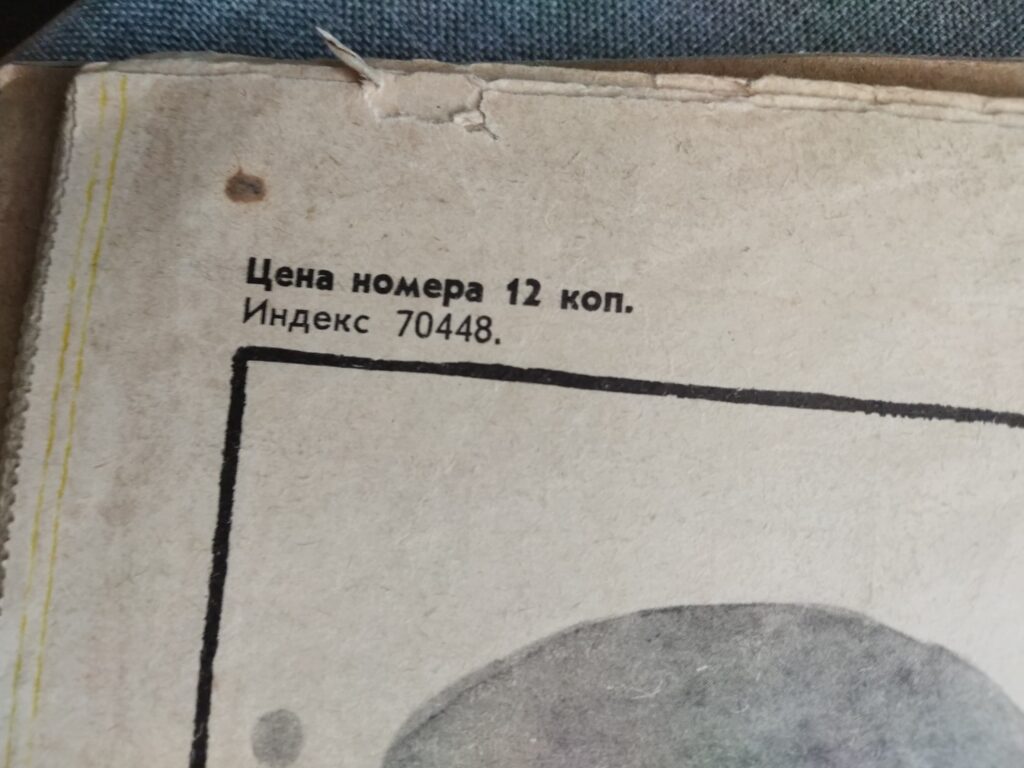
The price of the issue is 12 cents – kopeek are similar to American cents. Index 70448
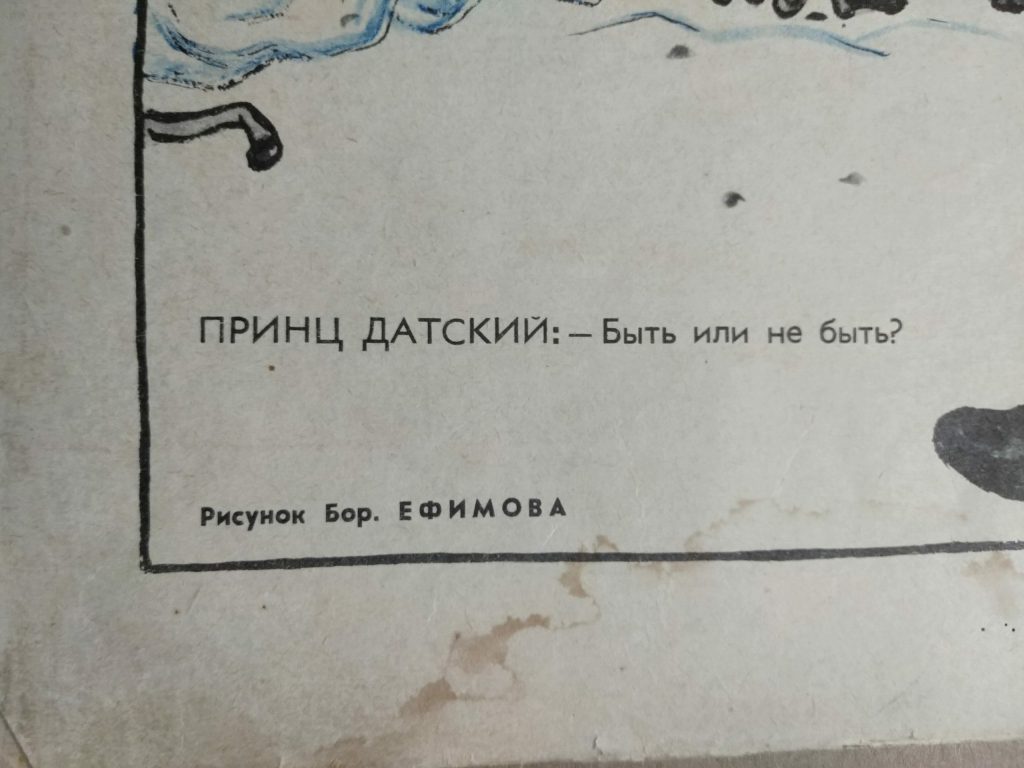
Dutch Prince: “To be or not to be” Drawing by Bor. Efimov
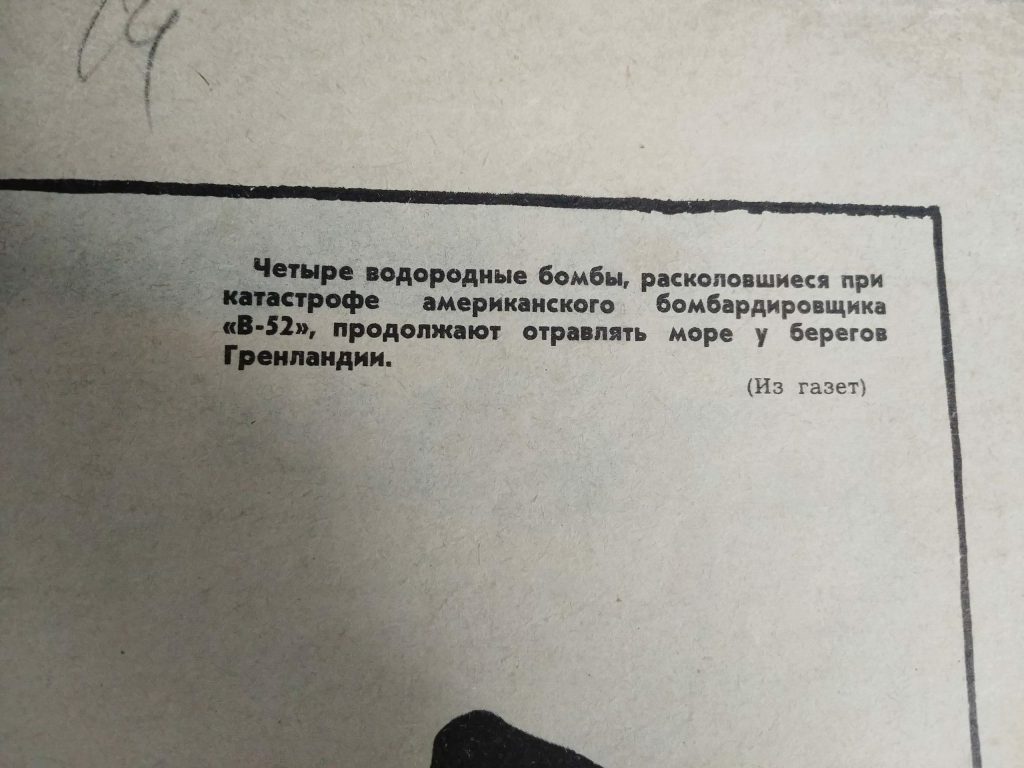
Four hydrogen bombs, that were broken and opened up upon the crash of American “B-52” bomber, continue to poison the see at the coast of Greenland.
Close-up of the three text areas on the magazine back page
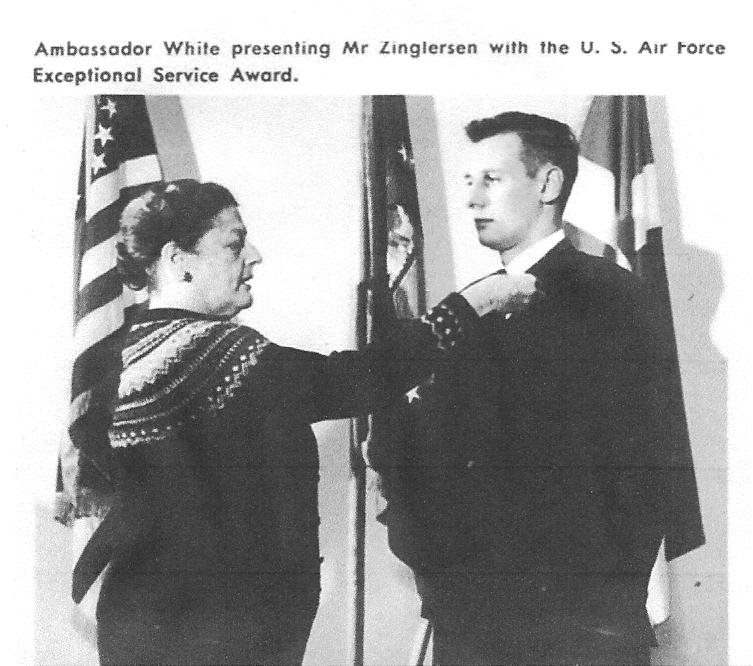
Jens Zinglersen and Jim Calhoun are the only two living members of the United States Air Force EOD SAC team that had the responsibility to find and recover, whatever that was left of the 4 hydrogen bombs. The B-52 crashed with 4-MK28 hydrogen bombs 11 kilometers west of Thule Air Base. The rescue and recovery took 9 months. Jim Calhoun retired as a Chief Master Sergeant after 20 years of service.
Jens Zinglersen receiving the Exceptional Service Award by Ambassador White.
The Prince depicted above is the Soviets depiction of “HAMLET.”
The last two years researching and writing the Overland Trains story has been a journey, both academically and personally. I have added a handful of people as friends and many more as acquaintances. I have been taught humility, the art of listening, and patience along this journey. As we experience Veteran’s Day together, I remember so many of the American Service Members that I spoke with along the way. They served as young men in their twenties, forging a new path for America during the Cold War and beyond. One of the men I met during my journey was Marty Martinez.
Marty served in the Korean War, the Army in Alaska, and Vietnam. His life sacrifice, and others who contributed to our freedom, makes me think about my own Army service and how different they must have been. During this day, and hopefully everyday, Service Members and Americans around the globe celebrate the dedication, sacrifice, and commitment to the United States Armed Forces.
Regardless of your political ideologies, America deserves your allegiance. We were built upon unifying principles of liberty, freedom of thought, and justice. Men and women and fought and died for our rights. This Veteran’s Day, please recognize the sacrifice our fellow American’s have made, reflect on your contribution, and understand that you have rights because of the sacrifice that Veteran’s have made.
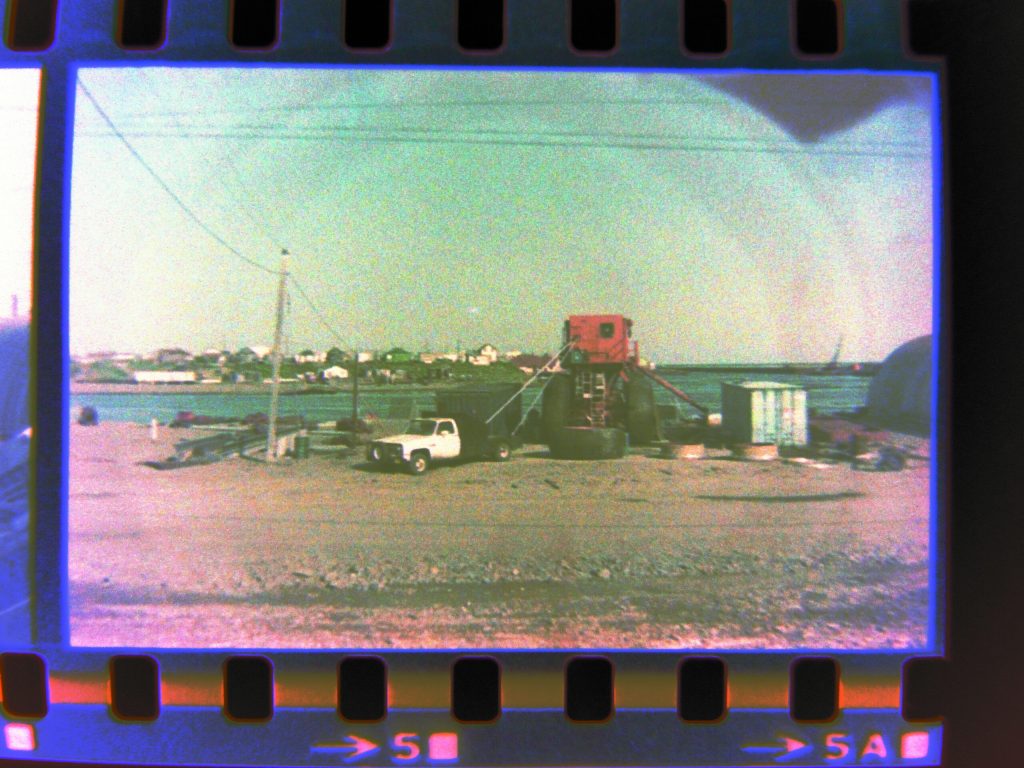
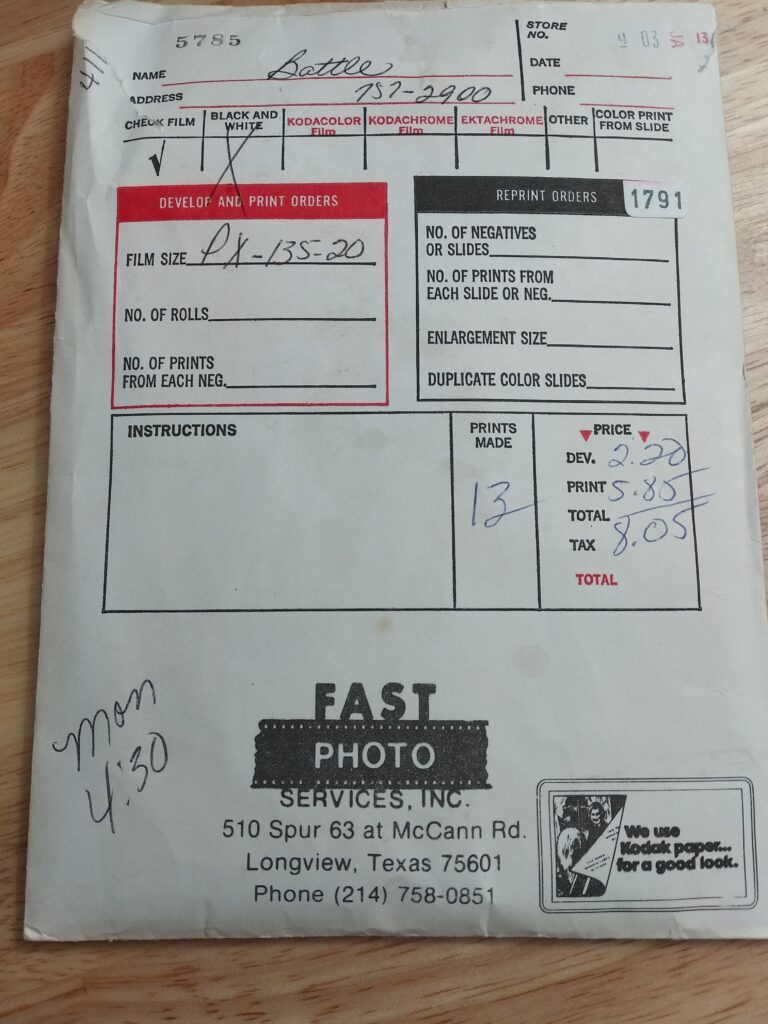
As part of researching “The Overland Trains Project,” I have been able to take use some of my technical background to good use. These slides show one of the Overland Trains trailers. On Thursday, I received an envelope of old film negatives. These needed to be digitized and analyzed for content. How in the heck do I do that?
Film negatives pouch
When I was a kid, I used to buy 35mm film, take random pictures, and take them to PayLess for developing. I would get back pictures and these negatives. I did not realized until now, how important these negatives are as a part of history.
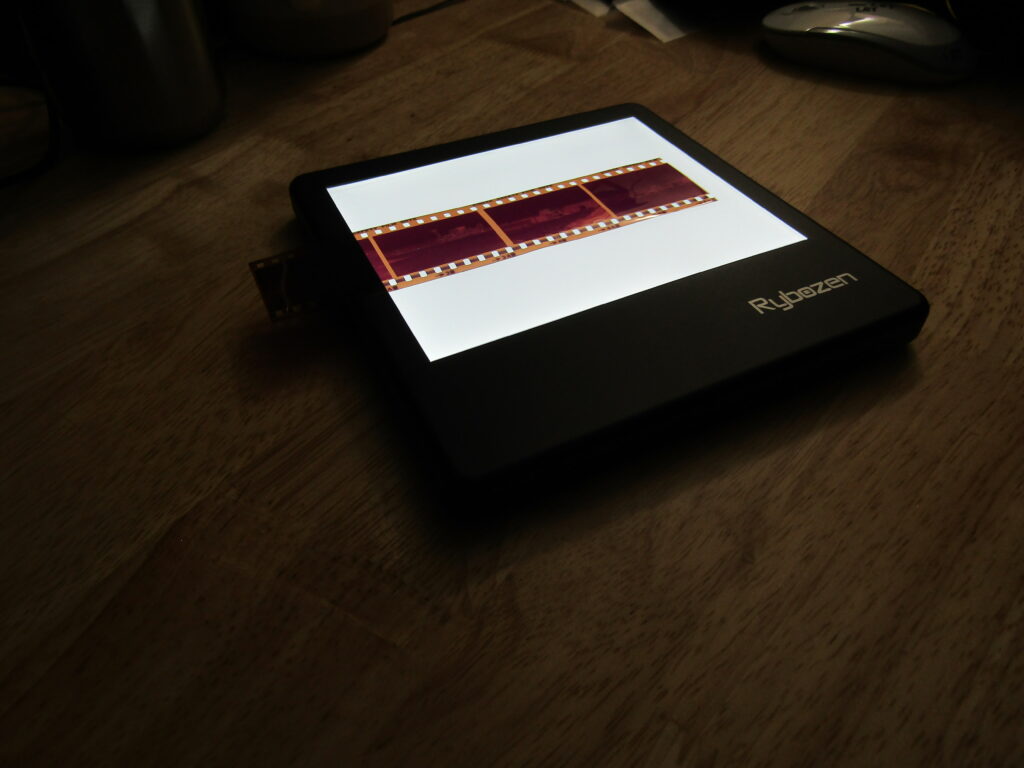
I called up a couple of pharmacy stores that had photo print capabilities. Anytime a customer wants negatives digitized, they are sent to Fuji, with a turnaround time of 2-4 weeks. Realistically, this would end up being 6-8 weeks. I searched Neeva and found out that digitizing negatives is quite simple. In short, use a high quality, uniform light source, take a completely still digital camera image, then edit the colors in a photo editor.
Rybozen 5″x4″ light table
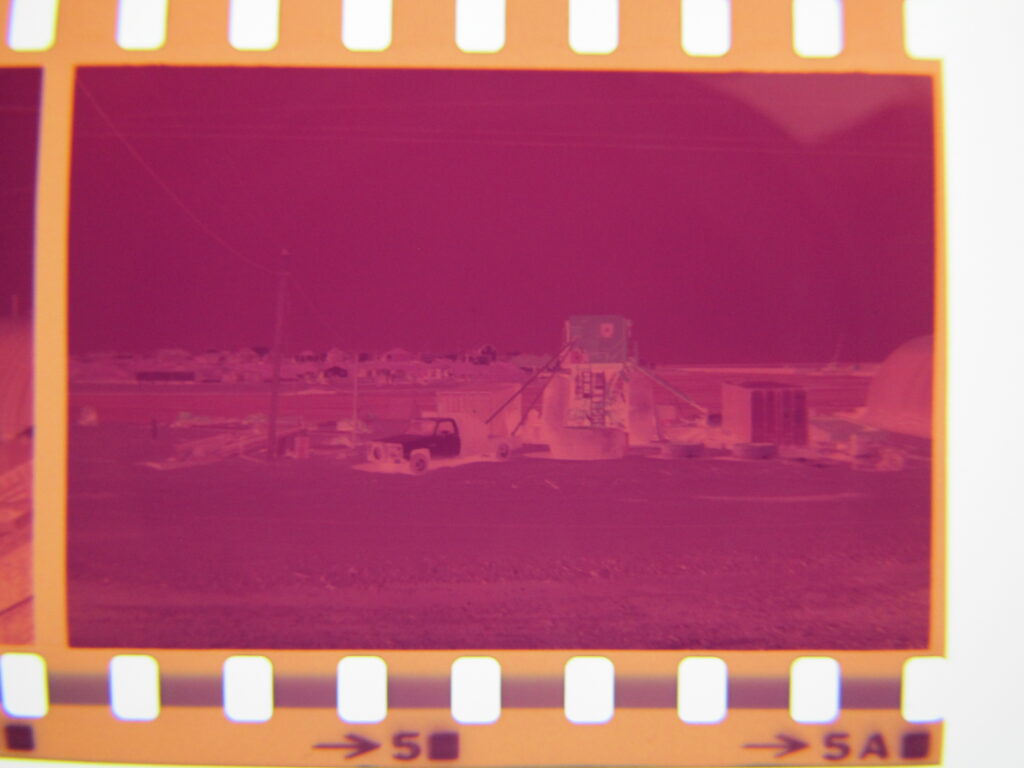
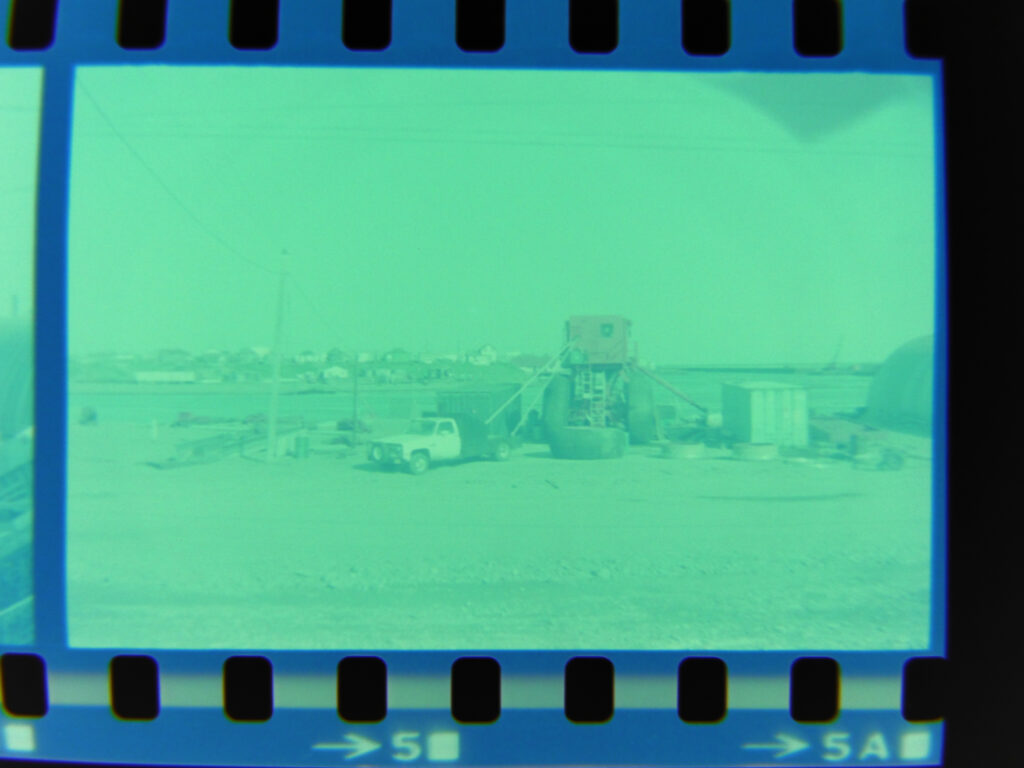
I used a high quality digital camera to capture an image of the negative. The raw image looks like this.
Raw negative image under a light table
Next, I used Gimp photo editor to Invert the colors, which makes the image have a blue hue.
Negative image after Invert colors was applied.
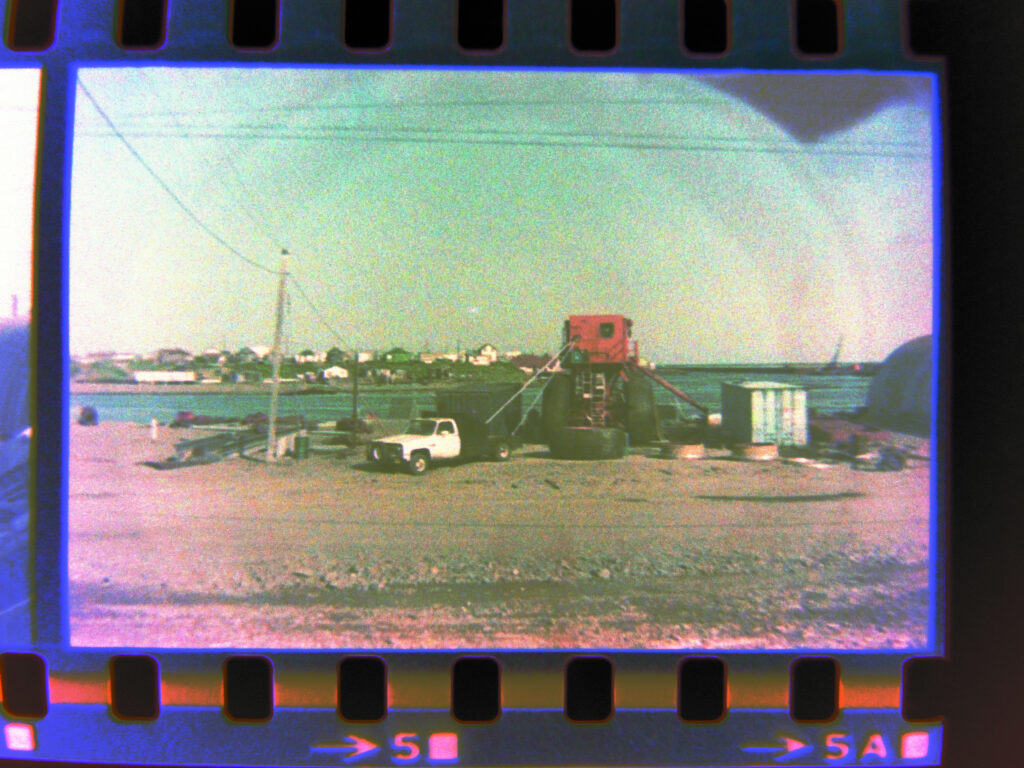
Lastly, Auto Equalize the image, and you are left with a digitized negative to image.
Final processed image from film negatives
Once the image is processed, crop and apply additional filters to meet your needs.
By now, you must be wondering what is the machine in this image. One of the more recognizable feature is the Firestone 120x48x68 tires. The tires above are 10 feet tall, with the machine standing well above the tire height. The amazing thing is that the machine is not even finished. Additional slides in this series show closeups of the rims and trailer. The trailer platform for this machine is from the Overland Mark II from Yuma Proving Ground, AZ. There is an additional top deck that is placed on top – not shown. I will discuss this machine, provide additional images, and talk about the story of this machine in my book.
The photo negative above was captured by Lloyd Molby. Thanks to a few amazing people, we are able to learn and relive Lloyd’s experiences. This is just the surface.
In the late 1950s, the United States Army (USAR) started carving ice tunnels in the Greenland ice shelf. The tunnels formed Camp Century, secretly known as Project Iceworm. Publicly, Camp Century was a research and development station. Ice cores sampled during this time are the foundation for scientists climate change assertion. The first functional nuclear power station, as part of the Army’s Nuclear Power Program, went CRITICAL in Camp Century – the reactor was called PM-2A and built by ALCO. Project Iceworm’s mission was to determine the feasibility for the Greenland ice shelf to support nuclear missile launches.
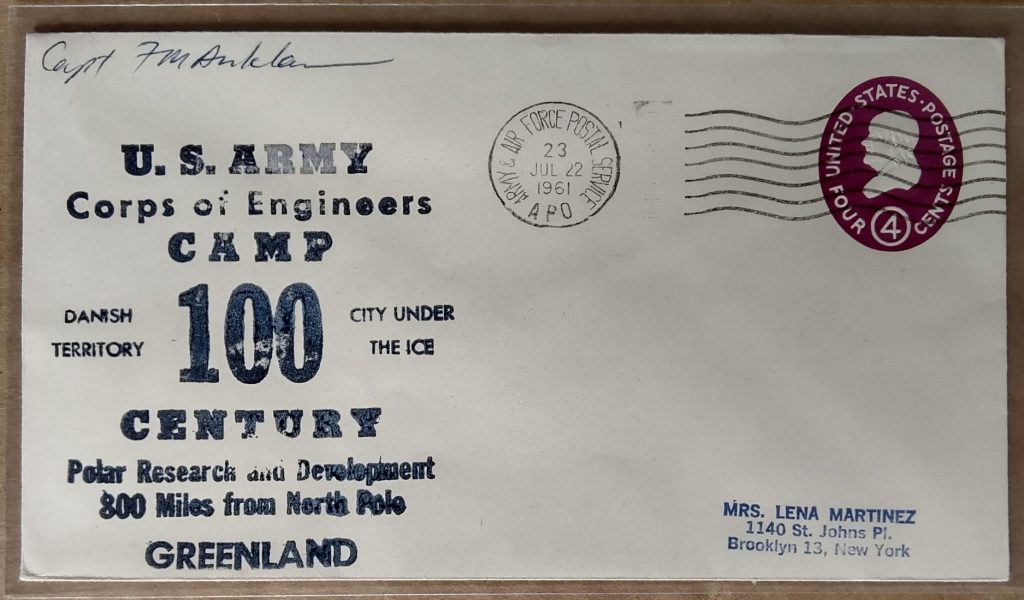
Letter stamped with Camp Century processed through Army and Air Force Postal Service dated 22July61.
A couple of decades after Camp Century was abandoned, a 1962 memo was found, detailing Project Iceworm’s proposal. The USAR really wanted to determine the feasibility for the Greenland ice shelf to support 600 nuclear missiles, targeted at the Soviet Union. The missiles would be moved around, under the ice sheet, by rail. The warheads would be safely concealed under 28 feet of ice, with a surface area equal to the state of Alabama.
photo: A. Haynes
In 2013, the United States Air Force Nuclear Weapons Center was planning to award several study contracts, worth up to $3 million each. The goal of the study contract was to figure out how to extend the operational life of the Minuteman III missiles.
There were two possible outcomes that the Air Force was looking to pursue, (1) maintain the current Minuteman III missiles until around 2030 or, (2) replace the current setup with a new ICBM that would be hidden within a trackless, underground subway system. The cost of developing a complex underground system would be a considerable, with figures between $52 billion to $210 billion.
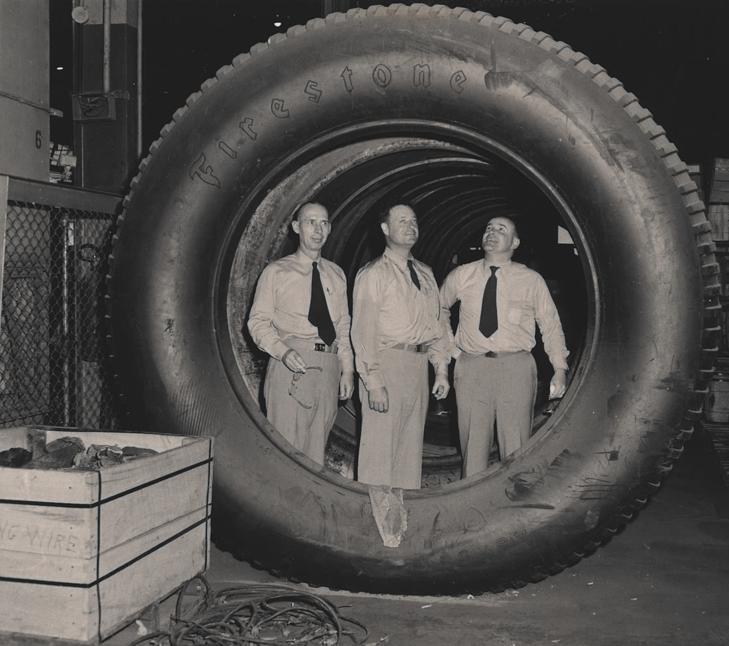
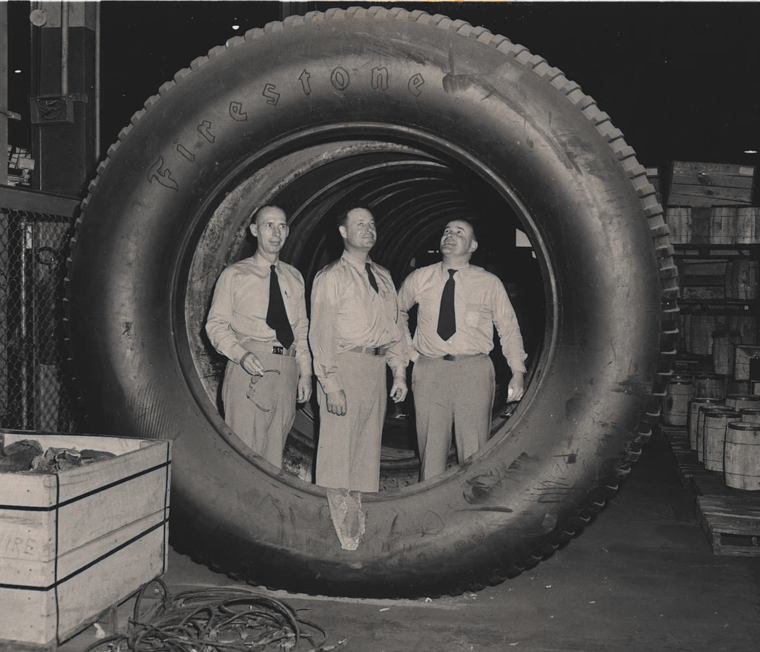
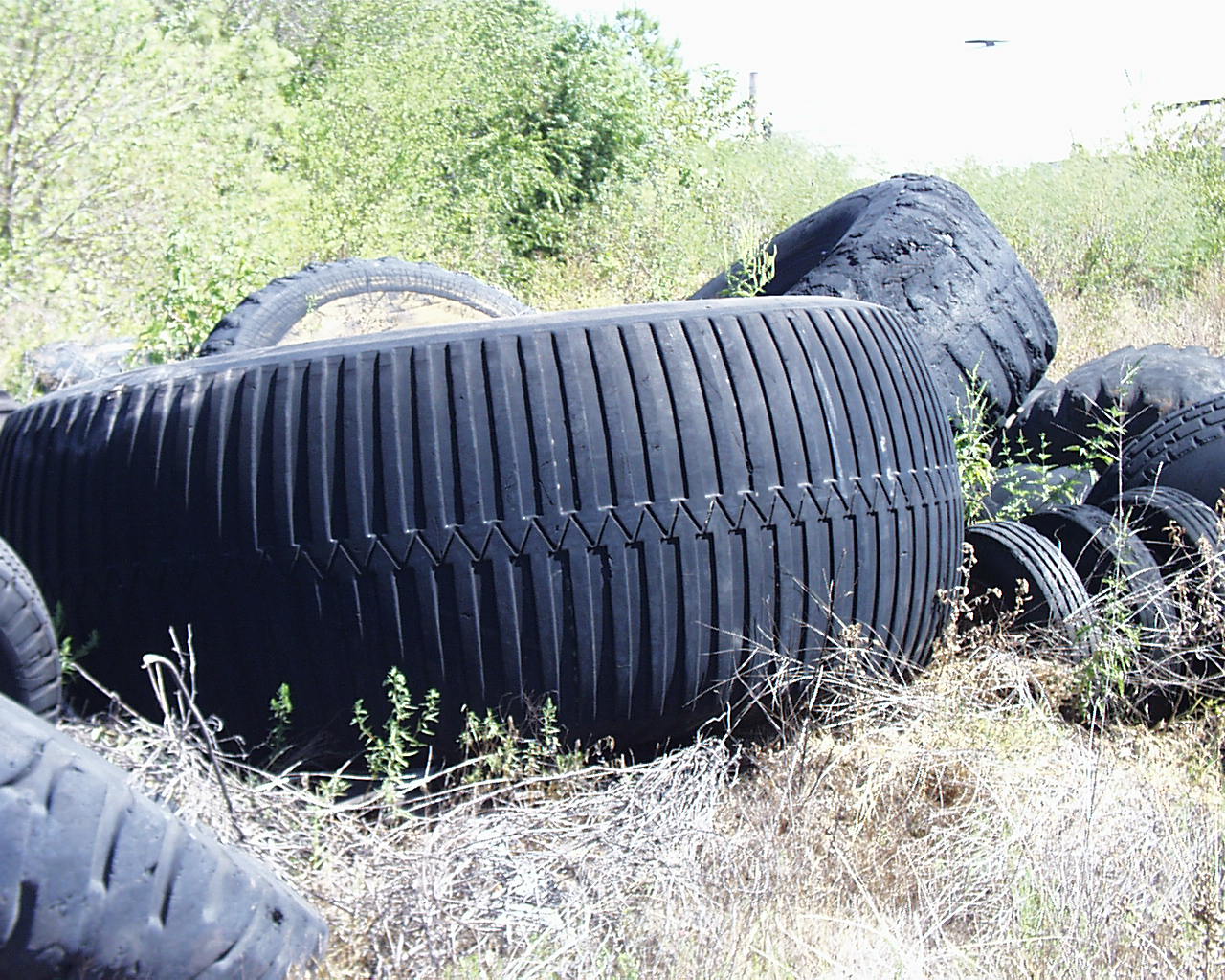
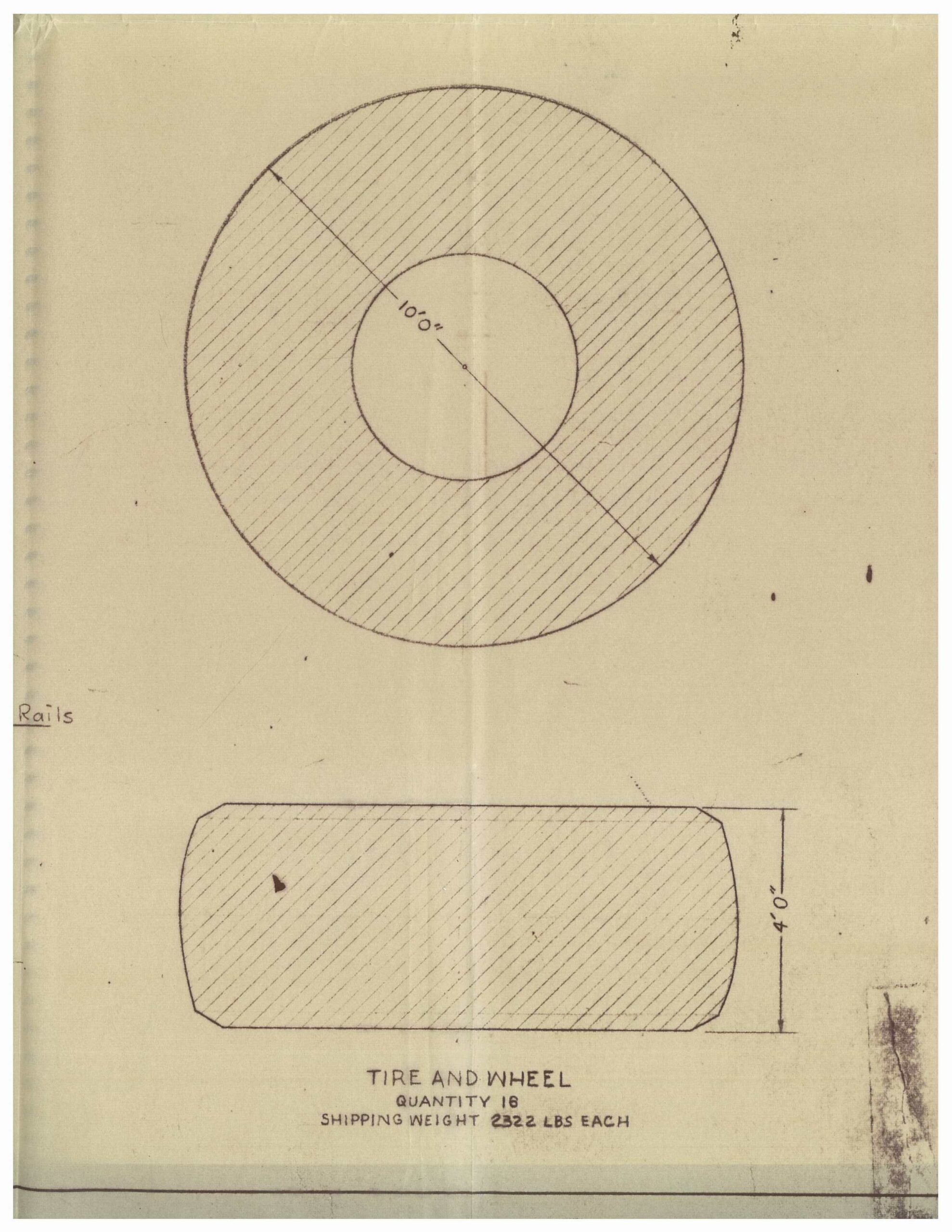
The Firestone 120x48x68 tires are arguably, one of the most recognizable features on the last 3 LeTourneau Overland Trains. These tires were first produced in 1952. The numbers describe the tire dimensions as 120 inches tall – diameter (10 feet), 48 inches wide (4 feet), and 68 inches inner diameter. The were manufactured in thicknesses of 10-ply to 36-ply based on the machine it was used. If you wanted to buy a tire and rim combination during the 1960s, you would expect to shell out around $3,500 per tire and $1,600 per rim.
photo: D.Hardy, 2009
Rim and tire combo weight, 2,322 pounds each.
Tire and rim combination weights will vary by rim model, rim metal composition, and tire plies. These tires were also used on the Crash Pusher, Water Wagon, Marsh Buggy, Sno/Swamp-Buggy, and possibly a few others that I have not seen.
April 15, 1954 – Ft. Eustis, VA. Three visitors marvel at the new Firestone tires.
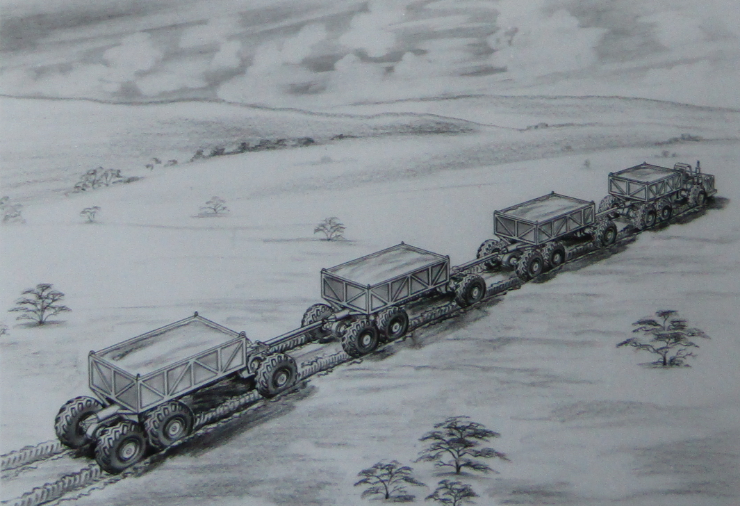
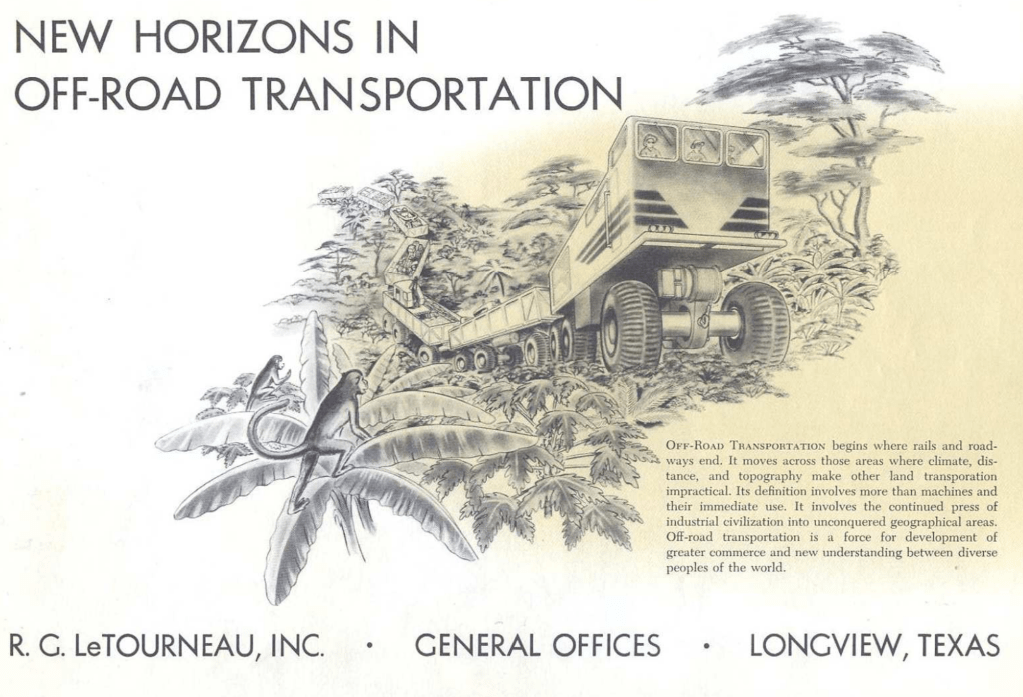
R.G. LeTourneau, Inc. drew a number of trailer concepts and trains before the 6 Overland Trains we know of today. His newly developed electric drive wheel seemed to spur his Train concepts. R.G. developed nearly a dozen train ideas during the early to late 1950s. The train concept below is a 6×6, powered electric drive developed for the Iraqi government. The lead car, or control car looks to use a Side Dump Train style front. The 4 containers on this train were designed to be removed and left at a work site, only to be picked up later. This train was never built.
undated train concept for the Iraqi government
The train above was not the first to be targeted for use in a desert environment. The Sno-Freighter was also marketed for use in the Sahara! Read through the Sno-Freighter brochure below.

 Overland Trains