Category: DEW Line

  • Abbreviations and Acronyms

    Abbreviations and Acronyms

    If the military is involved, you can be certain that they will use an abbreviation or acronym for their organized name, project, or equipment. Here are a few of the more commonly used abbreviations and acronyms used during the scope of the Overland Trains.

    ACAN – Army Command and Administrative Network

    ACFEL – Arctic Construction & Frosts Laboratory

    APPR – Army Package Power Reactor

    ERDL – Engineer Research & Development Laboratory

    FESA – Facilities Engineering Support Agency

    LCC – Logistical Cargo Carrier

    PR&DC – Polar Research & Development Center

    SIPRE – Snow, Ice, Permafrost & Research Establishment

    TRADCOM – Transportation Research Development Command

    TRARG – Transportation Arctic Group

    TRECOM – Transportation Research Command

    TREOG – Transportation Research & Environmental Operations Group

    USARSG – United States Army Research & Standardization Group
  • The United States Air Force Modern Day Project Iceworm

    The United States Air Force Modern Day Project Iceworm

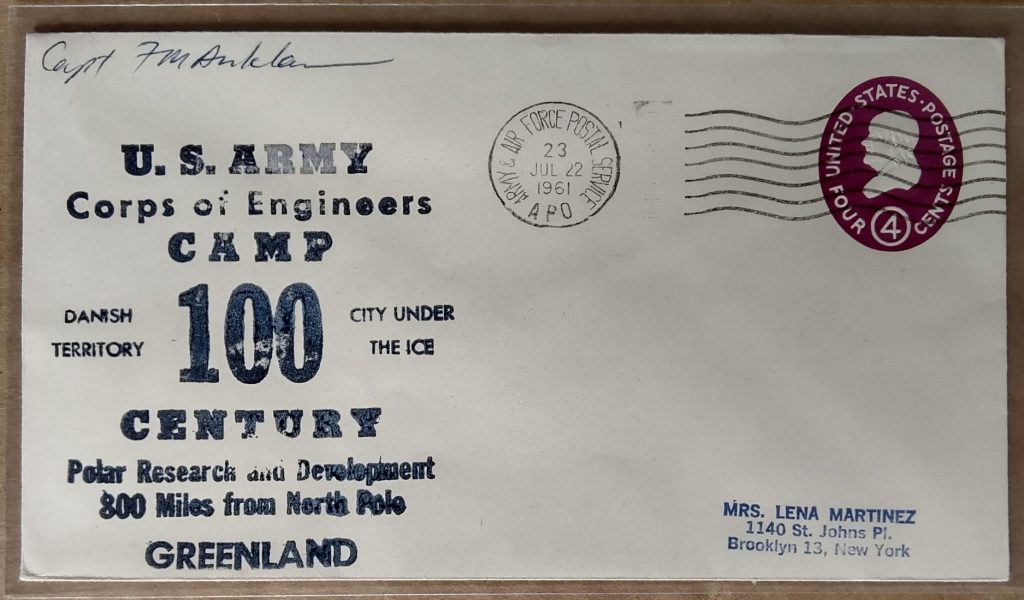
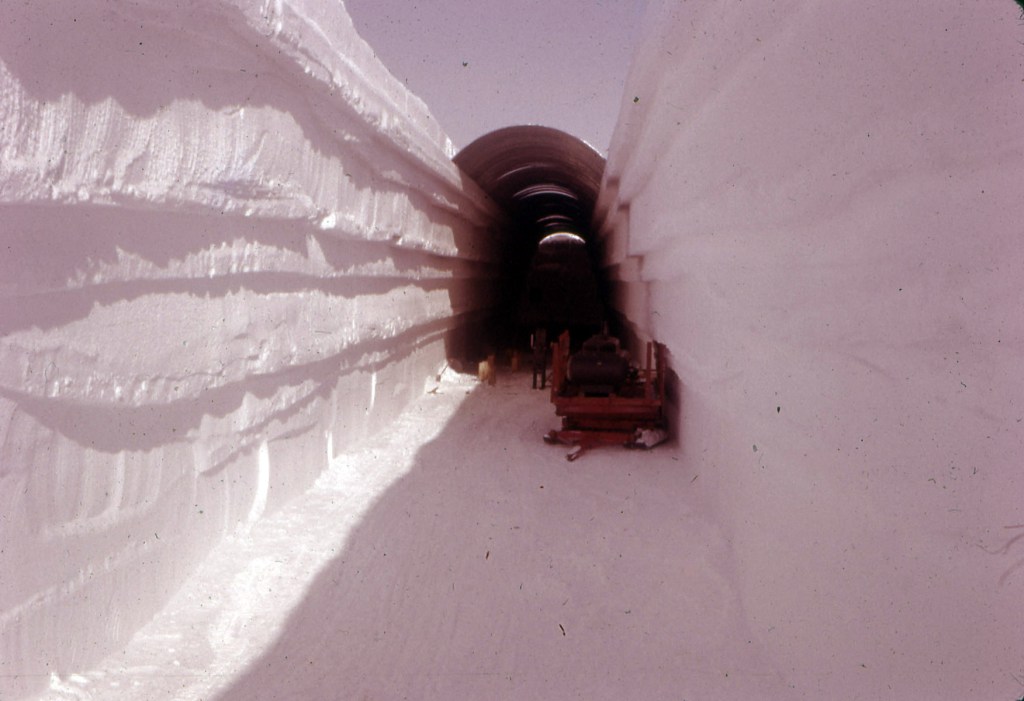
    In the late 1950s, the United States Army (USAR) started carving ice tunnels in the Greenland ice shelf. The tunnels formed Camp Century, secretly known as Project Iceworm. Publicly, Camp Century was a research and development station. Ice cores sampled during this time are the foundation for scientists climate change assertion. The first functional nuclear power station, as part of the Army’s Nuclear Power Program, went CRITICAL in Camp Century – the reactor was called PM-2A and built by ALCO. Project Iceworm’s mission was to determine the feasibility for the Greenland ice shelf to support nuclear missile launches.

    Letter stamped with Camp Century processed through Army and Air Force Postal Service dated 22July61.

    A couple of decades after Camp Century was abandoned, a 1962 memo was found, detailing Project Iceworm’s proposal. The USAR really wanted to determine the feasibility for the Greenland ice shelf to support 600 nuclear missiles, targeted at the Soviet Union. The missiles would be moved around, under the ice sheet, by rail. The warheads would be safely concealed under 28 feet of ice, with a surface area equal to the state of Alabama.

    photo: A. Haynes

    In 2013, the United States Air Force Nuclear Weapons Center was planning to award several study contracts, worth up to $3 million each. The goal of the study contract was to figure out how to extend the operational life of the Minuteman III missiles.

    There were two possible outcomes that the Air Force was looking to pursue, (1) maintain the current Minuteman III missiles until around 2030 or, (2) replace the current setup with a new ICBM that would be hidden within a trackless, underground subway system. The cost of developing a complex underground system would be a considerable, with figures between $52 billion to $210 billion.

    You can read the 2013 United States Air Force Counterproliferation Research & Education article at https://media.defense.gov/2019/Jul/24/2002161886/-1/-1/0/CPC%20OUTREACH%201049.PDF. I did not want to post the article here because of possible copyright issues.

  • Sno-Freighter Globe-Union Inc. Batteries Advertisement

    Sno-Freighter Globe-Union Inc. Batteries Advertisement

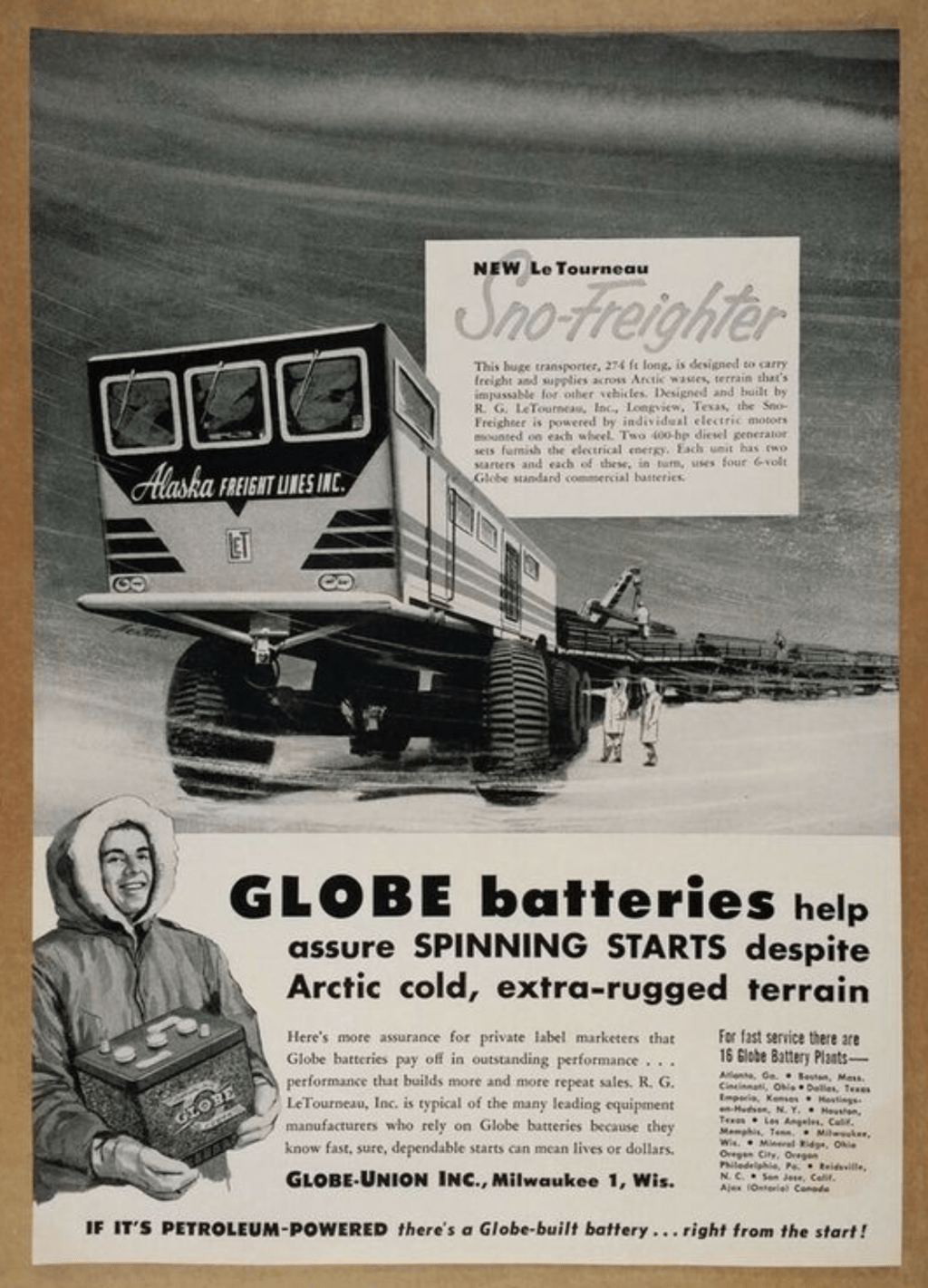
    Have you noticed your car, truck, or equipment starts a little slower when it is cold outside? Anyone who lives in or near the Arctic knows that you better have a well maintained battery. When it gets cold, batteries lose efficiency. When the Sno-Freighter came to Alaska to help supply Distant Early Warning (DEW) Line sites, it captured the attention of corporate America. The Sno-Freighter was designed to carry heavy loads through the back country. Companies had the new rugged product comparison that they always wanted.

    The advertisement assures performance of Globe-Union Inc. batteries with “…SPINNING STARTS despite the Arctic cold.”

    The logs shown in the advertisement above were from the tests at LeTourneau’s Longview, TX facility. Typical cargo for resupplying DEW Line stations were cement, petroleum, oil, and liquids (POL), and a wannigan for housing the men and chef.

    Globe-Union Inc. Notes

    • Globe-Union batteries production started at Tampa Industrial Park in 1958.
    • In 1970, battery production was up to 400,000 a year
    • In February of 1982, the Globe-Union factory experienced a gas fire at their factory.
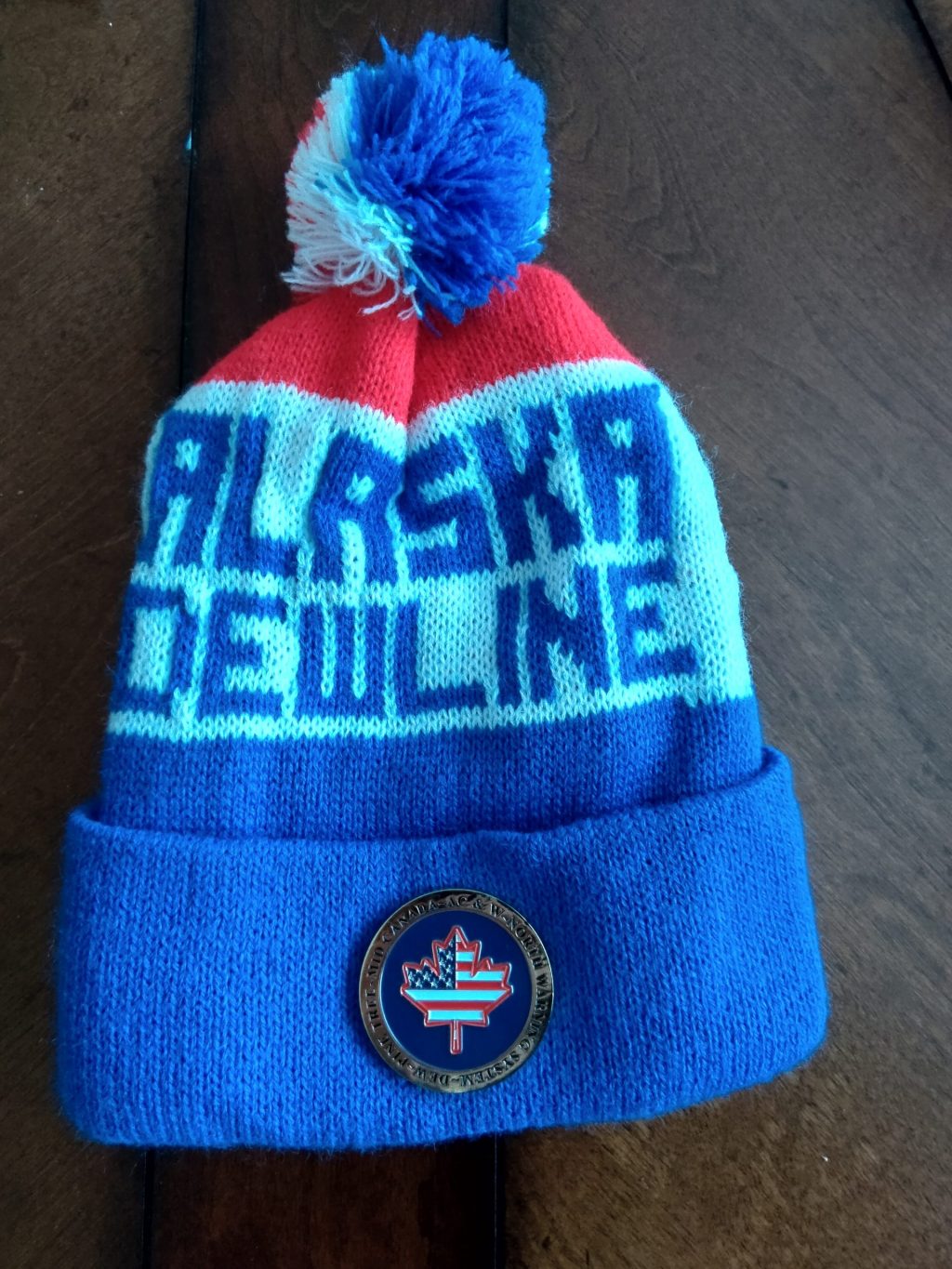
    • New DEW Line Challenge Coin & Beanie

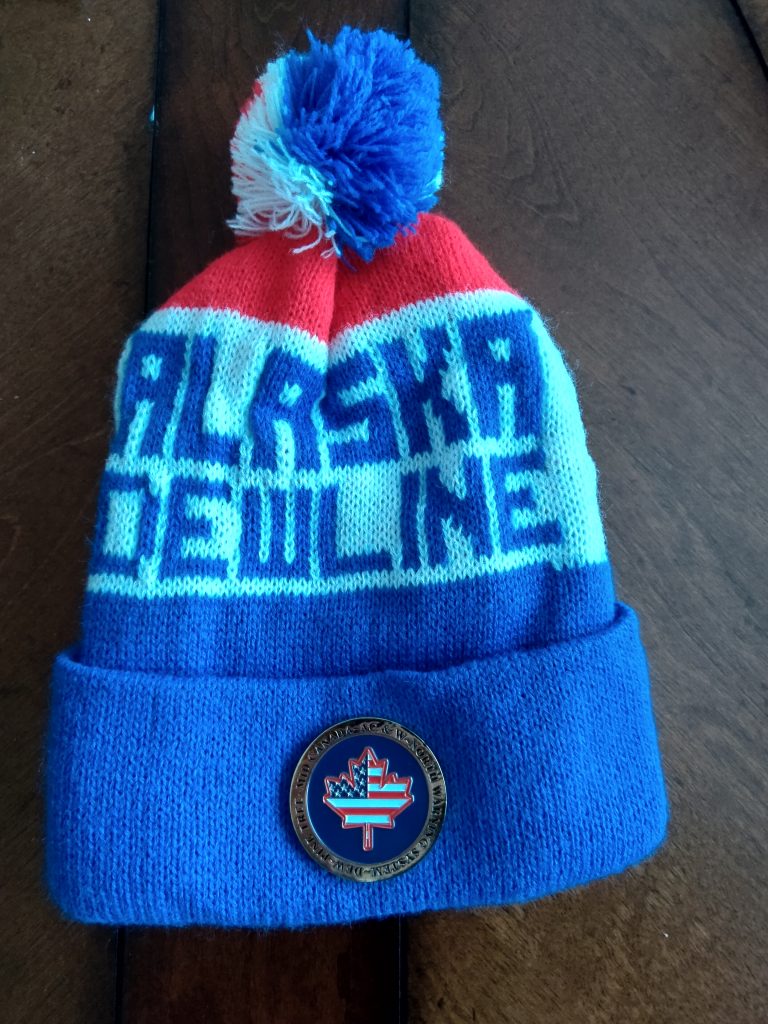
      Writing the Overland Trains book has made me more sentimental. Conversations with individuals and their kin about the Distant Early Warning (DEW) Line, Alaska, and Yukon history made me realize that many of the historical artifacts and accompanying stories are being lost to children that “just don’t have the space” and degradation due to time. I will buy artifacts like the DEW Line beanie and challenge coin to preserve them for history and others to enjoy. The beanie seller said that it “Came from the estate of a gentleman stationed on the DEW line in the 70s.”

    • North American Alert and Warning Networks

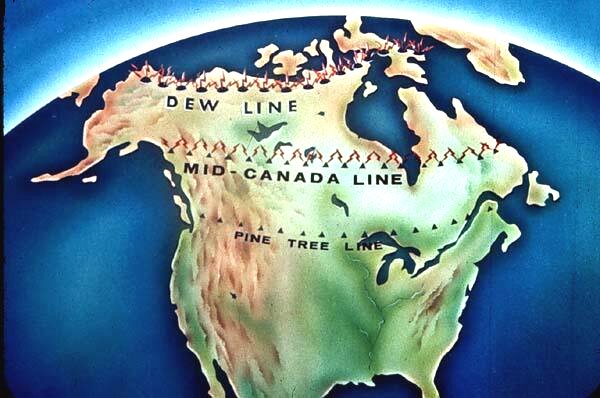
      Pine Tree Line – radar, planned 1946, handed over to Canada on 10Jan55

      Mid-Canada Line or McGill Fence – 1956-1965
      DEW Line – radio frequency tripwire 1957-1993, most deactivated 1988, the remaining upgraded
      Green Pine Network – UHF, designed 1967, phased out in 1987
      North Warning System (NWS) – radar, 1988-2025, Ratheon, AN/FPS-117 and short range AN/FPS-124 surveillance radars
      Upgrade – As part of the United States Air Force new Arctic Strategy, their is a proposed upgrade occurring in 2025.

      Others
      The U.S. Navy also operates the Raytheon TPS-71 Relocatable Over-the-Horizon Radar(ROTHR)

    • DEW Line Logistics

      DEW Line Logistics

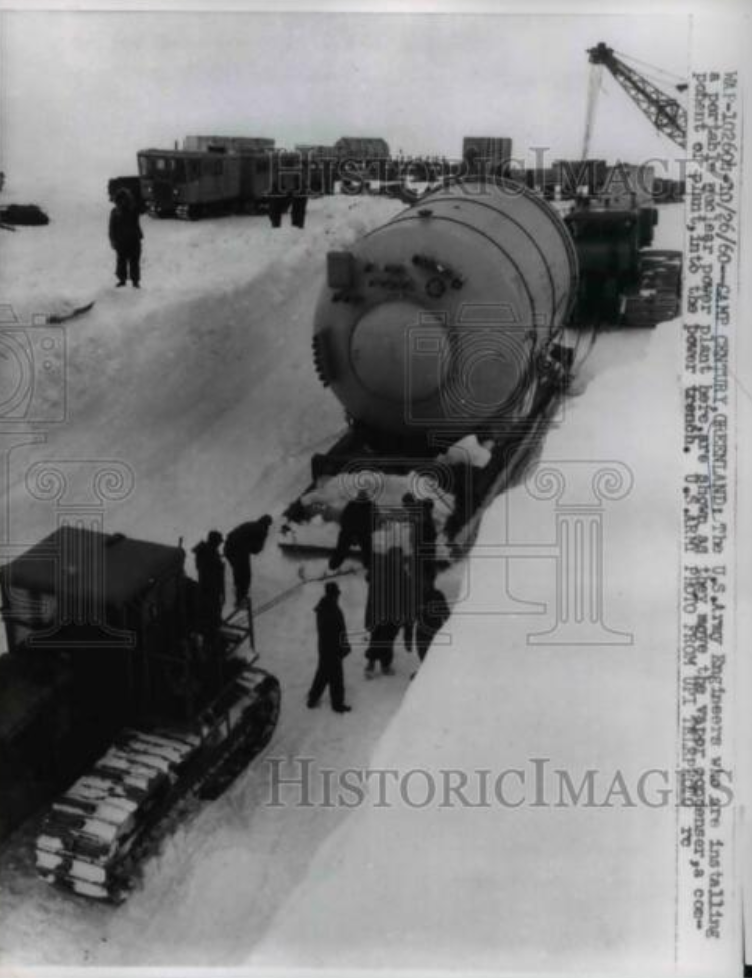
      I just finished reading Brian Jeffrey’s book “Adventures from the Coldest Part of the Cold War.” Brian’s book reviews his DEW Line and life experiences. The DEW Line represents a time in our history when the United States took huge risks. The Soviets and the United States were in a Cold War. Both sides had their hands on the triggers, so to speak. Nuclear technology was being tested on the Bikini Atoll, along with experimentation with small, portable nuclear reactors like the one seen below.

      Read more about Brian’s DEW Line adventures on his website at http://www.dewlineadventures.com/.

      source: HistoricImages store on eBay. https://www.ebay.com/i/372979736849?mkevt=1&mkpid=2&emsid=e112358.m43.l1123&mkcid=8&bu=45362334499&osub=3fbfe2ced3e91b2e727cfa85acf728f5%257E16TE1798421_T_PREPURCHASE_CT3&segname=16TE1798421_T_PREPURCHASE_CT3&crd=20200727090000&ch=osgood&sojTags=osub%3Dosub%2Csegname%3Dsegname%2Ccrd%3Dcrd%2Cch%3Dch%2Cchnl%3Dmkcid

      The DEW Line was a logistical feat, worthy of only the strongest and toughest minds. Built, in cooperation with Canada, the DEW Line completion proved to the world that North America could intelligently detect enemies. We transported equipment and supplies by the thousands of tons, including 140,400 tons by aircraft, 281,600 tons by naval convoy, 17,600 tons by cat train, and 20,300 tons by barge. LeTourneau’s Overland Trains, more specifically, the VC-22 Sno-Freighter and LCC-1 Sno-Train helped transport those materials over the snow and to the doorstep of those who needed it most.

      Technical Note: As an avid Kindle reader, I find the highlighting and notes within the device extremely useful. All of these highlights and notes are found at https://read.amazon.com/notebook. Export them as a PDF and you have a “paper copy” ready to print.