I have had 4 days off for the weekend, President’s Day, and one day of vacation to write. The work week does not leave much time past email correspondence to work on the Overland Train book. There are 15 chapters in the book, with all but 2 or 3 that are in the editing phase.
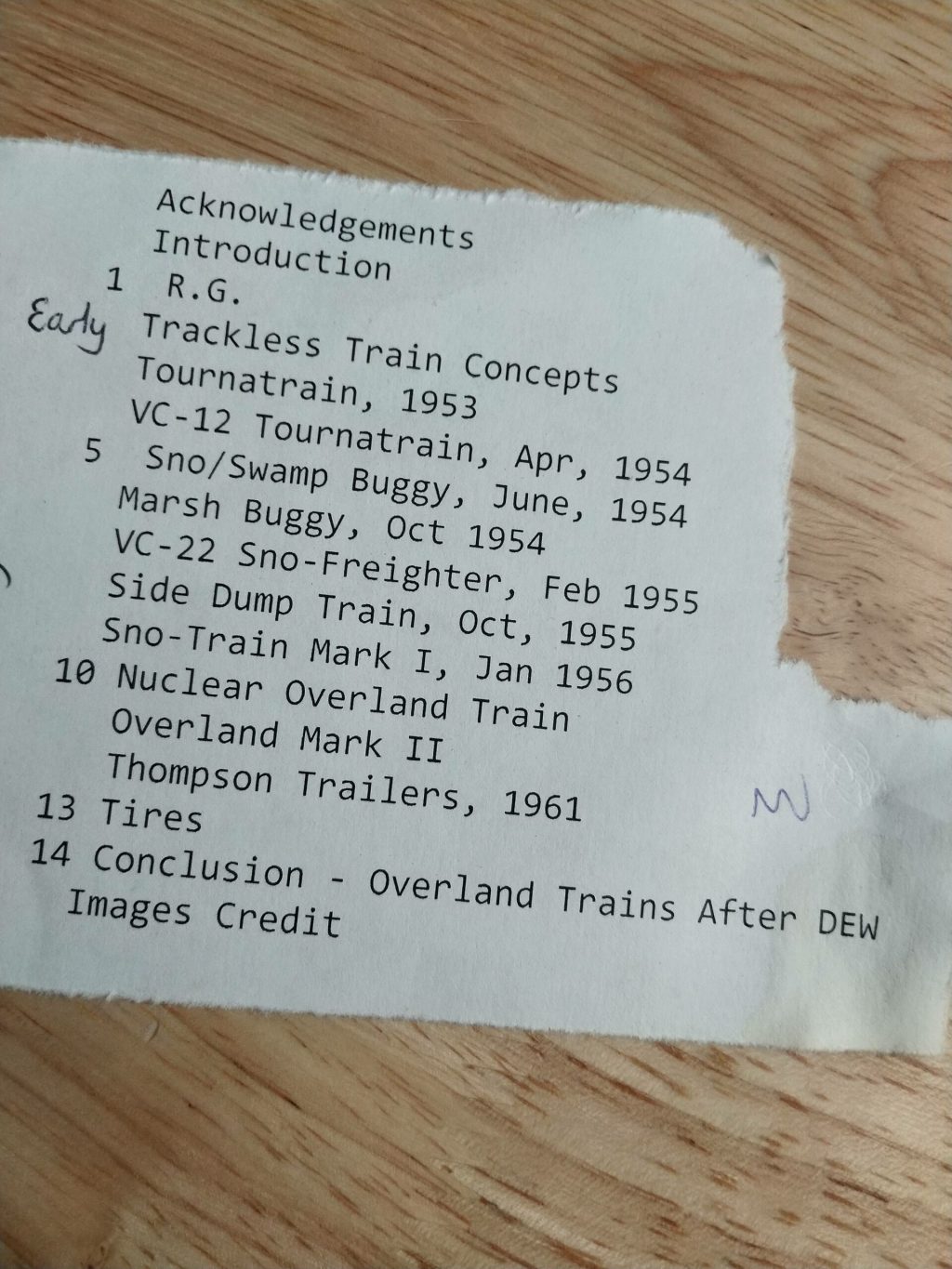
Draft Overland Trains book chapters list.
The editing phase means that I am no longer incorporating new content. Changes are grammatical, shifting content around, and spelling or word choice changes. The remaining two chapters where I am still incorporating content are relatively minimal.
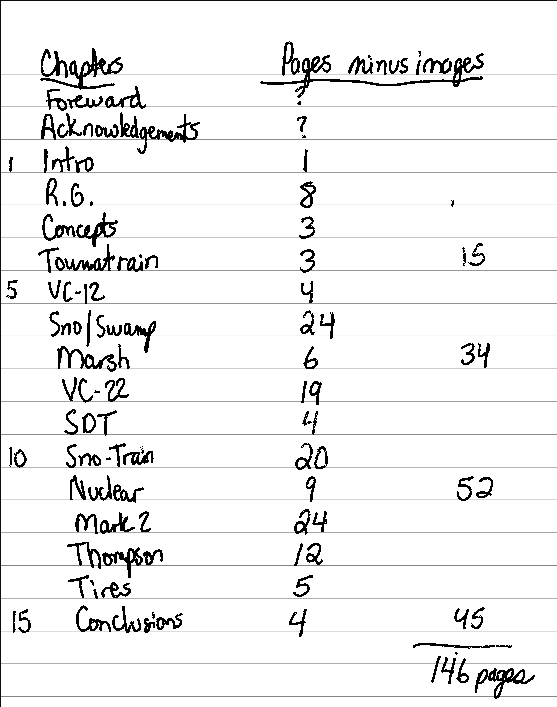
As a curiosity, I opened up each chapter document and counted the pages. Using Amazon Kindle Direct for publishing does not limit reasonable page count, rather the overall uploaded files size. If I recall, the maximum page count was something like 828 pages…? After counting all of the pages, single spaced and no images, I came out to 146. Once I add images and another 5-10 content pages, I should be around the 300-350 page mark.
Calum’s recent video on the Overland Trains has caused quite a stir about these machines. It was really nice to see and hear him talk about R. G. LeTourneau a little and his other projects. The video has prompted many of you to ask, “when is the book coming out?”
Writing this book has taken much longer than I had imagined. The raw data volume is incredible. I would say around 90% of the data collected has not been from the internet. The majority of data found on the trains has been captured from physical data archives, phone interviews, and emails.
I have rough drafts on 12 of 14 chapters. The remaining two chapters, the Sno-Train and the Mark 2, are 90% complete. Speaking of chapters, here’s a sneak peak at my working chapters list. I am waiting on a data source that will not be available until May 2022. Until then, I continue to work on my drafts and tweak details. I will also be adding new information in the R. G. chapter about his more obscure inventions.
When I started researching the Overland Trains book, I thought that I had a pretty good idea of how to accomplish the technical aspects. I have worked in information technology for the past 12 years, working in Linux, networks, and information security. One of the most important aspects of any projects is data. Data is the lifeblood of everything that we do. I realized that I did not want to store my files on any system where privacy would not be paramount. I decided to spin up another virtual server and install a clean version of Nextcloud. Nextcloud is a free and open-source software that provides calendar, contacts, data storage and sync, and a whole other host of services.
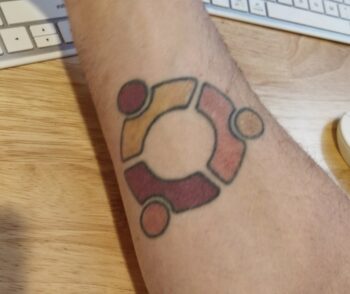
My Ubuntu tattoo
Gadgets
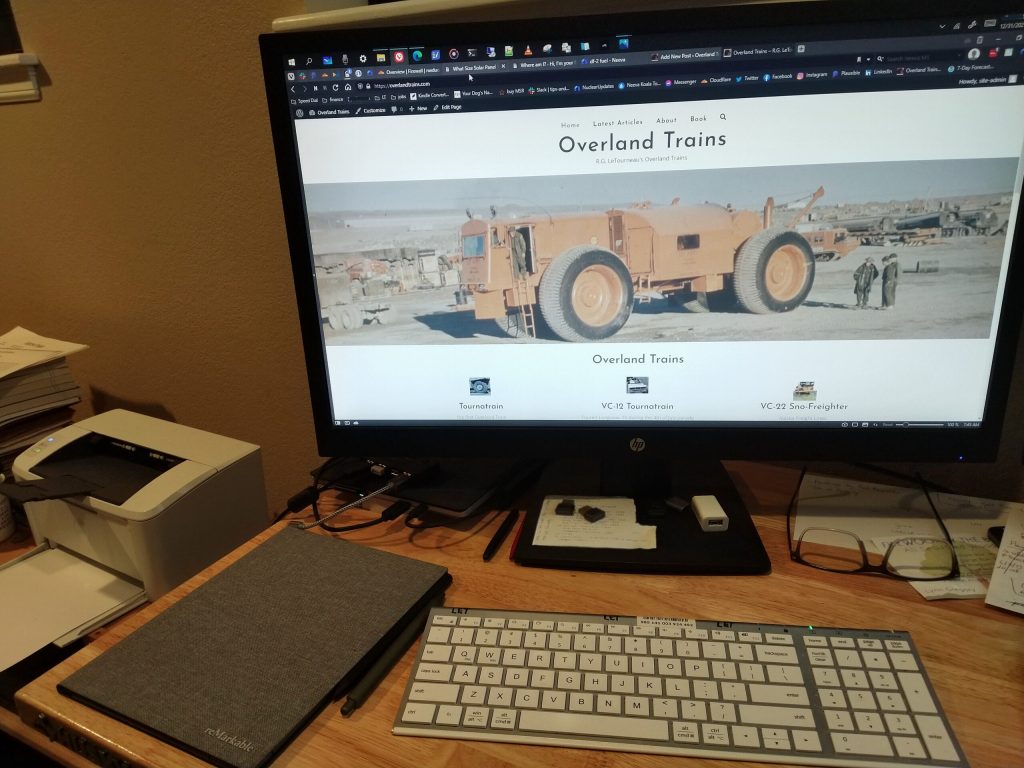
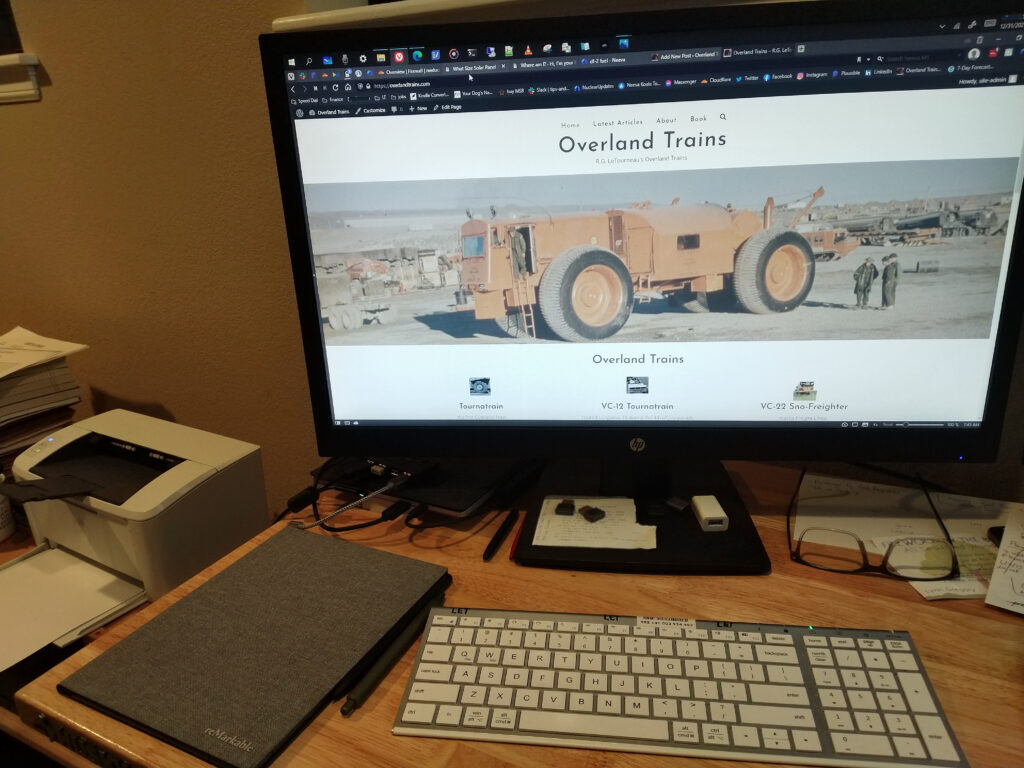
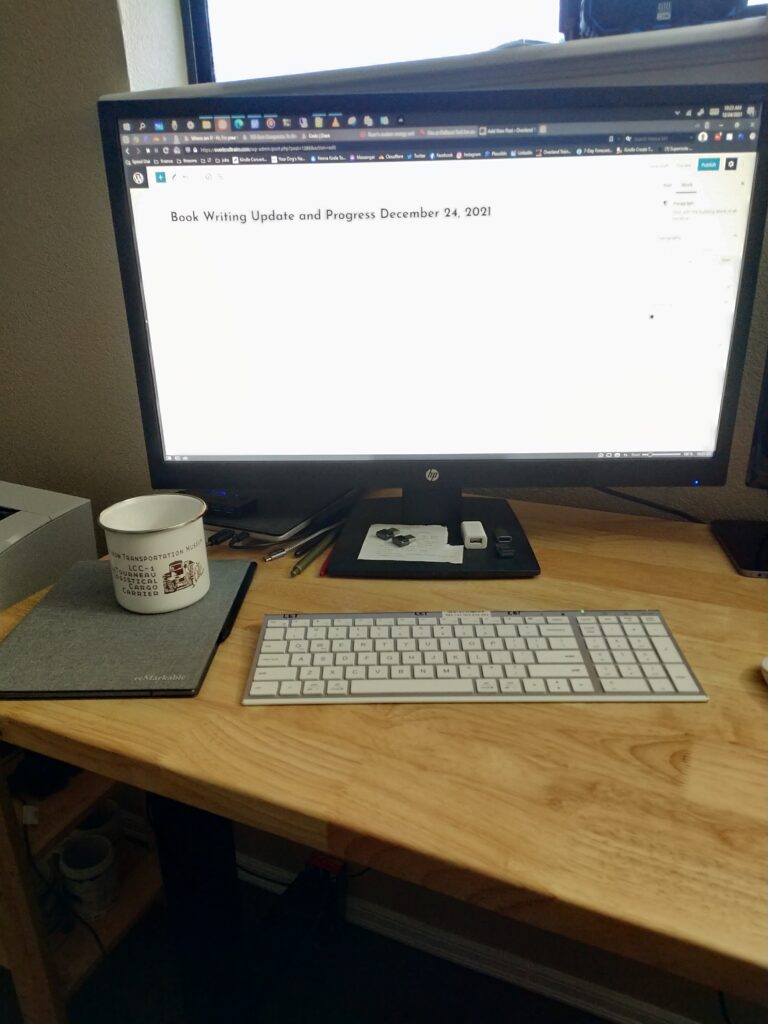
I use a Microsoft Surface to house my data and work (pictured underneath my monitor on the left). A large external monitor gives me the screen real estate to open a document side-by-side to my writing document. When I save the document or add files to my Nextcloud Sync, they are automatically saved on my server. As added protection against data loss, I backup all of my files, now a little over 30GB, to a USB3.0 thumb drive. Some of the other electronic gadgets that I use during my writing are a reMarkable 2 (for taking notes during interviews and editing documents), USB drives for data backup, printer, scanner (critical), and a digital camera.
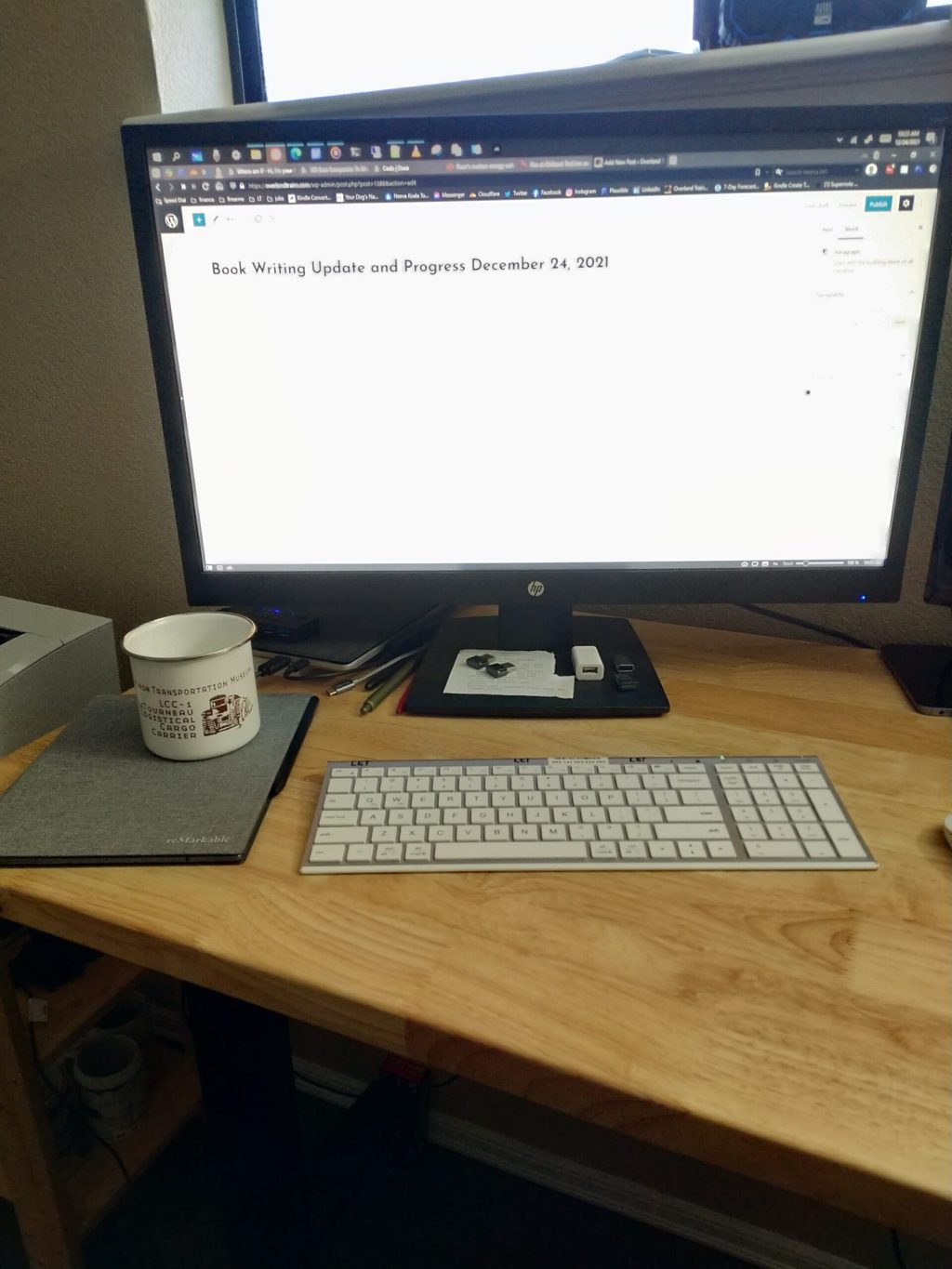
My writing desk
Servers and Services
The Overland Trains website, which you are reading from right now, is a hosted virtual server with WordPress. I use 2-factor authentication for everything, including service providers that I use. I protect my Nextcloud server and this website with a paid instance of Cloudflare. This service processes DNS queries for my sites and protects them from all of the attempted cyber attacks or hacks. First and foremost, I keep things simple. You could easily go crazy and spend a fortune with this or that. Based on the project scale, this is my easy. Your easy may vary.
What does it Cost?
As I have put in another post, the virtual servers hosting data storage and this website cost me a little over $60 a month. Cloudflare cost me $20 a month. I also spend $100-$200 a month of promoting website articles on Facebook. I traveled to Texas for a week for interviews and research, which cost around $2,000. I also purchased Hancom Office, instead of using Microsoft Office or Libre Office. I bought a Surface just to write this book, which was around $800. Lastly, the printer and scanner for this project cost around $400 for both. I also pay for Plausible website analytics, which tells me articles that are more popular, my audience, and overall traffic. If you are writing a non-fiction book, costs may be significantly less. However, this is a deep, deep, deep dive into history. I consider this a research project, which requires the level of certainty and resiliency needed in the paragraphs above.
My original deadline for publishing at the end of 2021 has come and gone. Researching, learning, and writing has evolved so much more than I thought was possible. The amount of details and history about these machines is staggering. Every time that I think an information source is exhausted, someone will email me or I will read a social media comment and I come across more history. The book will be completed in early to mid 2022. A critical historical resource for the Sno-Train chapter will not be available until May. Until then, I am finishing up the Overland Mark 2 chapter and editing the remaining chapters.
Editing the chapters has been the most laborious. I am publishing on Amazon, but that does not mean the editing scrutiny is any less robust. I have one editor for content and another applying the Chicago Manual of Style.
I have been working on the finishing the Sno-Train chapter for the last two weeks. This machine has the most complex history out of all of the 6 Overland Trains. In one of the more detailed sections of my book, I am writing about a vehicle recovery journey where the Sno-Train was used as the primary vehicle. This journey took months of travel time, ingenuity, and drive to complete the mission.
During the months long recovery mission, men were exposed to continuous Arctic cold, rain, mucky conditions, and then more cold. They did not have running water or YouTube videos to help them figure out how-to. They had the knowledge, skills, and ability to fail fast and often, then keep on going to accomplish the mission.
My day job has nothing to do with writing or history. When I find my self in a conversation about history at work, it tends to spark my interest a little more. I was talking to a guy on video chat yesterday about publishing options and why I chose Amazon. He was explaining that Amazon would not publish his friend’s book because it was too gory and too long of a book. The book was titled simply and was about the lifecycle of a pig – it was something like “Pig to Table.” The book describes and shows how to go from a living animal to a meal on your plate in graphic detail. How many people living know the right way to raise, kill, butcher, and prepare a pig full cycle? I don’t. The book successfully raised money on Kickstarter and was published.
The conversation with this man led to his own interests in iron works and our inability to figure things out. How many people know how, or have the ability work with iron? How many of us could can effectively farm to feed ourselves or our family? I have interviewed over a dozen people for my book, with the majority between the ages of 75-98. Their stories demonstrate extreme adaptation abilities, humility, and character. How many of us would be willing to get paid Army wages to go out into the mud for months on end without our home comforts, finish the job, and not complain a single day?
We have forgotten how to endure. We have forgotten how to adapt creatively in less than ideal physical conditions. More importantly, we have forgotten how to be good humans. As David Goggins would say, “Go out and do something that sucks everyday.” Let’s see what happens.
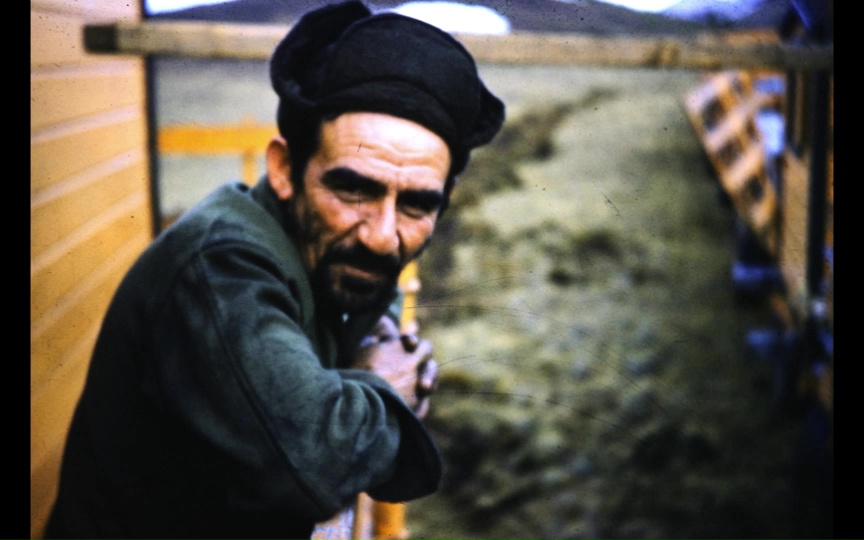
SP5 Alfonso Colon-Rivera 1961. Image: Marty Martinez.
The first 6 book chapters are being reviewed and edited! I received the first copy edit on Chapter 1 last night. I have three “Monster” chapters in the book, the Sno-Freighter, Sno-Train, and the Overland Mark II. The good news is that the remaining chapter drafts are complete, aside from the aforementioned three.
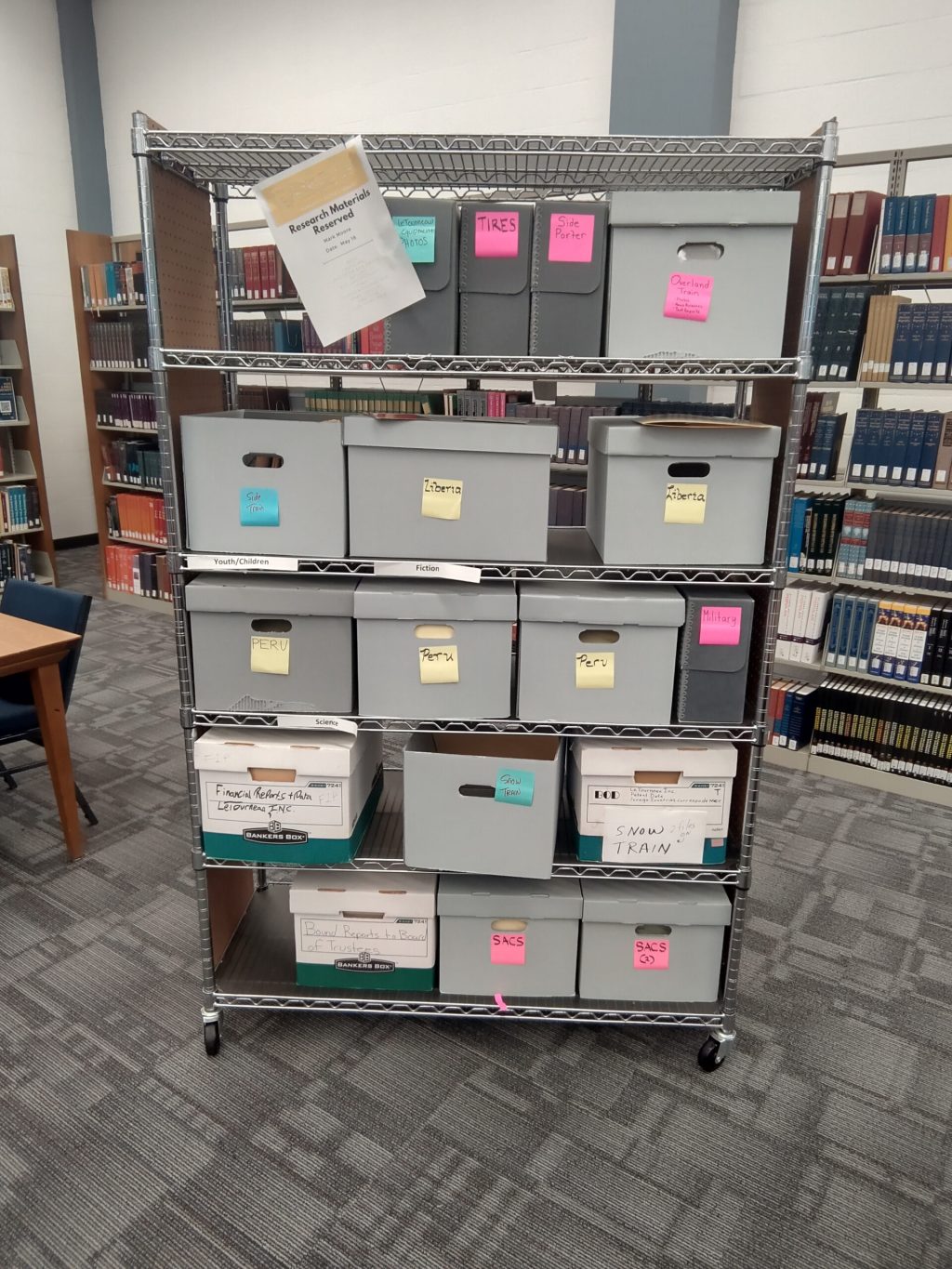
When I went to Texas for research last month, I had boxes and boxes of old documentation to review. The image below is just a small percentage of data that were reviewed. Part of the problem with all of these fantastic data sources was filtering. Sometimes, there were an excessive amount of documentation on a particular topic; I had to mentally step back and filter what was important to telling the story.
Some of the historical records researched for this book
As I started writing this book, I wanted to throw out any of the data derived from stories. I started from scratch, presenting information only from physical documentation or from those present during the event. Aside from the mass amount of information in this book, it is based on data that I can back up by documentation and first hand accounts.
Our Facebook Overland Trains page reached 1,000 followers yesterday! The first 7 chapters of the Overland Trains book are being edited, while I continue to work on the larger 3 chapters, the Sno-Freighter, Sno-Train, and Overland Mark II. Thank you for joining our Facebook Page – https://www.facebook.com/OverlandTrains.
These last couple of weeks have been full of interviews, both in-person, email, phone conversations, and one video chat. The interview usually starts off with me asking when they served in Greenland, Alaska, or in other parts of the world. Once you start jogging the memories of these fantastic people, the information flows well. I do not understand how many of these service men still remember the details of their Temporary Duty deployments over 60 years later. As I rethink that last statement, the raw, mostly untouched Greenland of the mid to late 1950’s and early 1960’s was a sight to see. They were figuring out how to make the equipment work in Arctic extremes.
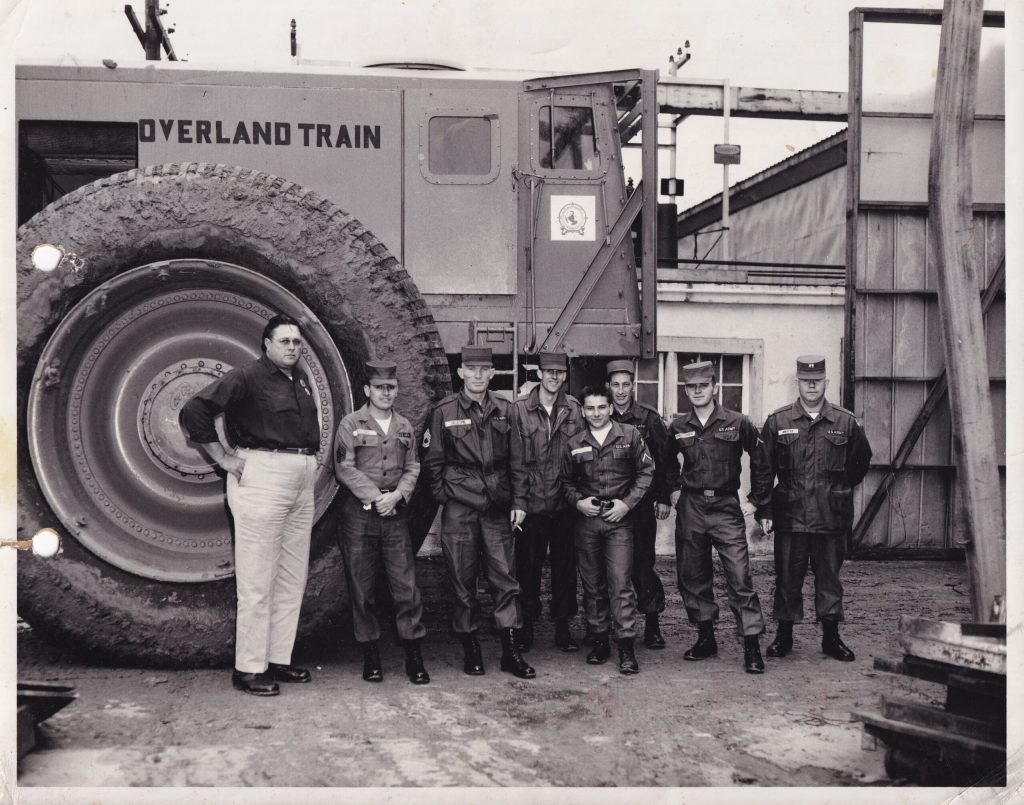
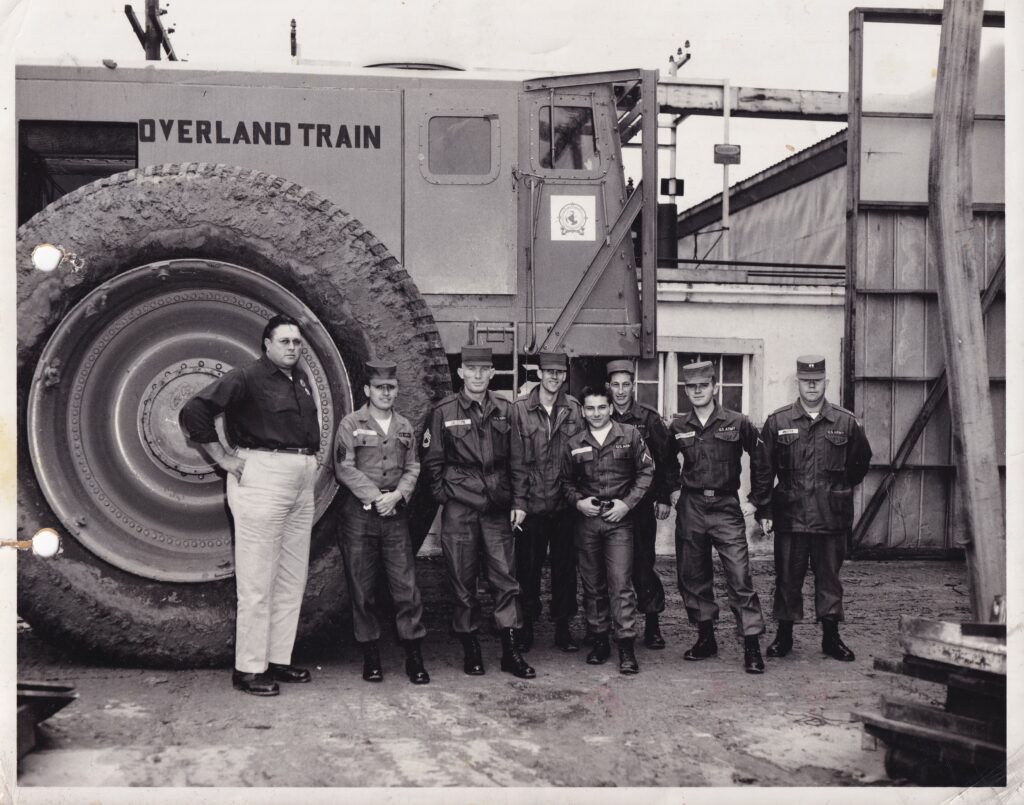
Around a month ago, I had a person reach out to me because they found this website. This contact has led to a wealth of new information and the opportunity for me and my wife to meet some truly great people. I met them both for lunch around 20 minutes from my house. Later next week, my wife and I went over to their house, around 30 minutes away, and spent three hours talking over pizza and beer. He was a Korean and Vietnam Vet, and had extensive time spent with the Sno-Train and Sno-Freighter – you just don’t hear of these individuals any more. He provided the image below from his time in Fort Eustis, VA.
Image courtesy M. Martinez (2nd from the left). Fort Eustis, VA
I am still processing the data from my trip to Texas. Rest assured, the pages are flowing!
Two weeks ago, I traveled to Texas for an extensive week long research mission. After braving a tornado siren warning and the extreme heat and humidity, I have to say MISSION ACCOMPLISHED. I visited in-person with a LeTourneau Historian, visited the Gregg County Historical Museum, spent hours sifting through boxes and boxes of records – spiders too – and interviewed two individuals that had direct experience assembling and drafting the Overland Trains. The information from this trip added over 6GB of electronic data, one sling shot, a piece of the former R.G. LeTourneau, Inc. Dome 1, and relayed experiences that will significant add to the Overland Train’s provenance.
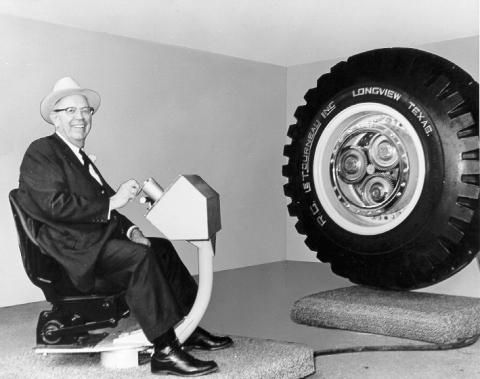
R.G. demonstrates equipment operation
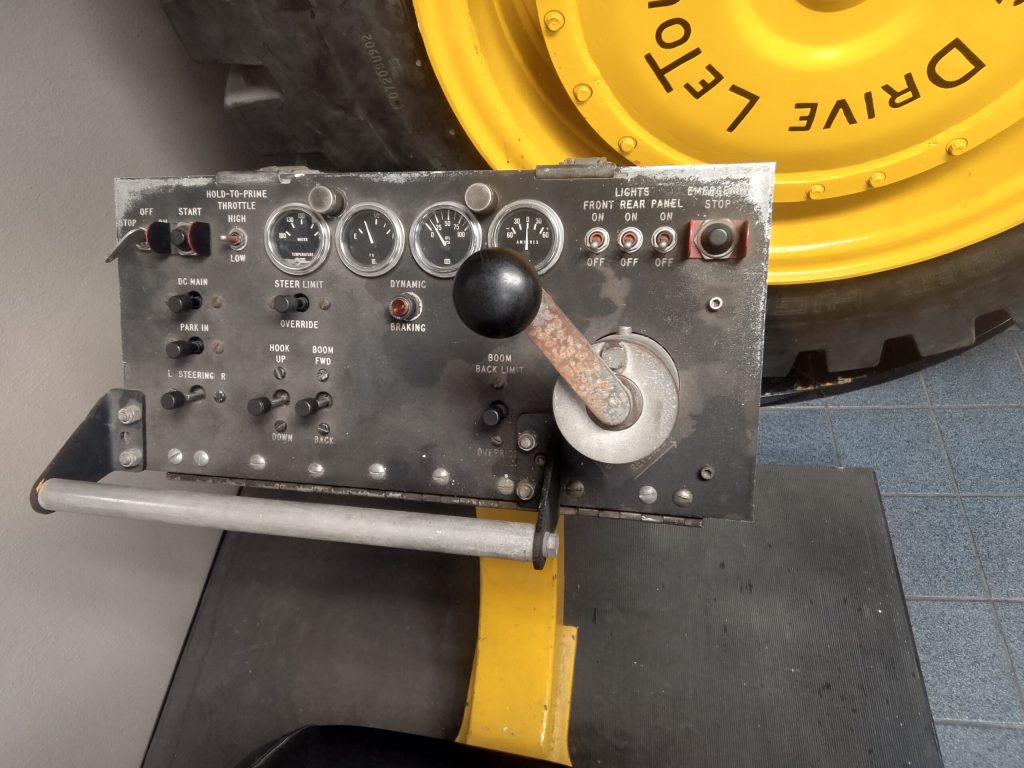
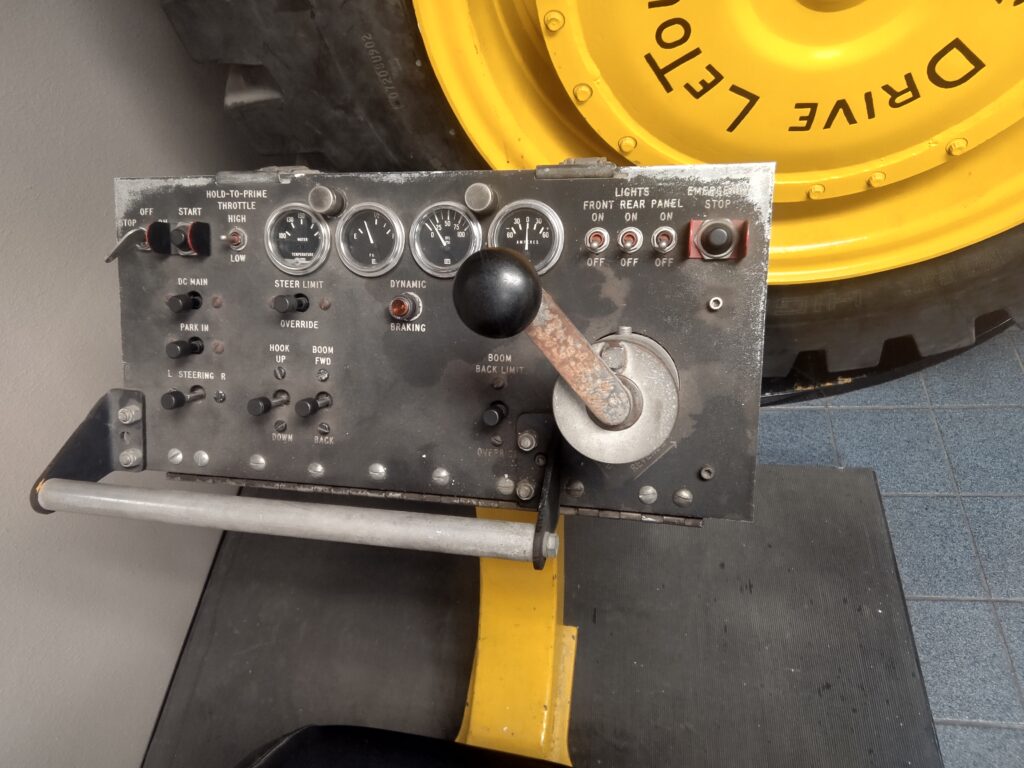
The controls and wheel motor and tire setup used on the picture to your left
The image with R.G. is a functional demonstration model using during shows. When the operator turned the potentiometer, the wheel would turn and the operator could see components move. The color image on the right side of the gallery is the actual control dashboard that R.G. sat in as it sits today. I was able to see and sit in the operator’s chair seen right during my trip.
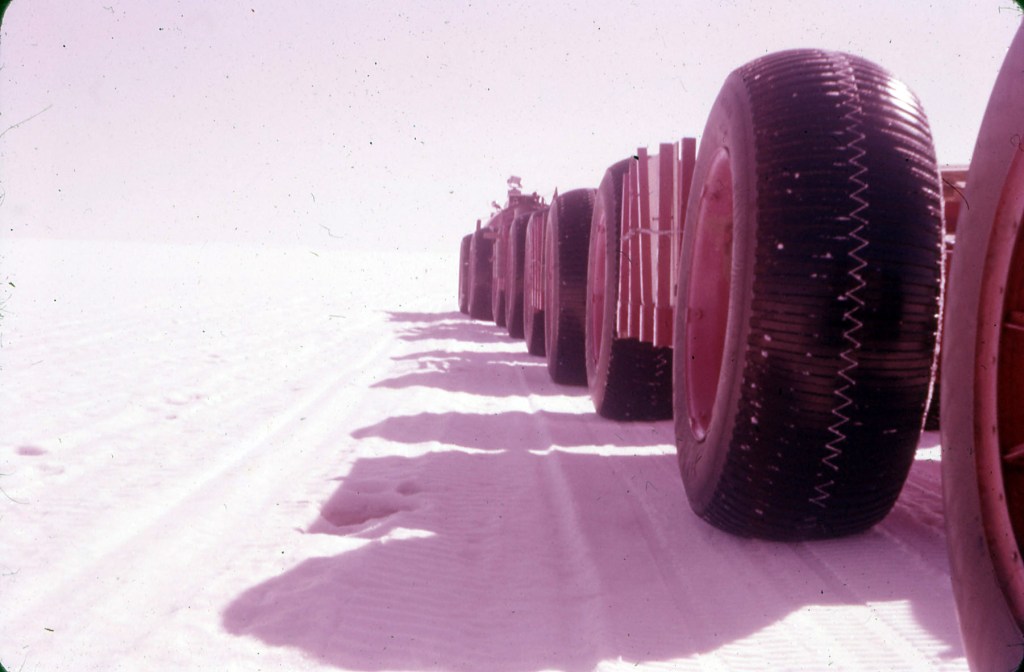
During any scientific, research, or subject matter exploration, understanding the finer details can make or break a project. Observations that seem like minutia can be key puzzle pieces. In the Sno-Train image below, you can just make out a 4th trailer attached to the convoy. If you look closely, you can make out, what appear to be a spoked rim. This trailer is NOT a LeTourneau trailer. I will dedicate an entire chapter in my book to what these trailers and wheels originated and who built them. Until then, enjoy this newly published image.

 Overland Trains